

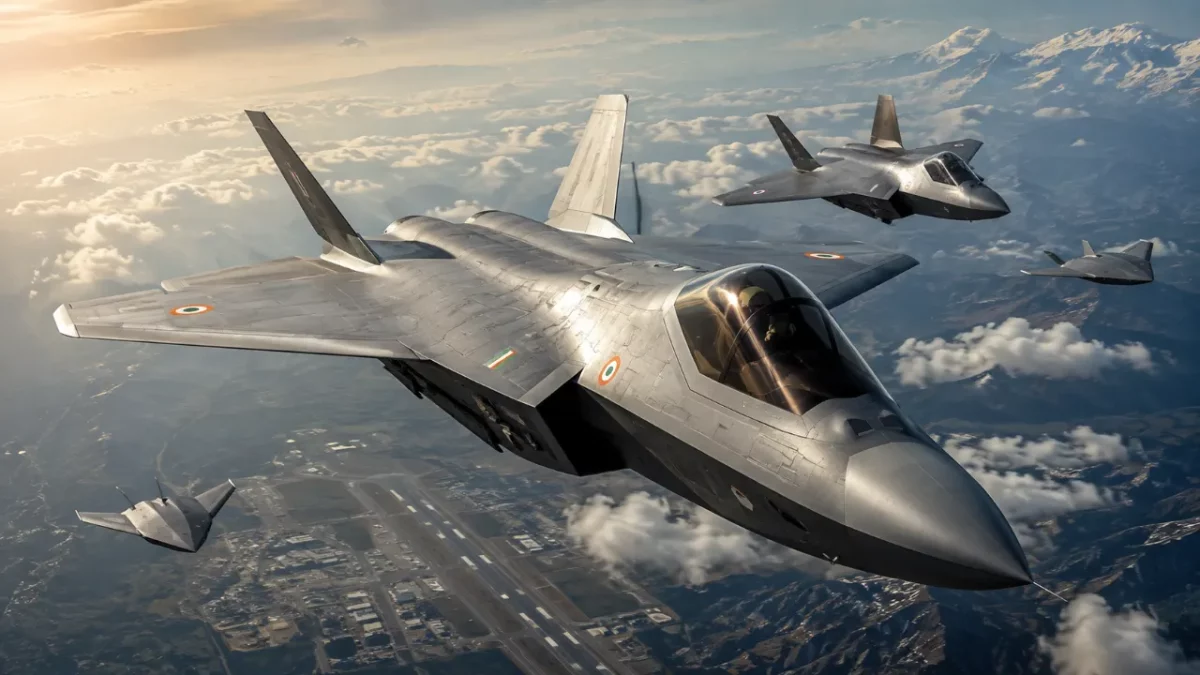
New Delhi: The Ministry of Defence has initiated concerted efforts to join the French-led sixth-generation fighter aircraft development programme, known as the Future Combat Air System (FCAS), the Parliamentary Standing Committee on Defence has been informed.



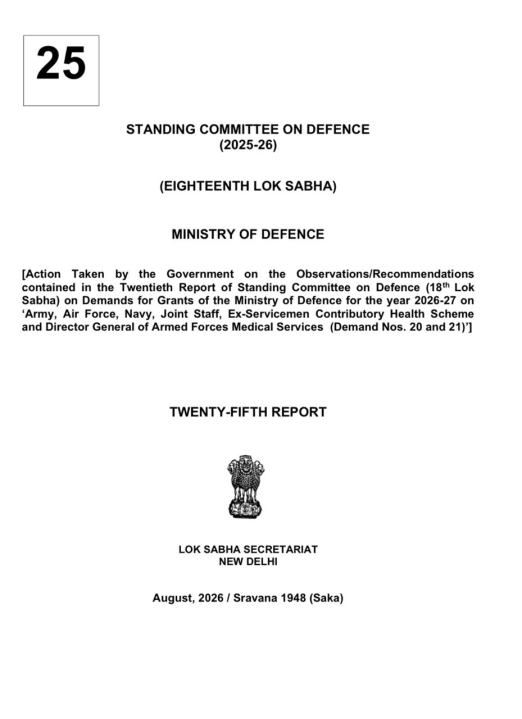
In its Action Taken Report (the 25th Report examining progress on recommendations from its earlier Twentieth Report on the Ministry’s Demands for Grants for 2026-27), tabled in Parliament on August 7, 2026, the panel recorded the Ministry’s response: “The Ministry of Defence has initiated efforts in a concerted manner to co-join the 6th Generation Fighter Aircraft Development Programme viz. Future Combat Air System (FCAS) spearheaded by the French Government.”
The Committee has welcomed the move but sought a detailed status report on the development and acquisition of sixth-generation aircraft, along with any roadmap prepared and a tentative timeline for acquisition. It has also asked for an update on the indigenous Advanced Medium Combat Aircraft (AMCA) programme when the Ministry submits its next action-taken statement.
Two International Consortia and the Push to Avoid Falling Behind
The Standing Committee noted that it had earlier been informed of two major international consortia developing sixth-generation combat aircraft. One comprises the United Kingdom, Italy and Japan under the Global Combat Air Programme (GCAP). The other involves France and Germany (originally with Spain) under FCAS. Both are working on next-generation platforms.
The Indian Air Force, the panel was told, intends to associate with one of these consortia and begin considering a sixth-generation fighter at the earliest so that India does not lag in acquiring advanced air combat capabilities. The Committee observed that, given rapid global technological advancements in fighter aircraft and the present security environment, technical upgradation of the combat fleet is a top priority. It recommended that the Ministry chalk out a clear trajectory and accelerate the planning process for the development and acquisition of sixth-generation aircraft to enhance India’s air-domain capabilities in today’s highly air-centric modern warfare.
FCAS Context: From Trilateral Ambition to French-Led Opportunity
FCAS was launched in 2017 as a Franco-German initiative (Spain joined later) to develop a system of systems that would include a next-generation fighter (the New Generation Fighter or NGF), remote carriers (loyal wingman-type unmanned systems), and a combat cloud for networked operations. The goal was to field a successor to the French Rafale and the Eurofighter Typhoon around 2040, combining manned-unmanned teaming, advanced sensors, artificial intelligence, and high levels of connectivity.
Industrial differences between France’s Dassault Aviation and Airbus (representing German and Spanish interests) over leadership, workshare, intellectual property and design philosophy repeatedly delayed the programme. In June 2026, Germany formally withdrew from the core fighter element of FCAS after the two governments concluded that the industrial partners could not reach agreement. Elements such as the combat cloud may continue under a modified framework, but the manned fighter component is now effectively France-spearheaded. This shift has created space for potential new partners.
India’s existing deep defence relationship with France makes the French-led pathway particularly relevant. France has been a long-standing supplier of combat aircraft to the Indian Air Force (from the Ouragan/Toofani era through the Mirage 2000 to the Rafale). Ongoing or advanced discussions include the proposed large Multi-Role Fighter Aircraft (MRFA) deal for additional Rafales with substantial Indian manufacturing content, co-development of advanced engines (involving Safran and India’s GTRE for future platforms including AMCA variants), and naval aviation cooperation. Senior-level India-France defence dialogues in 2026 have already touched upon next-generation collaboration possibilities.
Parallel Track: Indigenous AMCA Progress
The Standing Committee was also informed that the design of the Advanced Medium Combat Aircraft (AMCA) has been developed and discussions on its production are underway. AMCA is India’s indigenous fifth-generation stealth fighter programme, intended to deliver supercruise capability, internal weapons bays, low observability, and advanced sensor fusion.
Recent progress includes the issuance of Requests for Proposal to shortlisted private-sector consortia for prototype development under a public-private partnership model, foundation-laying for a dedicated Core Integration and Flight Testing Centre, and continued work on critical technologies such as intakes, materials and propulsion. Current planning targets prototype rollout in the late 2020s, first flight around 2028, and eventual induction in the mid-2030s, though such complex programmes historically face schedule pressures. The Committee has specifically asked the Ministry to provide an update on AMCA’s development and production status.
Sixth-generation efforts are thus being pursued as a longer-term complementary track rather than a substitute for the fifth-generation AMCA. Sixth-generation concepts typically emphasise even greater levels of networking, artificial intelligence-assisted decision-making, directed-energy or advanced effectors options, adaptive engines, and seamless integration of manned aircraft with large numbers of autonomous systems—capabilities that will define air superiority in the 2035–2050 timeframe.
Strategic Imperative and Next Steps
The Committee’s emphasis reflects the changing character of warfare, in which air power, space-enabled networks, and multi-domain integration play an increasingly decisive role. Neighbouring and peer powers are investing heavily in advanced combat aviation. India’s approach of simultaneously advancing indigenous platforms while exploring selective international collaboration on the technological frontier aims to close capability gaps without compromising long-term self-reliance goals.
The Ministry is now expected to furnish the Committee with a more granular status report covering the nature of the efforts underway with France, any exploratory discussions held, potential workshare or technology-access frameworks under consideration, and a tentative acquisition or development timeline. Parallel updates on AMCA production planning will also be required.
While no formal agreement, work-share allocation, funding commitment or joint development contract has been announced, the official confirmation that concerted efforts to co-join the French-led FCAS programme have begun marks a significant step in India’s long-term combat aircraft planning. It underscores both the urgency of preparing for sixth-generation air warfare and the preference for leveraging the mature strategic partnership with France as one pathway forward.