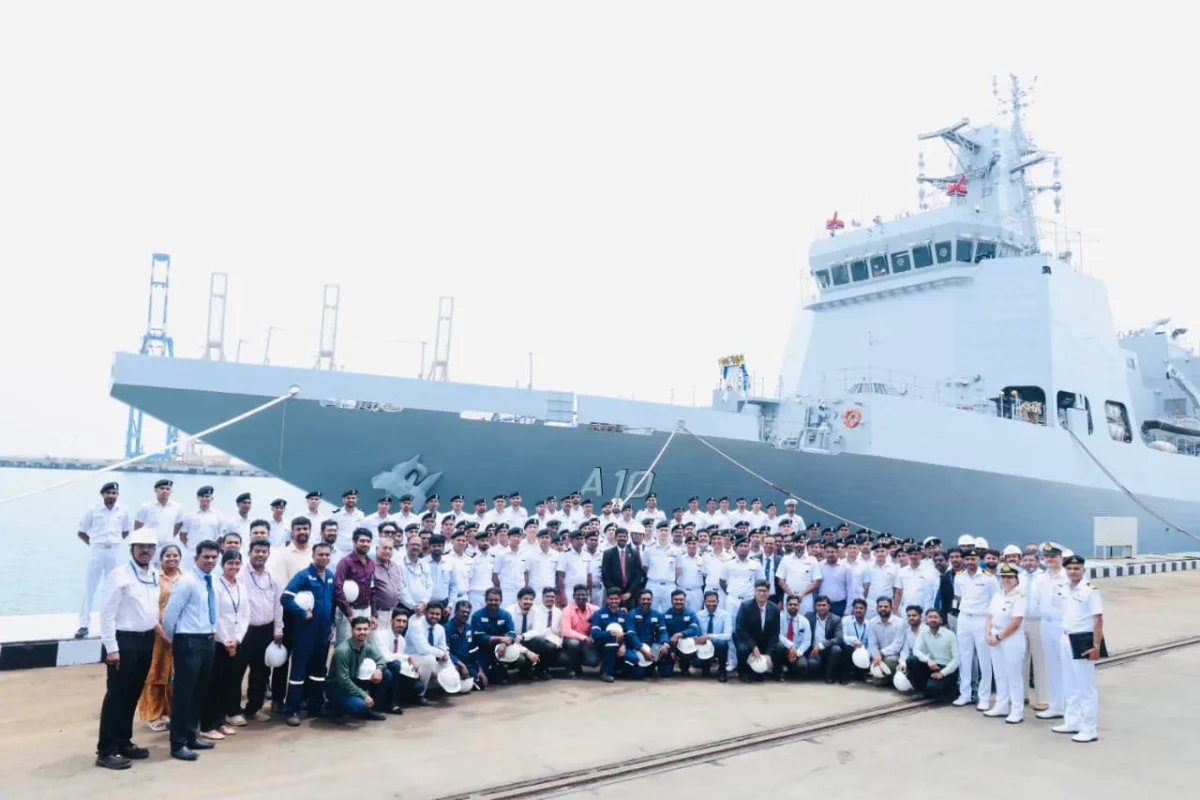
The Indian Navy has taken delivery of Samarthak, its first indigenously designed and built Multi-Purpose Vessel, from Larsen & Toubro at the Kattupalli shipyard near Chennai on 27 August 2026.





The 107-metre, 3,750-tonne-plus platform is the lead ship of a two-vessel class ordered under an ₹887-crore “Buy (Indian)” contract signed in March 2022. It carries more than 75 percent indigenous content and is intended as a flexible enabler rather than a front-line combatant.
The name Samarthak means “The Proponent.” Officials say it reflects the ship’s designed role as a dependable platform that can support many missions instead of being locked into a single task.
A Platform Built for Trials and Support
Samarthak’s primary purpose is to serve as a trial and evaluation platform for next-generation indigenous weapons, sensors and systems before they are fitted on operational warships. That function is expected to shorten development cycles and reduce the need to divert frontline ships for testing.
Beyond trials, the vessel is engineered for maritime surveillance and reconnaissance, offshore patrolling, and Humanitarian Assistance and Disaster Relief (HADR) operations. Additional capabilities listed by the Navy and L&T include launching and recovering surface and aerial targets for gunnery and anti-submarine warfare exercises, operating unmanned and remotely piloted vehicles, towing other ships, limited hospital support, and responding to sea pollution.
The design is modular so the same hull can be reconfigured for different missions. In practice this should free dedicated warships for combat tasks while Samarthak handles support, training and evaluation work.
Key published specifications include a beam of 18.6 metres, a maximum speed of 15 knots and a range of about 4,500 nautical miles. The ship accommodates a crew of 116, including eight officers. Propulsion is a CODAD arrangement; exact engine details vary slightly across public sources.
From Contract to Delivery
The Ministry of Defence and L&T signed the contract on 25 March 2022. Keels for both ships were laid on 20 March 2023. Samarthak was launched on 14 October 2024 at Kattupalli in a ceremony presided over by then Chief of the Naval Staff Admiral Dinesh K. Tripathi. The second ship, Utkarsh, was launched on 14 January 2025 and remains under construction and trials.
Original delivery targets were later revised; Samarthak reached the Navy on 27 August 2026 after sea trials and acceptance checks. Commissioning into the fleet has not yet been announced.
The project is frequently cited as an example of private-sector participation in naval shipbuilding. L&T’s Kattupalli yard, north of Chennai, handled design and construction under the government’s Aatmanirbhar Bharat and Make in India programmes. Official statements describe the delivery as another milestone in the Navy’s indigenous shipbuilding journey and evidence of a growing domestic defence industrial base.
Why a Multi-Purpose Vessel Matters
Indian Navy planners have long needed a cost-effective, adaptable hull that can perform several secondary roles without consuming scarce combatant hulls. Dedicated trial ships, target-launch platforms, pollution-response vessels and HADR assets are expensive to maintain separately. A single modular MPV reduces that overhead.
The high indigenous content also has industrial implications. Complex integration of sensors, deck machinery, target-handling systems and command-and-control equipment tests the ability of Indian yards and vendors to deliver specialised naval platforms, not only standard patrol or survey ships.
Samarthak is not intended to replace destroyers, frigates or corvettes. Its value lies in versatility and availability: it can be tasked for a weapons trial one month, an offshore patrol the next, and disaster-relief support after a cyclone. That flexibility is the reason officials repeatedly describe it as an “enabler of multiple missions.”
The second ship of the class, Utkarsh, is expected to follow a similar path. Together the pair will give the Navy two dedicated multi-role support platforms built in India, by an Indian private shipyard, to Indian specifications.
Delivery of Samarthak therefore marks both a practical addition to the fleet and a visible step in the longer effort to design, build and sustain specialised naval vessels at home.