
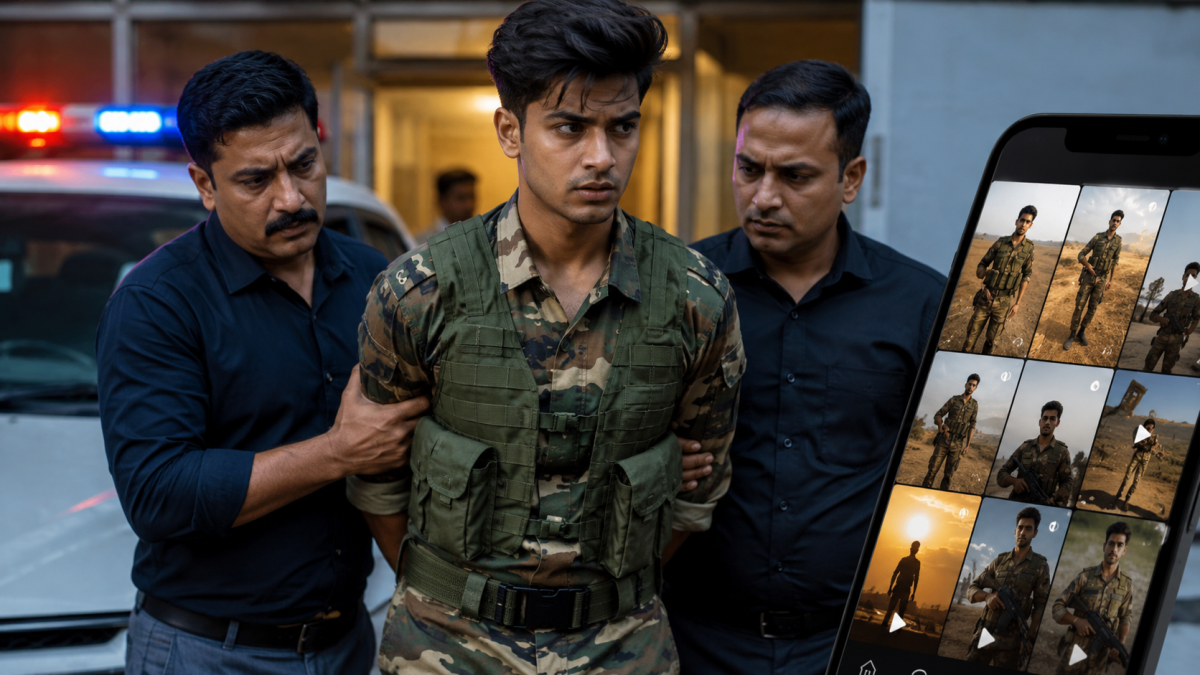
Badi Sadri police in Chittorgarh district, Rajasthan, arrested a man on Sunday for allegedly impersonating a soldier of the Indian Army’s prestigious Rajputana Rifles regiment and circulating photographs, videos, and reels of himself in Army uniform across social media platforms.
The accused has been identified as Bharat Singh, son of Ramsingh Rajput and a resident of Khardevla. Chittorgarh Superintendent of Police Dharmendra Singh stated that Military Intelligence (MI), Pune, alerted Badi Sadri police on August 21 about the man’s alleged activities. According to the information, Bharat Singh had created fake social media accounts to pass himself off as a member of the Rajputana Rifles and was actively posting content related to the force while dressed in uniform.
A special team was promptly formed under the supervision of Additional Superintendent of Police Gajendra Singh and led by Badi Sadri Station House Officer Bhagwanlal. Police detained Bharat Singh and seized two Android phones from his possession for examination. Digital forensic scrutiny of the devices revealed active accounts on Facebook, Instagram, and YouTube. These accounts featured his photograph in an Indian Army uniform as the profile picture, along with videos and reels showing him in military attire.
Police confirmed that Bharat Singh is not, and has never been, a member of the Indian Army. He was allegedly making and circulating the uniform-clad content purely for social media dissemination. Officials from Chittorgarh Police also publicised the arrest on their official X (formerly Twitter) handle, stating that the accused, while not a member of the Indian Army, had been presenting himself as a jawan of the Rajputana Rifles, creating social media accounts, and propagating photographs, videos, and reels in Army uniform.
A case has been registered against him under relevant sections of the Bharatiya Nyaya Sanhita (BNS) and the Information Technology Act. One of the primary provisions likely invoked is BNS Section 168, which makes it an offence for any person who is not a soldier, sailor, or airman in the Army, Navy, or Air Force of the Government of India to wear any garb or carry any token resembling those used by such personnel with the intention that it may be believed he is a member of the armed forces. The punishment under this section can extend to imprisonment of up to three months, a fine of up to ₹2,000, or both. Additional IT Act provisions typically cover the online publication and circulation of misleading or impersonating content.
Police further disclosed that a previous criminal case had already been registered against Bharat Singh, in which a chargesheet has been filed in court. Further investigation is underway to determine the full extent of his social media activity, the source of the uniform, any potential financial motives, or whether the content was used for any other purpose beyond seeking online attention.
Context of the Rajputana Rifles
The regiment the accused allegedly claimed affiliation with is one of the Indian Army’s most storied infantry formations. The Rajputana Rifles is the oldest rifle regiment of the Indian Army, with origins tracing back to 1775 when units were raised under the East India Company. Formally reorganised in the early 1920s as the 6th Rajputana Rifles (the numerical designation was later dropped), it draws recruits primarily from Rajasthan and neighbouring regions and carries the war cry “Raja Ramchandra Ki Jai.”
The regiment has an extensive record of gallantry, with battle honours spanning multiple wars and operations, including the World Wars, the 1947-48 Jammu and Kashmir operations, the 1965 and 1971 Indo-Pak wars, and the Kargil conflict. Its soldiers have been decorated with the Param Vir Chakra, multiple Maha Vir Chakras, Kirti Chakras, Vir Chakras, Shaurya Chakras, and numerous other awards. Impersonating a member of such a distinguished unit is viewed particularly seriously by both the military and civil authorities because it dilutes the honour associated with the uniform and can create confusion or misuse of the regiment’s reputation.
Broader Implications and Rising Trend
This incident is part of a wider pattern observed across India in recent years, where individuals wear military or police uniforms primarily to create content for Instagram Reels, YouTube Shorts, and similar platforms. While some cases involve simple desire for social media validation or “clout,” others have escalated into fraud, unauthorised access to restricted areas, or even security concerns. Military Intelligence units routinely monitor open-source social media for such impersonations precisely because the uniform carries authority and can be exploited.
Authorities have repeatedly emphasised that the Army uniform is not a costume. Unauthorised possession or display, especially when accompanied by claims of service, attracts legal action. In this case, the proactive tip from Military Intelligence, Pune, and the swift response by local police underscore the coordination between defence intelligence and state police in protecting the integrity of the armed forces’ identity.
As of the latest reports, Bharat Singh remains in custody and is expected to be produced before a local court. Investigation continues into the digital footprint of the accounts, the origin of the uniform used in the reels, and any other associated activities. The case serves as a reminder that social media trends involving military attire can quickly cross into criminal territory when they involve deliberate impersonation of serving or veteran personnel.