
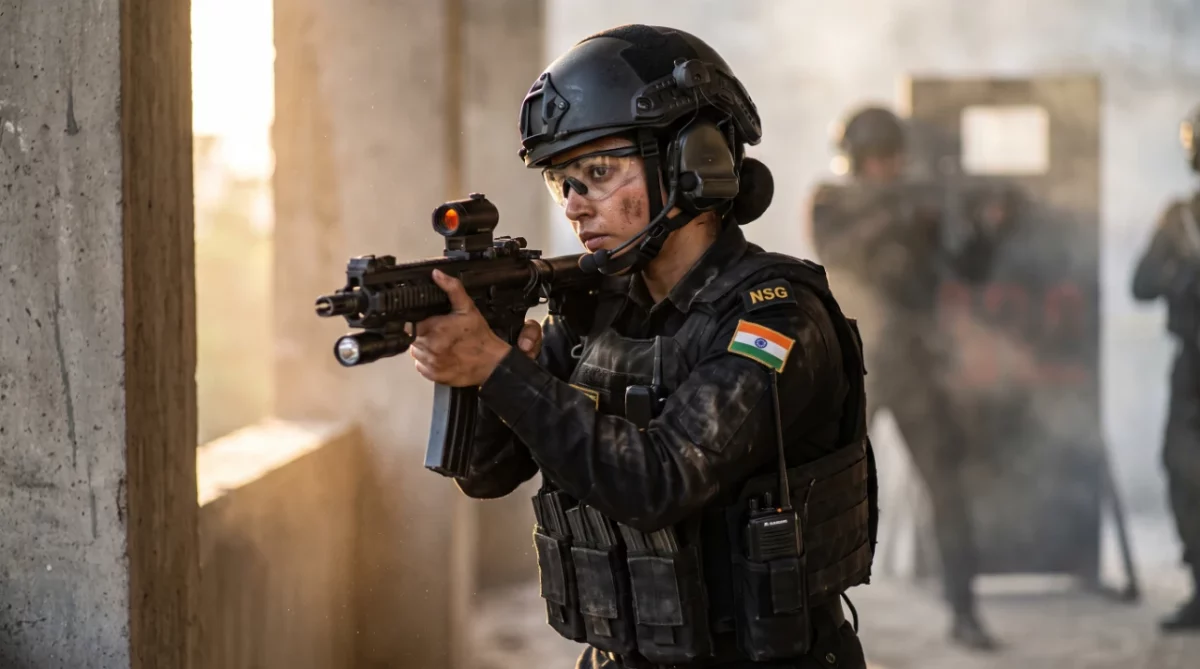
Manesar, Haryana: In a major step towards expanding the operational role of women in India’s internal security apparatus, the National Security Guard (NSG) Training Academy at Manesar has commenced the 1st Mahila Commando Conversion Course (MCCC) for women personnel drawn from State Police Forces and Central Armed Police Forces (CAPFs).




The pioneering initiative is aimed at developing a new pool of women personnel trained in specialised counter-terrorism operations, including tactical intervention, weapons handling, marksmanship and hostage-rescue techniques.
The intensive 12-week training programme is designed to transform selected women personnel into physically robust, technically proficient and operationally prepared commandos capable of functioning in demanding security environments.
The NSG described the initiative with the message “She Who Dares, Leads”, highlighting the growing emphasis on providing women personnel not merely greater representation in security forces but opportunities to acquire specialised combat and counter-terrorism capabilities.
12 Weeks of Intensive Commando Training
Women personnel undergoing the Mahila Commando Conversion Course will be exposed to a demanding training programme covering several critical aspects of counter-terrorism operations.
The curriculum includes physical conditioning, weapons training, marksmanship, tactical intervention, hostage rescue and other specialised counter-terrorism skills.
Physical conditioning is expected to form a significant component of the programme, preparing personnel to operate effectively under the demanding conditions associated with specialised intervention duties.
Weapons and marksmanship training will focus on developing proficiency in handling firearms and engaging threats accurately under operational conditions.
Tactical intervention training, meanwhile, will prepare participants for situations where security personnel may have to enter buildings, confined spaces or other sensitive locations to neutralise threats.
Hostage-rescue training is another important component of the course. Such operations can involve complex situations where security personnel must respond rapidly while minimising risks to civilians and hostages.
Together, these training modules are intended to create women commandos capable of supporting specialised counter-terrorism and high-risk security operations within their respective organisations.
NSG Expertise Being Shared With State Police and CAPFs
An important aspect of the initiative is that the course is not confined to personnel permanently serving with the NSG.
Instead, women from different State Police Forces and Central Armed Police Forces are being trained at the NSG Training Academy before returning to their parent organisations.
This approach allows specialised knowledge developed by India’s federal counter-terrorism force to be distributed across the wider national security network.
The NSG’s Training Centre was originally raised on 15 October 1985 for training NSG probationers and capacity-building personnel from State Police Forces. It has subsequently evolved into one of India’s principal institutions for specialised counter-terrorism training. The NSG says the centre provides training in areas including counter-terrorism, bomb disposal and counter-IED operations while also conducting joint exercises involving CAPFs, State Police organisations and security forces from friendly foreign countries.
The latest Mahila Commando Conversion Course builds on this long-standing capacity-building role while specifically expanding advanced operational training opportunities for women.
Building a Larger Counter-Terrorism Capability
The significance of the MCCC extends beyond the personnel attending the inaugural course.
Once they complete their training, the women personnel are expected to return to their respective forces carrying specialised operational knowledge and skills acquired at the NSG academy.
This could enable State Police Forces and CAPFs to maintain a larger pool of personnel capable of responding to complex security situations without specialised capability remaining concentrated within a limited number of units.
The initiative is therefore intended to strengthen India’s distributed counter-terrorism capability.
Trained personnel can potentially contribute to specialised intervention teams, counter-terrorism units and other operational formations within their parent organisations depending on individual force requirements and deployment policies.
Greater Interoperability Among Security Forces
Another objective of the course is to promote common professional standards among personnel belonging to different organisations.
India’s response to major terrorist incidents can require coordination between local police, specialised state units, CAPFs and central agencies such as the NSG.
Training personnel from multiple forces under a common programme can help improve familiarity with operational procedures, tactical concepts and response mechanisms.
This becomes particularly important during complex incidents where multiple security agencies may be required to operate together.
The NSG has increasingly emphasised such cooperation. Its 2026 institutional material describes structured cooperation with State Police Forces, joint training and interoperability as important elements of strengthening India’s national counter-terrorism framework.
Women Moving Into More Specialised Operational Roles
The Mahila Commando Conversion Course also represents the continuing expansion of opportunities available to women personnel in India’s police and paramilitary forces.
Women already serve across several Central Armed Police Forces and in State Police organisations in roles ranging from law and order and border security to intelligence, investigation and operational deployments.
According to data previously provided by the Ministry of Home Affairs, the combined strength of women personnel in the CAPFs and Assam Rifles stood at 41,606 as of early 2024. The government has also introduced a series of measures intended to encourage greater recruitment and career progression of women within these forces.
The NSG initiative represents a different dimension of that process: providing women personnel access to some of the specialised tactical skills associated with counter-terrorism operations.
Rather than focusing solely on increasing numerical representation, the programme places emphasis on operational capability and specialised professional training.
What Is the National Security Guard?
The National Security Guard is India’s specialised federal counter-terrorism force and was raised in 1984.
Commonly known through its famous Black Cat Commandos, the force is tasked with responding to particularly serious terrorist and hostage situations and maintaining specialised counter-terrorism capabilities.
The NSG comprises officers and personnel drawn from the Indian Army, Central Armed Police Forces and State Police Forces. Its Director General describes the organisation as India’s “anti-terror force”, maintaining readiness to respond to major national security challenges.
Its motto, “Sarvatra Sarvottam Suraksha”, reflects its commitment to maintaining specialised operational preparedness.
Apart from its direct operational responsibilities, training and capacity building have become an important part of the NSG’s wider contribution to India’s security architecture.
NSG Training Academy at Manesar
The NSG’s Manesar establishment has long served as a centre for preparing commandos and sharing specialist counter-terrorism expertise with other forces.
According to the NSG, the Training Centre combines expertise from CAPFs and the Indian Army and provides specialised instruction in urban counter-terrorism, bomb detection and disposal, counter-IED operations and related disciplines.
Historical NSG records also show that commando conversion courses have traditionally involved demanding training cycles. Previous NSG documentation, for example, records combined conversion courses involving 12 weeks of intensive training before commandos were inducted into the force.
The Mahila Commando Conversion Course therefore brings women personnel into a specialised training ecosystem that has been developed over decades for preparing personnel for high-risk operational responsibilities.
Strengthening India’s Counter-Terrorism Preparedness
Contemporary terrorist threats can involve attacks on crowded urban locations, critical infrastructure, transportation systems, public institutions and other sensitive establishments.
Responding effectively requires not only specialised national units but also highly trained personnel within police and paramilitary organisations capable of providing immediate and coordinated responses.
By training women personnel from several forces together, the NSG initiative seeks to broaden the availability of these capabilities.
The personnel completing the programme will take their training back to their respective organisations, potentially allowing the expertise developed at Manesar to influence training and operational preparedness well beyond the NSG itself.
This multiplier effect could become one of the most important outcomes of the programme.
From Participation to Operational Empowerment
The commencement of the first Mahila Commando Conversion Course marks a notable development in the evolution of women’s participation in India’s security forces.
Its significance lies not simply in placing more women into uniformed roles, but in preparing them for some of the most demanding specialised duties undertaken by security personnel.
Physical endurance, tactical decision-making, weapons proficiency, teamwork and the ability to operate under intense pressure are all central to counter-terrorism operations.
Women personnel successfully completing the 12-week course will therefore emerge with a set of specialised skills that can enhance the operational capabilities of their respective forces.
The initiative also sends a wider institutional message that opportunities for women within India’s security architecture are increasingly extending into specialised operational domains.
As the NSG summed up the initiative:
“She Who Dares, Leads.”
The first Mahila Commando Conversion Course consequently represents both a milestone for Nari Shakti and a practical effort to strengthen India’s counter-terrorism preparedness by creating a wider and more diverse pool of professionally trained operational personnel.