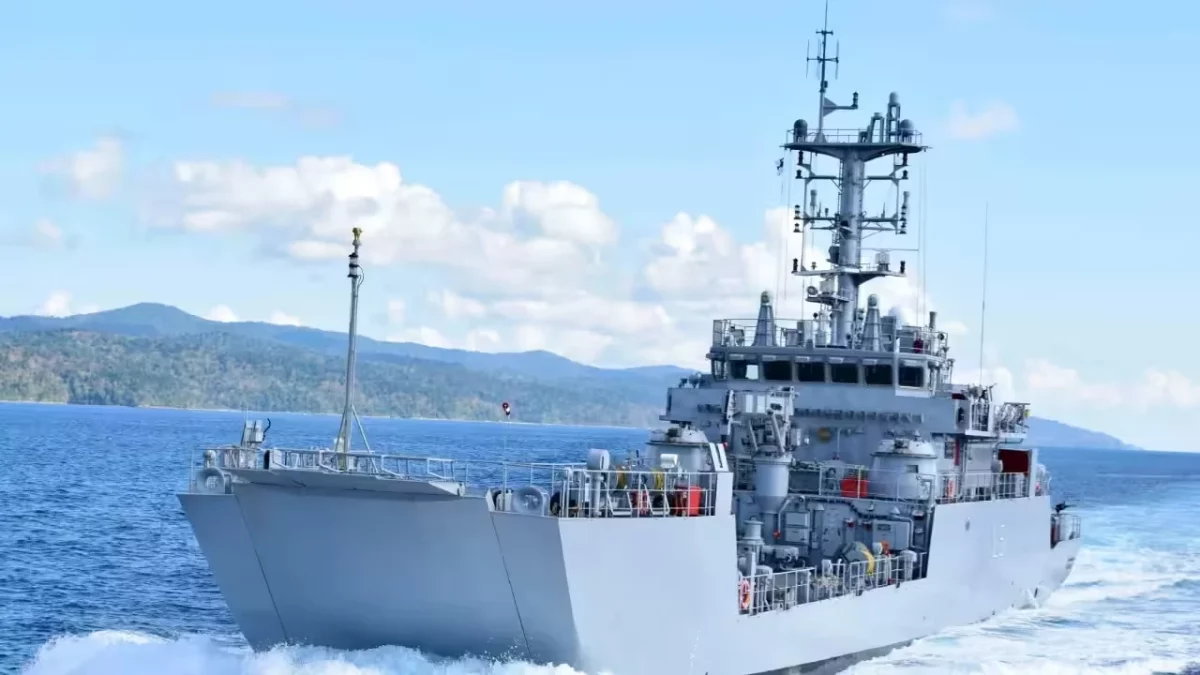
The Indian Navy has begun the process of acquiring six next-generation Landing Craft Utility (LCU) Mk-V ships from Indian shipyards. The service has issued a Request for Information (RFI) for the platforms, which are intended to strengthen amphibious operations, island logistics, and humanitarian assistance and disaster relief (HADR) across the Indian Ocean Region.





Each proposed vessel is specified at a displacement of about 1,500 tonnes, with an allowed variation of 15 per cent, and a length of approximately 85 metres. The ships are to use diesel propulsion, attain a maximum speed of at least 15 knots, and have an endurance of about 4,500 nautical miles. The RFI also requires the craft to operate in Sea State 3 and survive conditions up to Sea State 7, with a planned service life of 30 years.
For amphibious lift, each LCU Mk-V is required to carry at least four main battle tanks, four BMP infantry combat vehicles, and 190 fully equipped troops. The craft are intended to move heavy equipment and personnel from ship to shore and to support logistics to remote island territories.
The procurement is planned under the Buy (Indian-IDDM) category in accordance with Defence Procurement Procedure 2.0. Shipyards have been asked to provide details of indigenous content. The RFI has been issued as advance information so that yards can obtain the necessary government clearances and prepare manpower and material infrastructure. No contract value, delivery schedule, or shortlisted builder has been announced.
The Navy currently operates eight indigenous LCU Mk-IV ships, designed and built by Garden Reach Shipbuilders and Engineers (GRSE), Kolkata. Those vessels displace about 830 tonnes in standard condition and about 1,001 tonnes at full load. They are 62.8 metres long, have a speed of 15 knots, and an endurance of about 1,500 nautical miles. They can carry main battle tanks such as the Arjun or T-72, armoured vehicles, and up to about 160 troops. The class is based primarily under the Andaman and Nicobar Command and is used for beaching, transport, search and rescue, and disaster-relief tasks.
The existing Mk-IV fleet, L51 to L58, was built under a ₹2,100-crore contract signed with GRSE in September 2011. The last ship of the class, L58, was commissioned in March 2021.
The Mk-V requirement is therefore a step up in size, payload, and range. Endurance of about 4,500 nautical miles would allow longer independent deployments than the present class, which is useful for island chains, Exclusive Economic Zone patrol, medical evacuation, and HADR missions as well as conventional amphibious operations.
The move forms part of a wider effort to rebuild the Navy’s amphibious force. In addition to the LCUs, the Defence Acquisition Council has already granted Acceptance of Necessity for four much larger Landing Platform Docks of more than 32,000 tonnes. The Navy’s remaining large amphibious ships include INS Jalashwa and a small number of Landing Ship Tanks. The new LCUs would serve as ship-to-shore connectors and as independent logistics platforms for outlying islands.
An RFI is an early market-sounding stage. It does not constitute a tender or a purchase order. Responses from Indian shipyards will inform staff requirements, indigenous-content assessment, and a later Request for Proposal, subject to Acceptance of Necessity and subsequent approvals. GRSE, as the builder of the Mk-IV class, is among the yards expected to examine the requirement, though other public and private yards may also respond.
No official cost estimate has been published. Until the RFP and contract stages are completed, the six 1,500-tonne LCU Mk-V ships remain a planned capability rather than an approved build programme.