

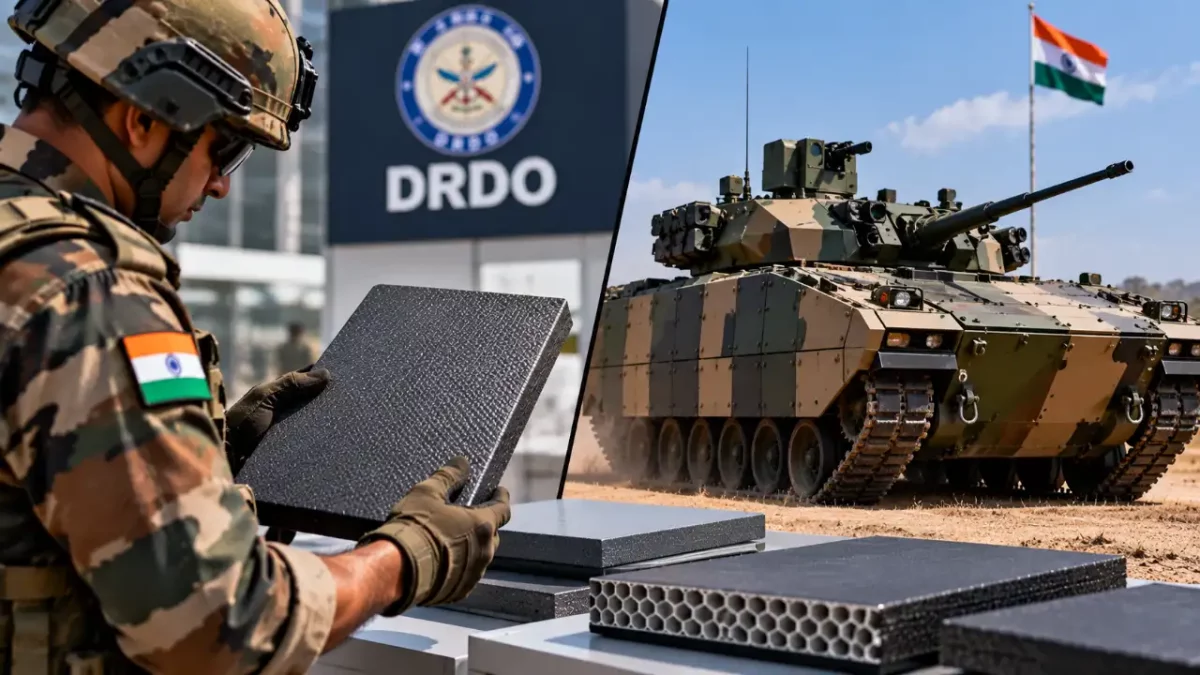
Pune, October 18, 2026: The Defence Research and Development Organisation (DRDO) has developed indigenous armour panels that are 20 percent lighter than existing systems while meeting specified protection requirements against 30 mm armour-piercing (AP) ammunition. The technology, developed by the Research and Development Establishment (Engineers) [R&DE(E)] in Pune, is intended for future main battle tanks (MBTs), light tanks, and Future Infantry Combat Vehicles (FICVs).

A senior DRDO scientist stated that the advanced armour “is 20% lighter than the current system, matching global standards in this sector.” In-house testing has been completed, and the panels have met the operational requirements of the force internally. R&DE(E) has offered the technology to private companies through the Transfer of Technology (ToT) route, and several leading firms have expressed interest.
The panels provide protection meeting STANAG 4569 Level 6 requirements against 30 mm AP threats. STANAG 4569 is a NATO standard defining protection levels for military vehicles; Level 6 addresses high-velocity 30 mm armour-piercing ammunition (including APFSDS variants in some classifications) at a reference distance of 500 metres, primarily on frontal arcs, along with associated artillery fragmentation threats.
Conventional steel armour can deliver comparable protection but adds substantial weight, increasing the load on engines and suspension systems, reducing mobility, fuel efficiency, and strategic transportability. Global armoured vehicle manufacturers are increasingly adopting composite materials, ceramics, and layered structures to achieve better protection-to-weight ratios. DRDO officials noted that the new panels address these operational needs amid modern battlefield threats, including armour-piercing ammunition, anti-tank guided missiles, rocket-propelled grenades, mines, improvised explosive devices, and drones.
Lighter armour is especially relevant for light tanks and infantry combat vehicles operating across varied terrain, and for high-altitude deployments. An Army officer observed that, given the extensive use of tanks in mountain regions, the system “adds a new dimension to mountain warfare and it provides advantage to armoured troops operationally.” It also gives designers greater flexibility to integrate additional sensors, active protection systems, and electronics without exceeding weight limits.
The technology was formally listed for industry transfer around October 1, 2026, under DRDO’s ToT programme (Category A), with three manufacturing licences available. The package typically includes the bill of materials, manufacturing process, quality assurance plan, and test details. No specific vehicle programme has yet formally selected the panels, though the development is relevant to platforms such as the Zorawar light tank and future FICV and MBT projects. The next stage involves industrial production and assessment for specific vehicle applications.
Indigenous development of the armour reduces dependence on imported protection systems and supports domestic defence manufacturing. R&DE(E) has previously advanced related composite and ceramic armour and hull technologies for next-generation infantry combat vehicles, including efforts aimed at weight reduction, lower signatures, and modular protection.
This development aligns with ongoing efforts to equip the Indian Army’s mechanised forces with lighter, more mobile, and adequately protected platforms suited to diverse operational environments.