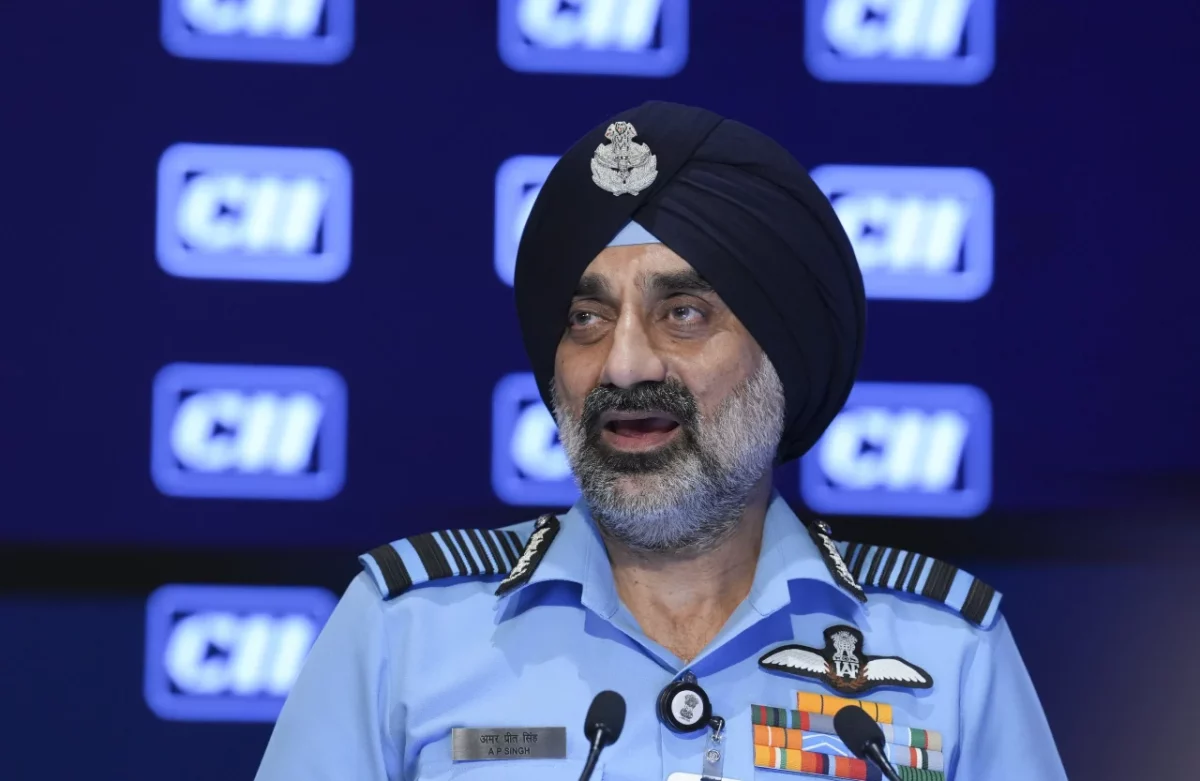
The Indian Air Force’s fighter squadron strength has fallen to 29 against a sanctioned strength of 42, with Chief of the Air Staff Air Chief Marshal A.P. Singh warning that delays in the Light Combat Aircraft Tejas Mk1A programme are “hurting” the force.





Air Chief Marshal Singh made the remarks on Saturday, 3 October 2026, at his annual press conference in New Delhi ahead of the 94th Air Force Day on 8 October. The briefing was also his last as Chief of the Air Staff before his retirement on 31 October.
“It happens that you plan something, but things get delayed. But this time, the delay has been much,” he said of the Tejas Mk1A. Asked about the slip in deliveries by Hindustan Aeronautics Limited, he added: “It is going to hurt us.” He repeated an earlier formulation — “technology delayed is technology denied” — and said the present delay was significant, with the programme running about two years behind schedule.
He stressed that lower numbers did not mean the force was operationally incapable. “We have less numbers, but we are not weak,” he said.
The squadron gap
The drop to 29 squadrons follows the retirement of the last MiG-21 Bison units in September 2025. Some accounts place the authorised strength at 42.5. Either figure leaves the IAF well short of the level long treated as the minimum for a two-front contingency.
The Air Chief said the service needs to induct roughly two squadrons a year — about 36 to 40 fighter aircraft — simply to stop the decline from around 30 squadrons and begin moving back toward 42. In later years, he said, the requirement would be higher still.
Further retirements will widen the gap if new aircraft do not arrive. Three MiG-29 squadrons and six Jaguar squadrons are due to leave service toward the end of the decade.
Tejas Mk1A: contracted, not delivered
In February 2021 the Ministry of Defence signed a contract of about ₹48,000 crore with HAL for 83 Tejas Mk1A aircraft — 73 fighters and 10 trainers. The first aircraft was to have been delivered in March 2024. Not one has been handed over.
A second order, signed in September 2025 for ₹62,370 crore, covers 97 more Mk1A aircraft (68 single-seaters and 29 twin-seaters). The two contracts together cover 180 aircraft valued at about ₹1.1 lakh crore. Deliveries under the second order are scheduled between September 2027 and September 2033, and completion of the first 83-aircraft order has been pushed toward 2031.
Early slippage was linked to the supply of General Electric F404-IN20 engines. GE Aerospace has since delivered engines, and airframes have been fitted, but radar, weapons integration and software validation still require clearance before induction. In September 2026, Defence Minister Rajnath Singh had already taken up the delivery delays with HAL.
How the IAF expects to recover numbers
Air Chief Marshal Singh set out the programmes meant to close the gap:
- Tejas Mk1A, if HAL sustains the output it has indicated. He said HAL has spoken of up to 24 aircraft a year; even 20 a year would be material.
- The Multi-Role Fighter Aircraft programme. In February 2026 the government cleared a proposal for 114 Rafale fighters under a government-to-government framework with France. He said he hoped the contract could be signed in the current financial year “if things go well,” while noting that negotiations are a two-way process. A concluded deal could yield about 12 aircraft a year, with a portion in fly-away condition and the rest built in India.
- Twelve additional Su-30MKI aircraft already on order.
- Tejas Mk2, whose prototype maiden flight is scheduled for 2027.
- The Advanced Medium Combat Aircraft, the indigenous fifth-generation fighter, as the longer-term answer.
Taken together, he said, around 20 Mk1A a year, about 12 from MRFA and a share of the Su-30MKI order could put annual induction in the region of 35 to 40 aircraft. “All these programmes need to be pushed with the whole-of-nation approach — and that is being done,” he said.
On AMCA, he was explicit that further delay would force a choice. “We have to look at some other platforms if there are delays in AMCA,” he said. Russia has offered the Su-57; no decision has been taken.
The remarks place the Tejas Mk1A schedule at the centre of the IAF’s near-term force structure. Until those aircraft, and the follow-on programmes, begin arriving in squadron strength, the fighter fleet will remain well below the sanctioned level even as older types continue to retire.