

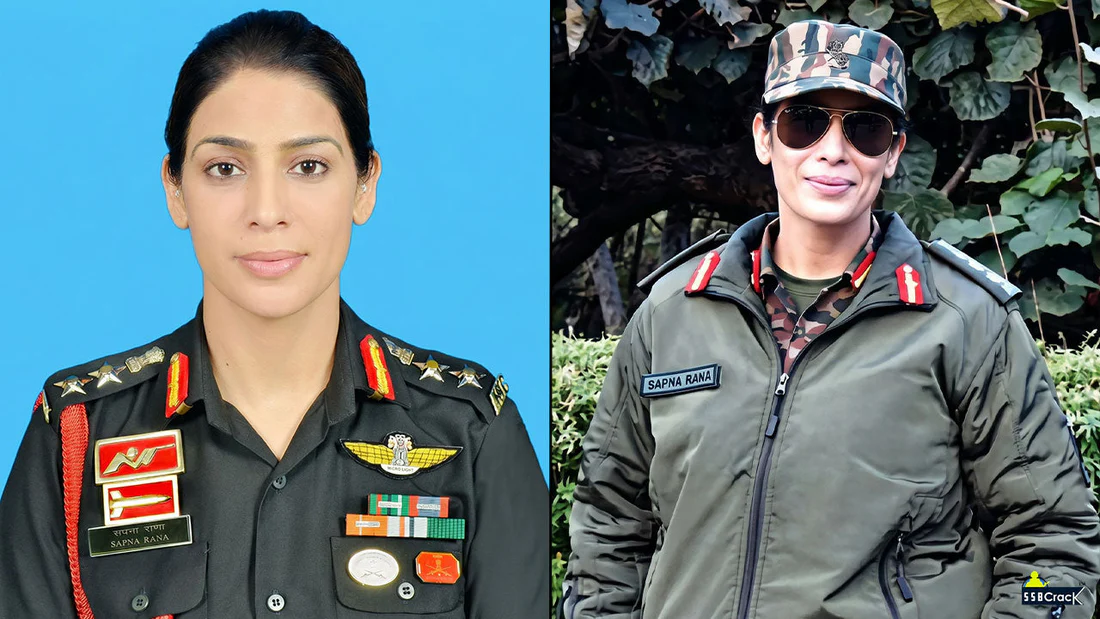
Colonel Sapna Rana has emerged as a remarkable symbol of determination, discipline, and leadership in the Indian Army. Recognised as the first woman from Himachal Pradesh to command an Army Service Corps battalion, she represents a new era of women officers taking on major command responsibilities in the armed forces. Her journey from a modest background in the hills of Himachal Pradesh to leading an ASC unit in Northeast India is a story of perseverance, professional excellence, and unwavering commitment to service.





Colonel Rana’s achievement is significant not only because of the milestone she has created for her home state, but also because of the nature of her command. The Army Service Corps plays a crucial role in maintaining the operational readiness of the Indian Army. From transportation and supply management to sustaining troops in remote and difficult terrain, ASC units form the backbone of military logistics. By taking charge of such a battalion, Colonel Rana has demonstrated her capability to lead complex operations in a demanding military environment.
Colonel Sapna Rana hails from Himachal Pradesh and grew up in a humble setting that shaped her strong character from an early age. Life in a modest environment taught her discipline, self-reliance, patience, and resilience. These qualities later became central to her personality as an Army officer. Her early years reflected the values that are often associated with mountain communities—hard work, simplicity, determination, and the ability to face challenges with courage.
She completed her schooling at government institutions, receiving her early education in Chandi and later pursuing her senior secondary studies in Solan. Her academic journey continued at Government Post Graduate College, Solan, where she earned a Bachelor of Commerce degree. She later completed an MBA in Business Management from Himachal Pradesh University, Shimla. Her educational background gave her a strong foundation in management and leadership, which proved useful in her later military career, especially in the logistics-oriented responsibilities of the Army Service Corps.
During her college years, Colonel Rana became actively involved with the National Cadet Corps. She joined the 1 HP Girls Battalion NCC and rose to the position of Senior Under Officer. Her NCC experience played a major role in shaping her interest in a career in uniform. It gave her early exposure to discipline, leadership, drill, camps, and the spirit of service. One of the most important milestones of her NCC journey was her selection for the prestigious Kargil Vijay Camp, where she was the only NCC cadet from Himachal Pradesh to be selected.
That experience strengthened her desire to serve the nation in uniform. Although she initially prepared for the Civil Services, her aspirations gradually shifted towards the armed forces. She later appeared for the Combined Defence Services examination and cleared it after a short coaching stint in Chandigarh. Her success in the written examination was followed by her selection through the Services Selection Board, one of the most challenging personality-based selection systems in the country.
In 2003, she joined the Officers Training Academy in Chennai, where she underwent rigorous military training. OTA is known for transforming young men and women into officers capable of leading troops in challenging conditions. Colonel Rana excelled during her training and proved her physical and mental toughness through her performance in various academy activities. She won gold medals in cross-country events, obstacle races, and endurance training, establishing herself as a highly capable officer cadet.
Colonel Sapna Rana was commissioned into the Army Service Corps in 2004. From the beginning of her career, she displayed dedication, professionalism, and a strong sense of responsibility. The ASC is one of the most vital arms of the Indian Army, responsible for ensuring that troops receive essential supplies, rations, fuel, transport, and logistical support. In operational areas, especially in remote and high-altitude regions, logistics can determine the effectiveness and endurance of military formations.
Over the years, Colonel Rana progressed through the ranks with distinction. Her career reflected consistent performance, adaptability, and leadership in varied appointments. The Army Service Corps requires officers who can manage large-scale coordination, planning, movement of resources, and supply chains under pressure. Colonel Rana’s rise within this service highlighted her ability to handle responsibility with precision and confidence.
Her appointment as the Commanding Officer of an ASC battalion in Northeast India became a landmark moment. With this command, she became the first woman from Himachal Pradesh to command a battalion in the Indian Army and one of the first women officers to lead an ASC battalion in such a demanding operational environment. The Northeast region presents unique military and logistical challenges due to its difficult terrain, weather conditions, remote locations, and operational sensitivity.
As a Commanding Officer, Colonel Rana is responsible for leading her unit, ensuring operational efficiency, maintaining discipline, managing resources, and supporting the logistical requirements of troops deployed in challenging areas. Her role requires decision-making under pressure, administrative excellence, and the ability to inspire personnel under her command. Command of a battalion is one of the most respected responsibilities in an Army officer’s career, and Colonel Rana’s appointment reflects the trust placed in her leadership.
Her success also reflects the changing landscape of the Indian Army, where women officers are increasingly being entrusted with significant leadership roles. Over the years, women officers have proven their capability across multiple branches and services. Colonel Rana’s command appointment reinforces the fact that competence, dedication, and leadership are not defined by gender. Her milestone stands as a powerful message for young women aspiring to join the armed forces.
Beyond her professional responsibilities, Colonel Rana has also excelled in sports and adventure activities. She is a nationally ranked pistol and trap shooter and has been a member of the Indian Army Shooting Team. Her achievements in shooting at the national level demonstrate her focus, precision, and competitive spirit. Shooting requires intense concentration, mental calmness, and discipline—qualities that also define effective military leadership.
She is also a qualified microlight aircraft pilot, adding another dimension to her diverse skill set. Her interest in aviation reflects her adventurous spirit and willingness to take on new challenges. In addition, she is an accomplished marathon runner, a pursuit that demands endurance, consistency, and mental strength. These achievements show that Colonel Rana’s personality extends far beyond her formal military appointments. She represents a complete officer—physically fit, mentally strong, professionally sound, and personally driven.
For her exceptional service and devotion to duty, Colonel Rana has received four Commendation Cards. These include two from the Chief of Army Staff and two from the General Officer Commanding-in-Chief. Such recognitions are awarded for distinguished service, professional excellence, and outstanding commitment. They stand as a testament to her consistent performance and the high standards she has maintained throughout her career.
Colonel Sapna Rana is also known for balancing her demanding military career with family responsibilities. She is married to a fellow Army officer, and the couple has a daughter. Managing command responsibilities while maintaining family life requires immense strength and organisation. Her life reflects the reality of many military families, where service, sacrifice, and responsibility become part of everyday living.
Her story is especially inspiring for young aspirants from small towns, villages, and hill states who dream of joining the armed forces. Colonel Rana’s journey proves that background is never a barrier when one has determination, discipline, and clarity of purpose. From government schools to OTA Chennai, from NCC camps to battalion command, her life shows how consistent effort can create history.
Colonel Rana has also interacted with youth platforms and inspired young people by sharing her experiences. Her message encourages students, NCC cadets, and defence aspirants to believe in themselves and pursue excellence with dedication. For young women, in particular, her journey stands as a reminder that the armed forces offer opportunities to serve the nation with honour and take on leadership roles of great responsibility.
Colonel Sapna Rana’s achievement is not merely a personal milestone. It is a proud moment for Himachal Pradesh, the Indian Army, and the larger journey of women in uniform. Her command of an ASC battalion highlights the expanding role of women officers in the military and the importance of recognising talent wherever it exists.
Today, Colonel Sapna Rana continues to serve with distinction, embodying the values of courage, integrity, discipline, and selfless service. Her journey from the hills of Himachal Pradesh to a position of command in the Indian Army will continue to inspire generations of defence aspirants. She stands as a powerful example of what determination can achieve and how leadership, when built on dedication and excellence, can break barriers and create history.