

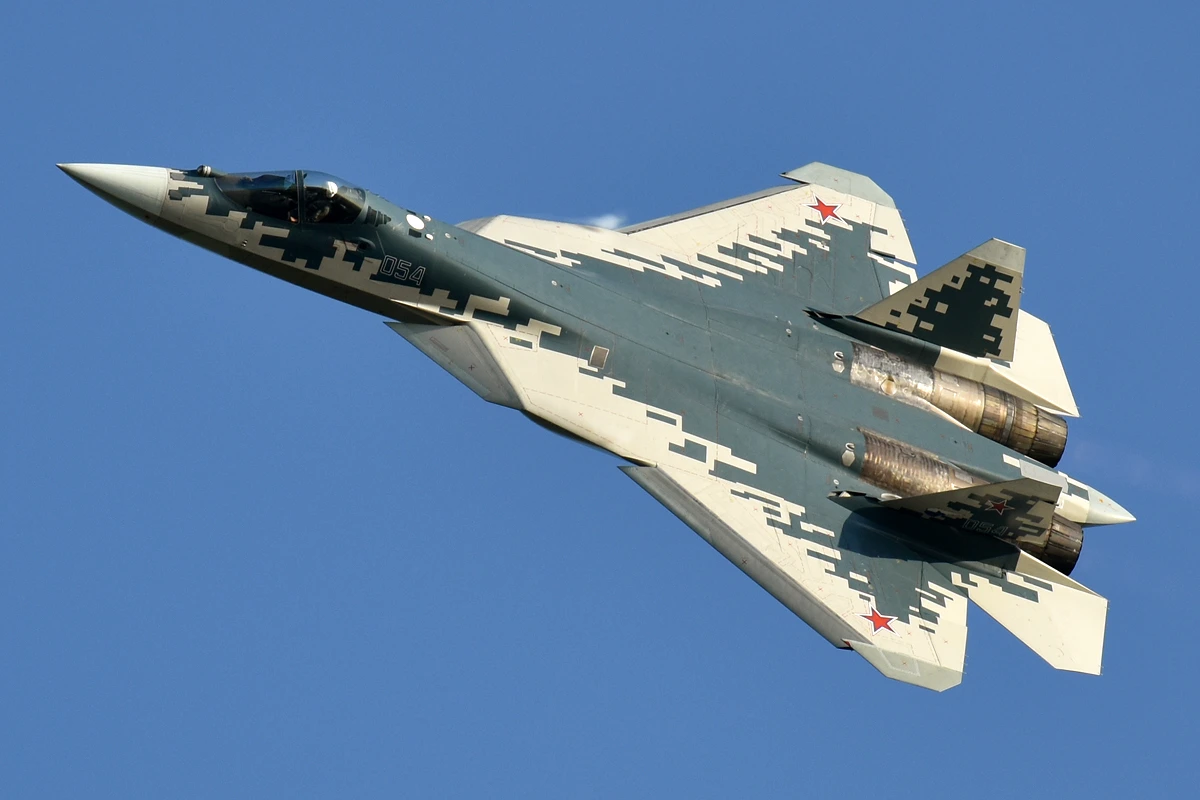
India has effectively ruled out the near-term acquisition of Russia’s Su-57 fifth-generation stealth fighter, with Defence Secretary Rajesh Kumar Singh confirming that the country has no plans to procure new Sukhoi variants and will instead focus on upgrading its existing Su-30MKI fleet. The decision reflects India’s broader strategy of strengthening indigenous defence capabilities while modernising its current combat aircraft inventory.


Speaking on the issue, Rajesh Kumar Singh stated that India is not considering the purchase of new Sukhoi platforms and is instead actively pursuing a comprehensive upgrade of the Su-30MKI fighters already being produced under licence. He described the Su-30MKI programme as a successful platform that continues to serve as the backbone of the Indian Air Force’s fighter fleet.
The decision marks a significant shift in India’s fighter aircraft roadmap, placing greater emphasis on indigenous capability development, technological self-reliance and long-term operational sustainability rather than importing a foreign fifth-generation fighter. It also signals a continued commitment to the Government’s Atmanirbhar Bharat initiative, which seeks to expand domestic defence manufacturing and reduce dependence on external suppliers.
At the centre of this strategy is the ambitious Super Sukhoi modernisation programme. The project aims to upgrade approximately 260 Su-30MKI aircraft with advanced indigenous technologies, extending their operational life while transforming them into highly capable 4.5-plus generation fighters.
The upgrade package is expected to include the indigenous Virupaksha Active Electronically Scanned Array (AESA) radar, advanced avionics, digital cockpit systems, enhanced mission computers, improved electronic warfare suites, secure data links and sensor fusion capabilities. The aircraft will also be integrated with a range of indigenous precision weapons, including the Astra beyond-visual-range air-to-air missile, BrahMos air-launched cruise missile and Rudram anti-radiation missile.
Defence planners believe the upgraded Su-30MKI fleet will provide significantly enhanced situational awareness, longer engagement ranges and greater survivability in contested environments while maintaining India’s long-range strike capability.
India’s decision comes amid a continuing shortage in fighter squadron strength. The Indian Air Force currently operates around 30 combat squadrons against an authorised strength of 42, with the retirement of ageing MiG-21 aircraft creating additional pressure to rapidly restore operational capacity.
To address this gap, the government continues to advance the Multi-Role Fighter Aircraft (MRFA) programme, under which up to 114 new fighter aircraft are expected to be procured. Alongside this, the indigenous Advanced Medium Combat Aircraft (AMCA) programme remains India’s long-term pathway towards acquiring a fifth-generation stealth fighter designed and developed domestically.
The AMCA is expected to become India’s first indigenous stealth combat aircraft, with development progressing toward prototype testing later this decade before eventual induction into service in the 2030s.
The decision also reflects lessons learned from the earlier Fifth Generation Fighter Aircraft (FGFA) programme, a joint Indo-Russian project based on the Su-57 that was eventually discontinued after disagreements over technology transfer, work share, cost escalation and access to critical source codes. The experience reinforced India’s preference for greater technological control and indigenous development in future strategic programmes.
Russia had continued promoting the Su-57E export variant to India, reportedly offering technology transfer, local production through Hindustan Aeronautics Limited and support for India’s aerospace industry. However, concerns regarding production capacity, supply chain reliability, operational maturity and long-term logistics appear to have influenced New Delhi’s decision to avoid introducing another Russian combat aircraft platform.
Another factor shaping India’s approach has been the experience gained during Operation Sindoor in May 2025. The operation demonstrated the effectiveness of the Su-30MKI in air superiority, precision strike and long-range missions, particularly through the employment of air-launched BrahMos cruise missiles. The aircraft’s operational performance reinforced confidence in upgrading proven platforms rather than investing in an entirely new fleet.
While ruling out new Sukhoi acquisitions, India continues to maintain a strong defence relationship with Russia. Bilateral cooperation remains active in areas including maintenance, spares support, engine development and sustainment of the extensive Russian-origin inventory already operated by the Indian Armed Forces.
The latest position illustrates India’s evolving procurement philosophy, which seeks to balance operational readiness with strategic autonomy. By combining the Super Sukhoi upgrade, additional multirole fighter acquisitions under the MRFA programme and the indigenous AMCA project, India aims to build a modern, technologically advanced and self-reliant air force capable of meeting future security challenges across the Indo-Pacific region while reducing long-term dependence on foreign combat aircraft imports.