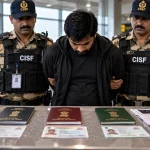


Alert personnel of the Central Industrial Security Force (CISF) detected a skull concealed inside the hand baggage of a passenger during security screening at Indira Gandhi International (IGI) Airport in New Delhi, officials said.





The incident occurred during the Pre-Embarkation Security Check when CISF personnel noticed a suspicious object inside the passenger’s cabin baggage. The passenger was scheduled to travel from Delhi to Hyderabad when the unusual item was detected.
According to the information available, CISF personnel subjected the baggage to further examination after the suspicious object was noticed during screening. The inspection led to the recovery of what appeared to be a skull concealed inside the hand baggage.
When questioned by security personnel about the object, the passenger reportedly stated that it was a monkey skull.
The discovery immediately raised concerns because possession or transportation of wildlife specimens and animal body parts may attract provisions of India’s wildlife protection laws, depending on the species involved and the circumstances in which the specimen was acquired and transported.
Considering the nature of the recovered item and its suspected wildlife connection, CISF personnel handed over the passenger to the local police for further investigation and necessary legal action under the provisions of the Wildlife (Protection) Act, 1972.
Authorities are expected to ascertain the exact nature and origin of the recovered skull as part of the investigation. The circumstances under which the passenger came into possession of the object and the purpose for which it was allegedly being transported are also likely to form part of the inquiry.
The case demonstrates the broader role played by aviation security personnel at India’s airports. While the CISF’s primary responsibility at airports is to protect passengers, aircraft and critical aviation infrastructure, security screening can also lead to the detection of prohibited, suspicious or potentially illegal articles being carried by passengers.
Pre-Embarkation Security Checks are an important component of India’s civil aviation security architecture, with passengers and their cabin baggage screened before they are permitted to enter secure boarding areas. Suspicious objects detected during this process can be subjected to additional examination and referred to the appropriate law-enforcement agencies when required.
Wildlife trafficking and the illegal possession or movement of protected animal specimens remain areas of concern for enforcement agencies. Airports can serve as important interception points because wildlife articles may be transported between cities or across international borders concealed in passenger baggage or cargo.
In this case, the timely detection ensured that the suspected wildlife specimen did not pass through the security checkpoint without scrutiny and allowed the matter to be referred to the competent authorities for investigation.
The incident highlights the alertness and vigilance of CISF personnel deployed at IGI Airport and their role not only in maintaining aviation security but also in assisting other agencies in enforcing laws concerning wildlife and other prohibited articles.
Further legal action in the case will depend on the findings of the police and relevant wildlife authorities, including confirmation of the species to which the recovered skull belongs and whether its possession or transportation constituted an offence under applicable law.