
External Affairs Minister S Jaishankar has played down the immediate significance of the Mecca Joint Defence Agreement between Pakistan, Saudi Arabia and Türkiye, while making it clear that India will factor the new arrangement into its broader national security assessment.




Speaking at an event in New Delhi, Jaishankar questioned the practical impact of the agreement, particularly in view of the security challenges and ongoing military situations faced by its three signatories.
“There are live military situations which each of the signatories face, what has the Makkah pact done in response to that?” Jaishankar said when asked about India’s assessment of the agreement.
At the same time, the External Affairs Minister stressed that India would closely assess developments involving countries whose policies or actions are not favourable towards New Delhi. He said every such development would carry a certain weight in India’s strategic calculations.
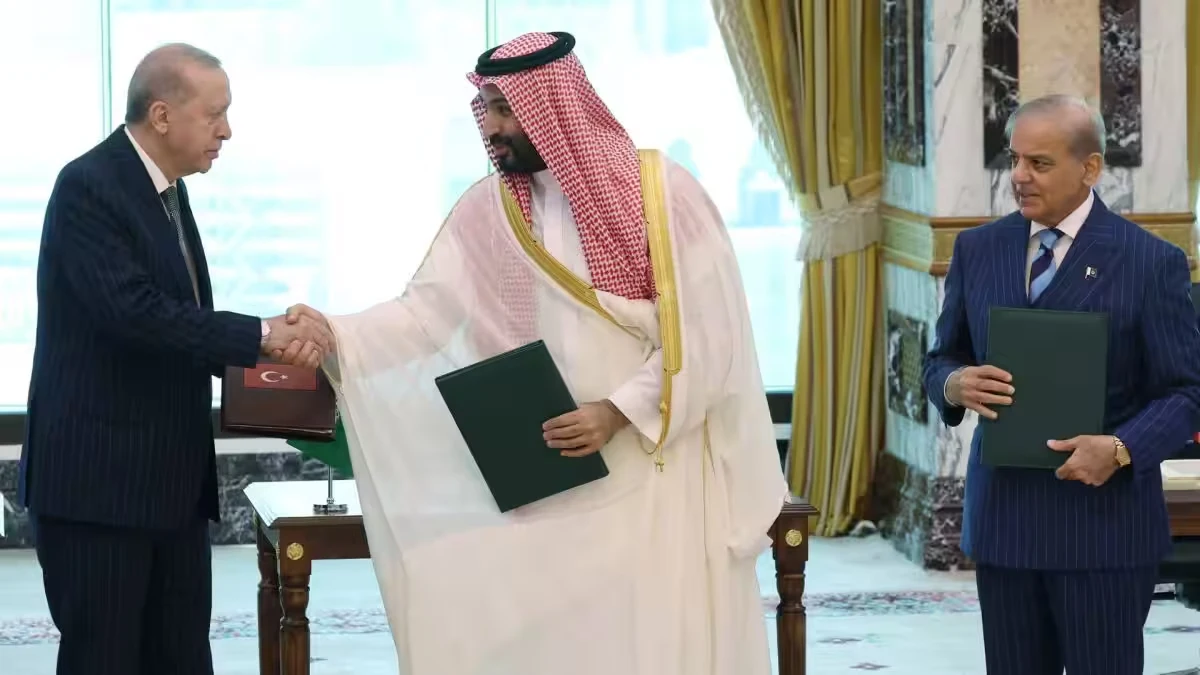
The Mecca Joint Defence Agreement was signed by Pakistan, Saudi Arabia and Türkiye on August 7 following discussions involving Pakistan Prime Minister Shehbaz Sharif, Saudi Crown Prince Mohammed bin Salman and Turkish President Recep Tayyip Erdogan.
According to a joint statement issued by the three countries, the agreement is based on shared strategic interests and longstanding defence cooperation. It seeks to strengthen collective deterrence and states that an armed attack against any one of the three countries would be regarded as an attack against all three.
The agreement also envisages expanding cooperation across various areas of defence between Pakistan, Saudi Arabia and Türkiye.
India has been assessing the implications of the pact from the perspective of national security as well as regional peace and stability. The Ministry of External Affairs had earlier said that New Delhi was examining the agreement while closely monitoring developments in the wider West Asia region.
Jaishankar also spoke about India’s assessment of Pakistan and described the country as unique in the context of its sustained use of terrorism against a neighbouring state. He argued that Pakistan’s approach has had a significant impact on Indian public opinion and remains an important factor in New Delhi’s strategic calculations.
On Pakistan-US relations, the External Affairs Minister noted the long history of ties between the two countries while emphasising that India has developed its own relationship with Washington.
Jaishankar also addressed India-China relations, saying that both countries have an interest in maintaining stability but that the situation along the border remains an important determinant of the broader relationship.
He said India must continue strengthening its own economic and industrial capabilities while maintaining commercial engagement with countries across the world, including China. Referring to the period of heightened tensions following the 2020 Galwan Valley clashes, he said the border situation had played a major role in the difficult phase in bilateral relations.
The External Affairs Minister stressed that India would continue to engage globally while standing firm on matters concerning its national interests and security.
His remarks on the Mecca pact underline New Delhi’s cautious approach towards emerging strategic alignments in its neighbourhood and West Asia, balancing diplomatic engagement with a close assessment of their potential implications for India’s security environment.