
Kolkata: The Calcutta High Court has quashed a criminal case against a serving Indian Army soldier after official military records showed he was on active duty in Imphal on the exact date and time of an alleged neighbourhood assault in Hooghly hundreds of kilometres, and by road close to 2,000 km, from the scene.


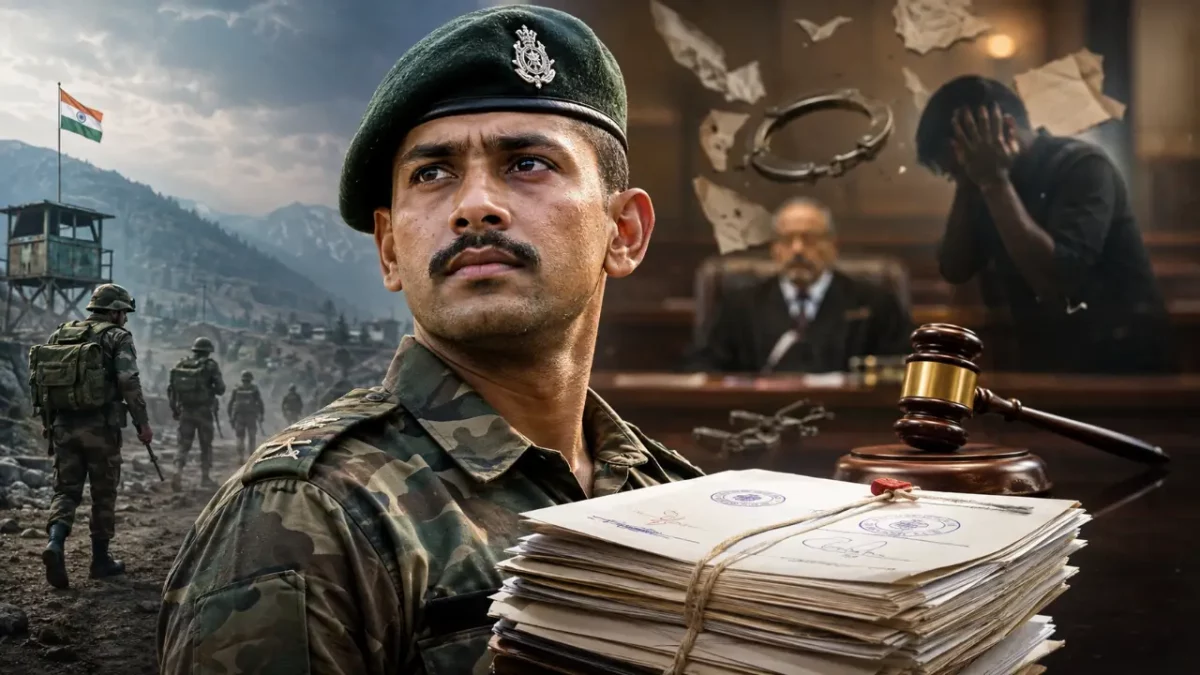
Justice Uday Kumar, in an order dated August 25, 2026, held that forcing a “soldier of the nation” to face trial on a “demonstrably false and vindictive police report” would be an “unconscionable abuse of the judicial process.” The court said the law was never meant to be a weapon of harassment, nor was the criminal justice system designed to settle personal scores born out of civil disputes.
The ruling draws a sharp line between a genuine criminal prosecution and a complaint that, on official records, could not possibly be true against one of the accused.
A property fight that turned into an FIR
The case grew out of a bitter, localised neighbourhood dispute in Hooghly between two families. The flashpoints were familiar to many Indian civil courts: alleged illegal construction, obstruction of entry and exit, and the right to use a narrow four-foot common passage and drainage. Both sides had already gone to the civil courts. Hostility, the High Court noted, was escalating.
When the complainant failed to secure an “immediate upper hand in the civil domain,” he lodged a police complaint on December 6, 2023 about two months after the alleged incident. He claimed that on October 5, 2023, at 6:30 a.m., two brothers and unknown associates physically assaulted him, demanded that his sister vacate her property, looted Rs 7,500 in cash, and issued threats.
One of those brothers was a serving Army soldier posted far from Bengal.
The alibi the complaint could not survive
Investigation threw up what the court called a “glaring” flaw. The soldier’s commanding officer certified that he was physically present on active military duty in Imphal, Manipur, at the precise date and time of the alleged brawl. That official record, Justice Kumar said, was “unimpeachable” and “authentic.” It “shatters the credibility of the complainant’s allegations against him.”
The court put the geography in blunt terms. The FIR, it said, had been drafted with “sweeping, reckless abandon, casually naming a serving soldier as a joint participant in an alleged early morning neighbourhood brawl in Hooghly.” It was “physically impossible for an individual to inhabit two geographical coordinates thousands of miles apart simultaneously.”
Imphal and Hooghly sit at opposite ends of a long overland journey across the Northeast and the eastern plains. Even allowing for variation in route, the distance is measured in well over a thousand kilometres commonly described as around 1,500–2,000 km by road. Presence on duty in Imphal at 6:30 a.m. is incompatible with participation in an assault in Hooghly the same morning.
A procedural anomaly in the police papers
The High Court also flagged how the case was processed. Police did not include the soldier’s name in the final report. Yet he continued to be treated as a co-petitioner in the High Court challenge. The judge called that a “procedural anomaly” revealing a “fatal defect in the initial police action of roping him into this prosecution.”
In other words, the soldier was named at the outset with little apparent verification of whether he could even have been there and the later investigation itself undercut that naming.
Case dropped against the soldier, not against his brother
The court did not treat both brothers as identically placed. The soldier’s sibling is a local resident. Eyewitness statements and injury reports, the court said, indicated the possibility of a “scuffle” and “neighbourhood friction” over the disputed passage. Proceedings against the brother will continue. The State argued that there remained a strong prima facie case of wrongful restraint and assault against him.
The distinction matters. The High Court did not hold that nothing happened in Hooghly, or that every allegation in the complaint was invented. It held that one named accused could not have been a participant because the State’s own materials and the Army’s official records proved he was elsewhere.
What the lawyers argued
Advocates Gunjan Kumar Singh and Rupsa Maity, appearing for the brothers, said the criminal case was meant to “coerce the petitioners into withdrawing their legitimate civil claims” and to “pressurise them in ongoing property disputes.” They pointed to the police investigation and Army records as proof that one brother was wholly absent from the locality.
Advocates Ramashis Mukherjee and Neel Chakraborty, for the State, pressed for the case to continue against the local brother. Advocates Sayan Kanjilal and Kaustav Shome appeared for the complainant.
Public reports have not named the soldier, his brother, or the complainant.
Why the judgment goes beyond one FIR
Indian courts have long warned against converting civil property fights into criminal prosecutions. This order sits in that line, but with an added institutional concern: a serving soldier posted in a sensitive theatre was casually arrayed as an accused in a dawn street quarrel he could not have attended.
The court’s language is unusually strong. It spoke of “ignominy and trauma,” of a “false and vindictive” police report, and of an abuse of process. That is not a routine finding that the prosecution case is weak. It is a finding that, as against the soldier, the accusation collapsed on official records that no one seriously disputed.
There is also a practical lesson for investigation. When an accused is a member of the armed forces, posting and attendance records are ordinary documents maintained in the course of duty. Checking them early would have avoided naming a man who was in Imphal in an FIR about Hooghly. The delayed complaint December for an October incident made that check even more important.
The case against the soldier is over. The property dispute, and the criminal case against his brother, are not. The High Court has separated the two: a soldier cannot be made to stand trial for being in two places at once, and a neighbourhood fight cannot be used as a shortcut to win a civil war over a four-foot passage.