
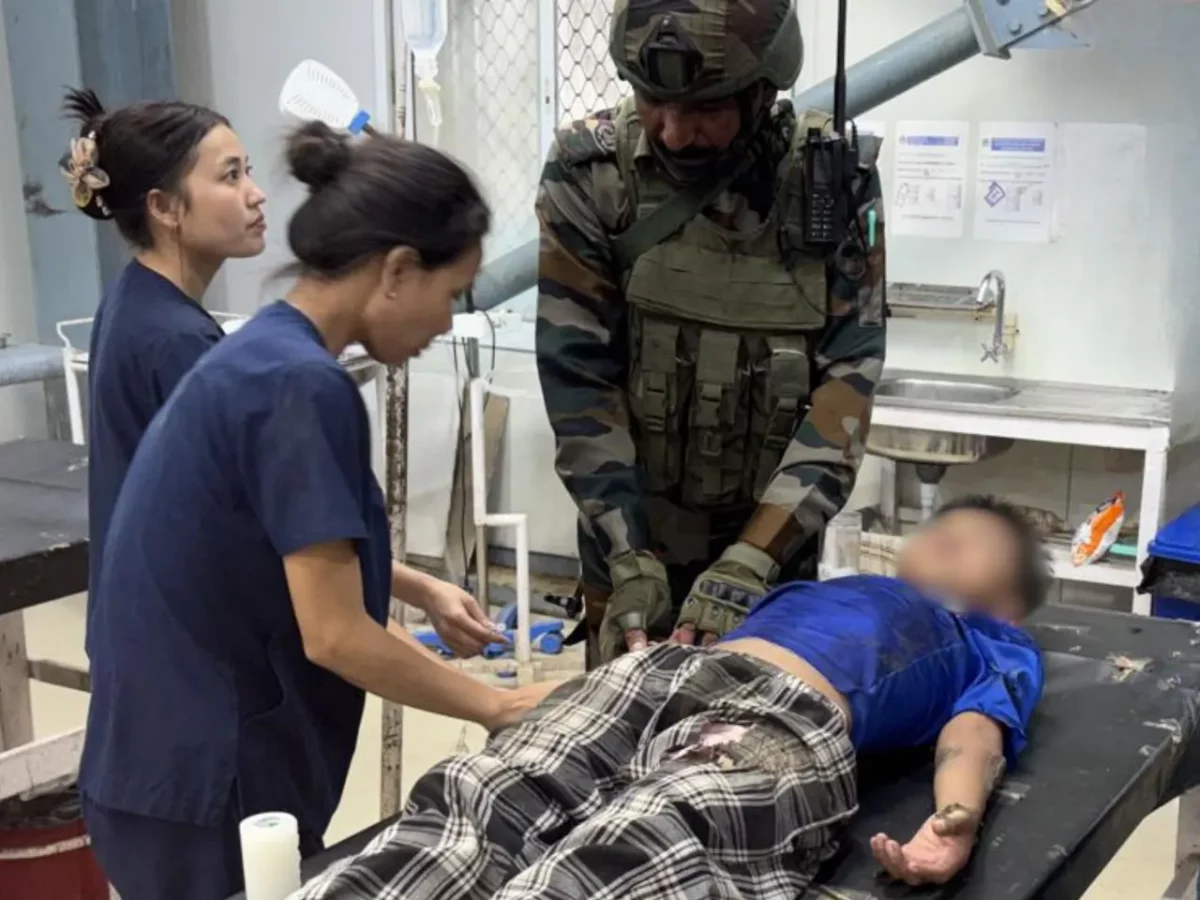
Churachandpur / Imphal: Personnel of the Assam Rifles provided prompt, life-saving first aid and evacuation after a young boy suffered electric shock in Churachandpur district of Manipur, according to the pattern of official humanitarian updates regularly issued by the force from the region.





In remote hill villages of Churachandpur, where civilian emergency services can take longer to arrive, Assam Rifles units frequently act as first responders. Official posts from the force in 2025–2026 document a consistent pattern: medical teams from unit hospitals—often the facility at Khuga—assess the casualty on the spot or at the nearest company operating base or Medical Inspection Room, administer immediate treatment, stabilise the patient, and shift him to the District Hospital, Churachandpur, or a Community Health Centre for further care. Locals and village authorities routinely express appreciation for the speed of the response.
Electrocution incidents in the Northeast often involve contact with a live wire, a low-hanging or snapped high-tension line, an unfenced or poorly maintained transformer, or wiring after rain. Similar accidents involving children have been reported across Assam and Manipur in recent years, sometimes with fatal outcomes when help is delayed. In cases where the victim is still alive when help arrives, the critical window is the first few minutes: stopping the current if it is still flowing, checking breathing and pulse, beginning CPR if needed, treating burns, and rapid evacuation.
Assam Rifles medical teams in the district have demonstrated this sequence in other paediatric emergencies. In July 2026, personnel revived a four-year-old boy from Kangkap village, Churachandpur, who was brought in unresponsive after a drowning; the team performed CPR in the golden hour, stabilised him, and referred him onward. In the same period they treated an eight-year-old injured in a road accident and multiple snake-bite victims, administering anti-venom and intravenous support before transfer to the district hospital. The same operational posture—trained medics, unit hospital capability, and willingness to move immediately—applies to an electrocution case.
A typical official account of such a rescue would describe personnel reaching the site or receiving the child at a nearby post, conducting an immediate assessment, providing first aid and cardiac or respiratory support if required, monitoring for complications of electric shock (arrhythmia, burns, internal injury), and arranging evacuation. Families and the village chief customarily thank the troops. The force frames these actions under its long-standing community role in the Northeast—often tagged in official language as service to remote populations, operational readiness, and “Community First.”
The incident, if it follows the documented pattern, also highlights a structural issue: electrical infrastructure in hilly and internally displaced persons (IDP) areas of Churachandpur is uneven. Transformers without adequate fencing, sagging lines, and informal connections after conflict-related displacement raise the risk for children. Assam Rifles units already run welfare and civic-action programmes in the district—medical camps, educational sponsorship for displaced students, Independence Day outreach at IDP camps, and youth leadership sessions. Electrical safety awareness and coordination with the state power utility would be a natural extension of that work.
Assam Rifles, India’s oldest paramilitary force and the primary counter-insurgency and border-guarding formation in the Northeast, maintains a dual mandate: security operations and civil assistance. In Churachandpur and adjoining districts it has repeatedly publicised timely medical interventions—snake bite, trauma, drowning, and accident cases—precisely because civilian hospitals are distant and the golden hour is short. A successful resuscitation after electrocution would sit in that same record: not a combat action, but the everyday work of troops who live among the population they are tasked to protect.
Further official confirmation—exact village, age of the boy, unit involved, and current medical status—would normally appear in a press note from Headquarters Directorate General Assam Rifles or the local battalion, and in follow-up reports from District Hospital, Churachandpur. Until those details are released, the episode fits a well-established local pattern: when a child is in sudden medical crisis in a remote part of the district, Assam Rifles personnel are often the nearest trained help.