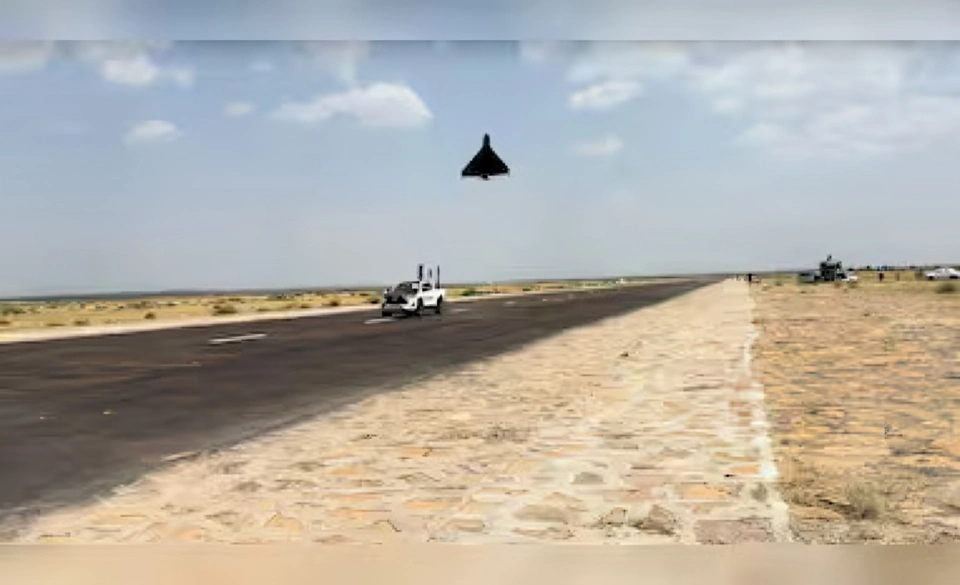
India’s indigenous long-range one-way attack drone KAL has been successfully flight-tested at the Pokhran range in Rajasthan, marking a significant development in the country’s efforts to build domestic unmanned strike capabilities.





Developed by Noida-based defence technology company IG Defence, KAL was test-flown from a vehicle-mounted launch platform. According to the company, the trial validated the drone’s integrated airframe, propulsion, avionics, navigation and mission architecture.
The successful test comes amid the growing use of long-range unmanned systems in contemporary conflicts and reflects the increasing importance being attached to autonomous and precision-capable platforms in modern military operations.
KAL has been developed as a long-range one-way attack drone designed to undertake missions against designated targets. The system has a stated range of up to 1,000 km, an endurance of seven to eight hours, a payload capacity of up to 50 kg and an operating altitude of up to 5,000 metres above mean sea level.
The drone incorporates a navigation architecture combining multi-band Global Navigation Satellite System (GNSS) and inertial navigation systems (INS), enabling autonomous flight through its mission profile.
According to IG Defence, the platform can be configured for precision engagement of designated targets, including infrastructure, radar installations, air-defence systems and other strategic targets, subject to mission configuration and operational authorisations.
A notable feature of the Pokhran trial was the use of a vehicle-mounted launch platform. A road-mobile configuration can provide greater flexibility in deploying unmanned systems from dispersed locations rather than depending exclusively on fixed launch infrastructure, according to the company.
The development of KAL comes against the backdrop of the expanding role of long-range one-way attack drones in recent conflicts. The Russia-Ukraine war has demonstrated the use of unmanned platforms for long-range strikes and for placing sustained pressure on air-defence networks. Similar systems have also been employed in the Middle East and in attacks involving maritime targets in the Red Sea.
The growing operational use of such systems has increased international attention on long-range unmanned strike platforms, particularly because of their ability to combine range, autonomous navigation and comparatively scalable production.
Bodhisattwa Sanghapriya, Founder and Chief Executive Officer of IG Defence, described the Pokhran trial as a milestone for the company and India’s efforts towards self-reliance in advanced defence technology.
He said recent conflicts had demonstrated the growing importance of long-range one-way attack drones in precision-strike and air-defence operations. According to him, KAL has been designed around emerging requirements for long range, autonomous operation, payload capability and scalable indigenous production.
The company has positioned KAL as part of a broader long-range precision-strike portfolio. The system can also be integrated with IG Defence’s GRID battle management system, an AI-powered C5ISRT architecture intended to coordinate unmanned platforms and battlefield information.
The combination of the drone with a broader command-and-control architecture reflects the increasing emphasis on networking unmanned systems with surveillance, intelligence and decision-making capabilities. Such integration is intended to allow information from different battlefield sources to be brought together within a common operational framework.
The Pokhran test also represents a step in the development of an indigenous industrial ecosystem for long-range unmanned systems. India has increasingly focused on domestic design and manufacturing of defence technologies, with unmanned platforms emerging as an important area for private-sector participation and innovation.
IG Defence said KAL is ready for the international market, subject to the requisite approvals from the Government of India and applicable export clearances. The company has also stated that several Gulf nations have expressed interest in the system for strategic and battlefield requirements.
Beyond KAL, IG Defence is developing a wider portfolio of indigenous defence technologies, including interceptor drones, FPV combat drones, autonomous UAVs, counter-UAS systems, electronic warfare systems, AI-enabled swarm technologies, tactical robotics and logistics drones.
The company’s broader portfolio indicates an effort to develop capabilities across several segments of unmanned and autonomous warfare rather than concentrating on a single platform category.
For India, the development of a long-range unmanned strike system has significance in the context of the changing character of warfare. Modern battlefields are increasingly characterised by the integration of unmanned platforms, precision weapons, surveillance systems, electronic warfare and networked command-and-control architectures.
KAL’s Pokhran trial therefore represents more than a flight demonstration. The validation of its airframe, propulsion, avionics, navigation and mission architecture marks an important development stage for the platform as its developers seek to establish an indigenous long-range unmanned strike capability.
The successful test also highlights the growing role of Indian defence companies in developing advanced unmanned systems and supporting the country’s broader push for self-reliance in defence technology.
With its stated 1,000-km range, extended endurance and vehicle-launched configuration, KAL is being developed for a segment of unmanned warfare that has gained increasing prominence globally. Further development, evaluations, approvals and operational assessment will determine the platform’s eventual employment and induction prospects.
For the Indian defence industry, however, the Pokhran trial demonstrates the expanding technological ambition in the domestic unmanned systems sector and the continued movement towards designing and manufacturing sophisticated defence platforms within the country.