
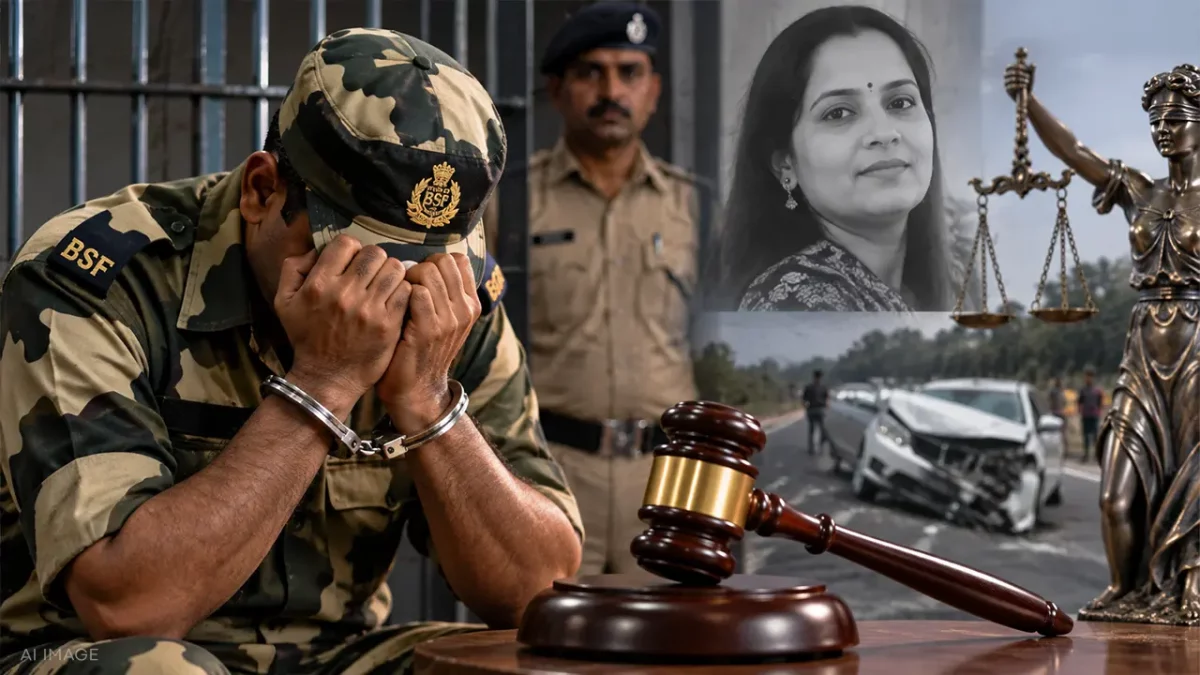
Muzaffarnagar (Uttar Pradesh), September 22, 2026 — A sessions court in Muzaffarnagar has sentenced a suspended Border Security Force (BSF) jawan to life imprisonment for murdering his wife and attempting to present the killing as a road accident.




Additional District and Sessions Judge Vijay Kumar convicted Manoj Kumar under Section 302 of the erstwhile Indian Penal Code and imposed a fine of Rs 50,000, government counsel Ashish Kumar said. The accused was produced before the court from the district jail through video conferencing.
According to the prosecution, Manoj Kumar assaulted his wife, Akanksha (also referred to as Pooja), with an iron rod on April 3, 2024, at Kasimpur village in the district. He then informed her family that she had died in a vehicular accident.
Local reporting has described a shifting account given to the victim’s natal family. Relatives were first told that Akanksha had suffered a heart attack and was being taken for medical treatment. Shortly afterwards, they were informed that the car had met with an accident on the way and that she had died. Suspicion over the explanation led her father, Subhash, a resident of Miwa village in Meerut district’s Mawana area, to lodge a police complaint.
The complaint named Manoj Kumar along with his father, Ajab Singh, his mother, Mithlesh, and his uncle, Babu. During the trial, Ajab Singh died. The court acquitted Mithlesh and Babu for want of sufficient evidence. Manoj Kumar was later suspended from the BSF. He has been in custody since 2024.
Akanksha and Manoj Kumar were married on February 6, 2017. The prosecution case, as presented before the court, was that the death was a homicidal assault and not an accident. After examining the evidence, the court convicted Manoj Kumar of murder and awarded life imprisonment.
The natal family had also alleged that Akanksha faced harassment after marriage, including over dowry demands. The conviction recorded by the court, however, is for murder under Section 302 of the IPC. Disciplinary action within the BSF is separate from the criminal trial in the civilian court. A conviction of this nature customarily leads to termination from service.