

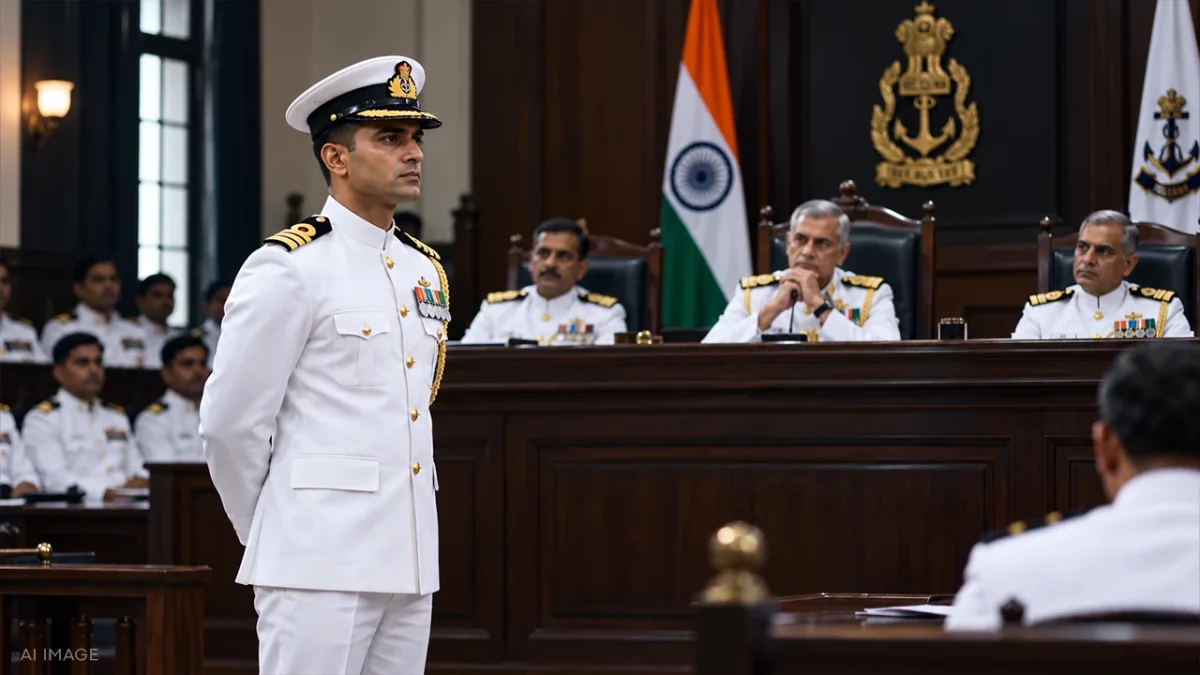
Kochi: The Kerala High Court has held that an officer who investigates allegations against naval personnel may also be appointed as prosecutor in the same court-martial, and that such a dual role does not, by itself, violate the accused’s right to a fair trial under Article 21 of the Constitution.

A Division Bench of Justice K. Natarajan and Justice Johnson John delivered the ruling on 18 September 2026 in appeals arising from a challenge by a Master Chief Petty Officer with 31 years of service. The Bench set aside observations of a Single Judge that the investigating officer could not be treated as a “suitable person” to prosecute the very case he had investigated.
The court observed that Navy (Discipline and Miscellaneous Provisions) Regulations, 1965, contain no express prohibition against the appointment. Regulation 163(1) requires the convening authority to appoint a “suitable person” as prosecutor. Regulation 178(3) treats the prosecutor as a competent witness. Read together, the provisions contemplate that a person who knows the facts and has filed the charge-sheet may conduct the prosecution and, if necessary, give evidence.
“The sole duty of the prosecutor is to place the evidence before the court-martial. The judgment or order of sentence is to be delivered by the court-martial itself, and not by the prosecutor,” the Bench said. “The prosecutor’s role is confined to effectively presenting the accused before the court and placing the evidence on record. Therefore, the prosecutor need not be an independent authority but must be a suitable person for prosecuting the case.”
Master Chief Petty Officer faced court-martial under the Navy Act, 1957, on charges that included dishonestly inducing fellow officers to transfer sums of approximately ₹1.10 lakh each, attracting Section 420 of the Indian Penal Code read with Section 77(2) of the Navy Act, together with related allegations of forgery and false entries. After eight witnesses had been examined, he approached the High Court, contending that the investigating officer had been appointed prosecutor and that Regulation 178(3) was unconstitutional.
A Single Judge declined to strike down the regulation but held that “suitable person” in Regulation 163(1) could not include the investigating officer of the same case, because the dual role would infringe the right to a fair trial. The judge left it to the Armed Forces Tribunal to decide, after the trial, whether actual prejudice had been caused. Both sides appealed.
The Division Bench accepted the Union’s submission that court-martial procedure is a special statutory regime. Article 33 of the Constitution empowers Parliament to restrict or modify fundamental rights of members of the armed forces in the interest of discipline and the discharge of their duties. Consequently, Regulation 178(3) is not ultra vires Article 21. The appointment of the investigating officer as prosecutor cannot, by itself, be treated as a violation of fair-trial rights.
The court dismissed Master Chief Petty Officer’s appeal and allowed the Union of India’s appeal. It directed that the Single Judge’s observations on prejudice arising from the dual appointment shall not influence further proceedings. The conviction and sentence recorded by the court-martial, and any pending challenge before the Armed Forces Tribunal, remain to be examined on their own merits.