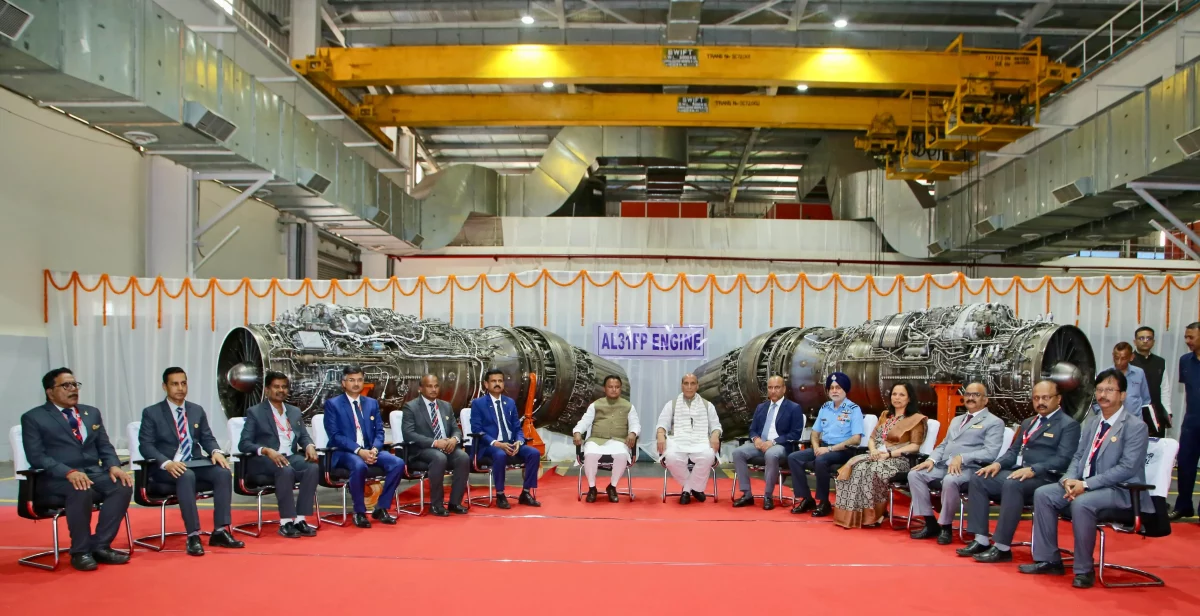
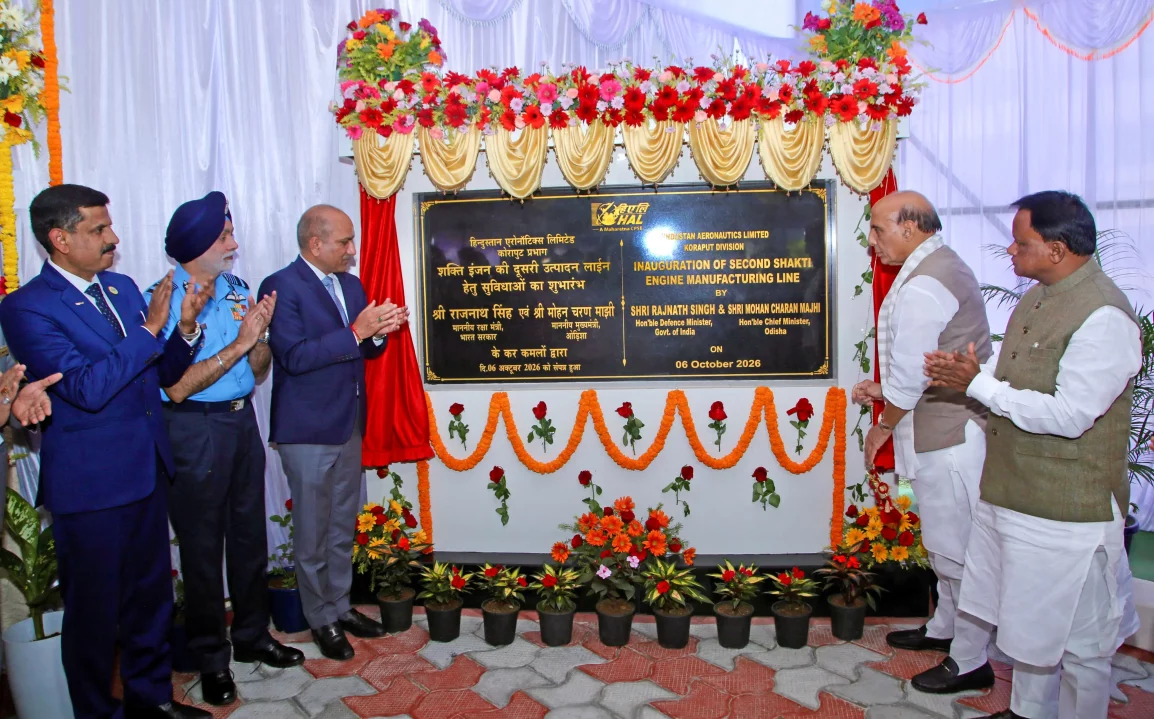
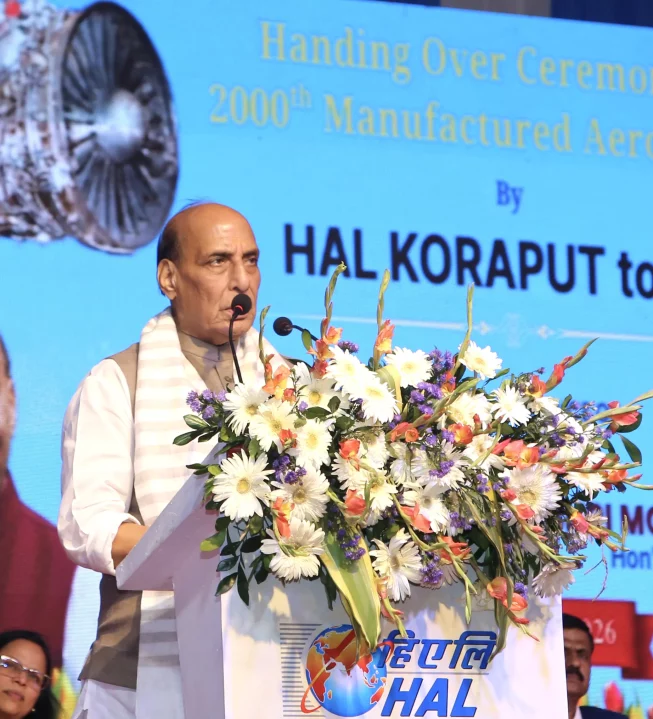
Defence Minister Rajnath Singh on October 6, 2026, witnessed the delivery of the 2,000th aero-engine by Hindustan Aeronautics Limited (HAL), Koraput Division, marking six decades of propulsion manufacturing and engineering expertise at the facility. He also announced the establishment of a second production line for Shakti engines.





Describing the milestone as a significant achievement in India’s aerospace journey, Rajnath Singh called for strengthening indigenous capabilities across the design, development, testing, manufacturing and maintenance of advanced aero-engines. He stressed that mastery of propulsion technology is essential for achieving self-reliance in the aerospace and defence sector.
Congratulating the engineers, technicians, scientists and skilled workforce of HAL Koraput, the Defence Minister said the delivery of 2,000 engines represented 2,000 significant contributions to the operational capability of the Defence Forces. He also highlighted the six decades of engineering expertise and technological experience accumulated since the Koraput Division was established in 1964.
Rajnath Singh highlighted HAL Koraput’s contribution to military aviation, noting that its engines have powered frontline aircraft including the MiG-21, MiG-27, MiG-29 and Su-30MKI. He emphasised that while production provides new capability, overhaul extends the service life of existing equipment, making both functions important for military preparedness.
HAL Koraput has overhauled more than 9,000 engines, with the Defence Minister appreciating its indigenous repair and overhaul capabilities. He noted that indigenisation of components and reduced turnaround time were contributing to operational readiness and extended service life of critical defence assets.
Describing the aero-engine as the “heart” of an aircraft, Rajnath Singh emphasised the importance of reliable propulsion for effectively utilising advanced airframes, radars, weapons and avionics. He highlighted the requirement for expertise in precision manufacturing, advanced materials, metallurgy, cooling technologies, testing and stringent quality assurance.
The Defence Minister noted that modern aero-engine technology combines advanced superalloys, thermal-barrier coatings and sophisticated cooling systems to ensure reliable performance under extreme conditions. He said mastery of propulsion technology therefore represents mastery of some of the most advanced industrial capabilities.
Rajnath Singh underlined that aerospace self-reliance must extend to indigenous aero-engine capability, particularly for the Advanced Medium Combat Aircraft (AMCA) programme. He highlighted the proposed investment of around Rs 5,000 crore, indigenisation of raw materials in partnership with Mishra Dhatu Nigam Limited (MIDHANI) and establishment of India’s first indigenous high-thrust engine testing facility.
He stressed that a sovereign aerospace ecosystem requires indigenous capabilities across materials, design, manufacturing, testing and Maintenance, Repair and Overhaul (MRO).
Highlighting HAL’s performance in meeting the requirements of the Defence Forces, Rajnath Singh noted that the Government placed an order for 240 AL-31FP engines with HAL in 2024 for the Su-30MKI. Despite global supply-chain disruptions and raw-material challenges, HAL delivered the first engine ahead of schedule and has delivered 63 engines against a target of 60 by the end of the second year.
The Defence Minister announced that HAL is enhancing its annual AL-31FP production capacity from 30 to 50 engines with an investment of Rs 335 crore. He also announced a second production line for Shakti engines with an investment of Rs 218 crore. The new line will manufacture up to 100 engines annually and is scheduled to be fully established by 2028-29.
The increased Shakti engine production capacity will cater to indigenous helicopters including the Dhruv Advanced Light Helicopter (ALH) and Prachand Light Combat Helicopter (LCH).
Emphasising the need for reliable indigenous propulsion for India’s helicopter ecosystem, Rajnath Singh said the Defence Forces require engines that are available when needed, supported throughout their lifecycle and upgraded with evolving technology.
He noted that aero-engine development is a long-term endeavour requiring sustained investment, specialised testing, skilled manpower and a strong industrial ecosystem. He stressed the importance of repeatable, reliable and scalable production, along with capabilities in design, critical materials and superalloys.
The Defence Minister also called for greater integration of MSMEs, start-ups, private industry, academia and research institutions into the propulsion ecosystem. He called upon HAL to develop Koraput not merely as an engine production facility but as a broader aerospace propulsion ecosystem.
This would involve nurturing suppliers, mentoring MSMEs, supporting start-ups and young engineers, collaborating with universities and research institutions and developing capabilities for critical components.
Highlighting Odisha’s growing importance in the defence and aerospace ecosystem, Rajnath Singh pointed to the State’s strategic location, long coastline, ports, mineral resources, industrial infrastructure and skilled manpower. He also highlighted DRDO’s Integrated Test Range at Chandipur and recent initiatives of the Odisha Government as providing a strong foundation for the growth of the aerospace and defence manufacturing ecosystem.
The Defence Minister appreciated initiatives of the Odisha Government under Chief Minister Mohan Charan Majhi, including the approval for an Aerospace and Defence Equipment Manufacturing Complex at Gajamara, Dhenkanal.
He called upon HAL to develop Koraput as the nucleus of a broader aerospace propulsion ecosystem by developing suppliers, mentoring MSMEs, providing opportunities to young engineers and start-ups in advanced technology areas, collaborating with universities and research institutions, creating opportunities for skilled local youth and developing indigenous manufacturing capabilities for critical engine components.
Urging the HAL Koraput team to raise standards in quality, productivity, indigenisation, innovation and delivery timelines, Rajnath Singh described the 2,000th engine as a significant milestone and called for using it as a foundation to build an Indian aerospace industry capable of designing, developing, manufacturing and supporting advanced propulsion systems.
He congratulated the HAL Koraput team, Indian Air Force, industry partners, MSMEs, scientists, engineers, technicians and the people of Odisha on the milestone.
The event was attended by Odisha Chief Minister Mohan Charan Majhi, Secretary (Defence Production) Sanjeev Kumar, Deputy Chief of the Air Staff Air Marshal Tejpal Singh, HAL Chairman and Managing Director Ravi K, MIDHANI Chairman and Managing Director Dr S.V.S. Narayana Murty and Joint Secretary (Aerospace Wing & DOMW) Manisha Chandra.