
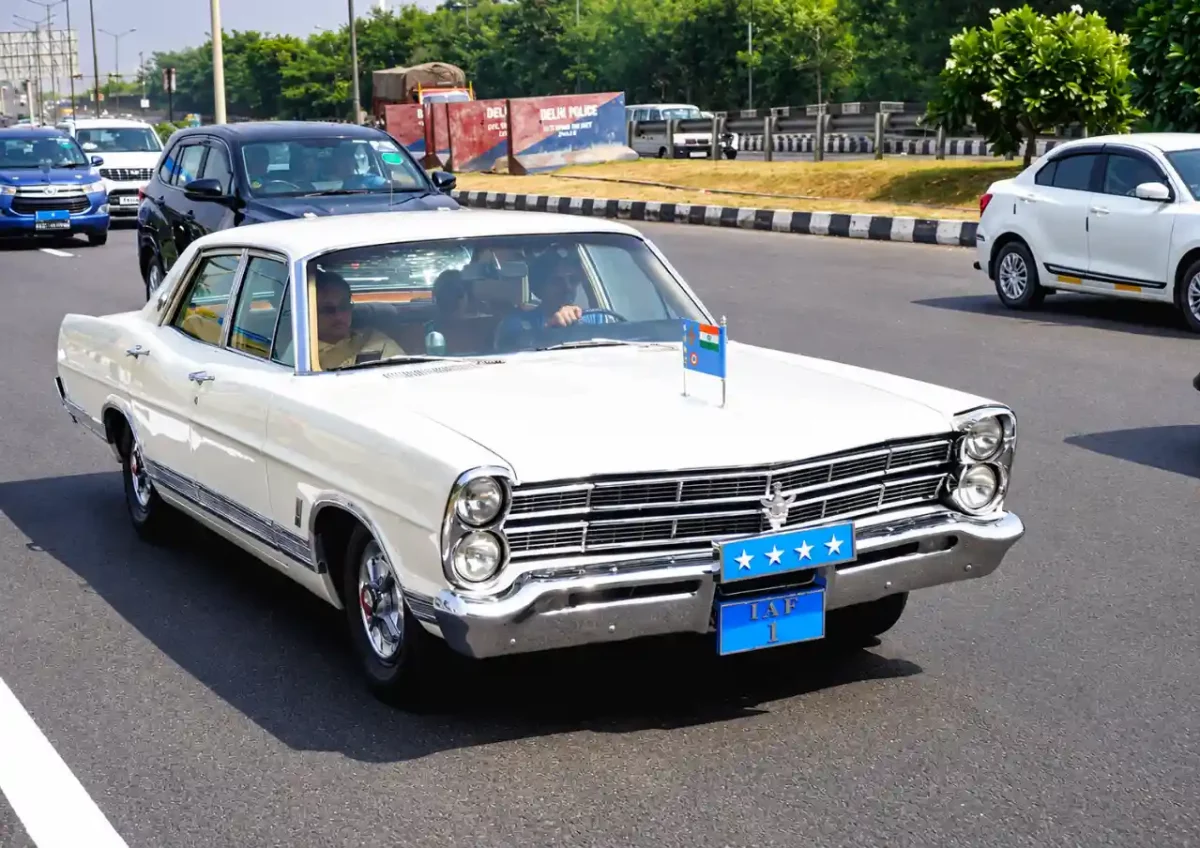
The Indian Air Force has a rich history of iconic aircraft, legendary commanders and remarkable traditions. Among its lesser-known historical treasures is IAF-1, a vintage left-hand-drive Ford saloon that served as the official vehicle of successive Chiefs of the Air Staff for 23 years. The historic car, which entered service in 1969, remains a symbol of the Indian Air Force’s heritage and its commitment to preserving the legacy of its leadership.
While the Indian Air Force is best known for its powerful fighter jets, transport aircraft and helicopters, IAF-1 represents a different chapter of its history. For more than two decades, the American-made Ford transported some of India’s most senior military leaders during a period that witnessed major developments in the country’s air power and national security.
The vintage Ford was inducted into Indian Air Force service on July 30, 1969. Unlike most vehicles seen on Indian roads, the car featured a left-hand-drive configuration, making it an unusual presence in a country where vehicles generally have right-hand steering. Its distinctive design, spacious interior and formal appearance made it suitable for transporting the Chief of the Air Staff.
During its years of service, IAF-1 became closely associated with the office of the Air Chief. The car served during the tenures of several senior commanders, including Air Chief Marshal Pratap Chandra Lal, who led the Indian Air Force during the 1971 India–Pakistan War that resulted in the liberation of Bangladesh.
The 1971 conflict was one of the defining moments in Indian military history. Under Air Chief Marshal P.C. Lal’s leadership, the Indian Air Force conducted extensive combat operations on both the eastern and western fronts, contributing significantly to India’s military victory. IAF-1 was part of the official transport arrangements during this important period, connecting the vintage vehicle to one of the most celebrated chapters in the Air Force’s history.
Over the following years, the Ford continued to serve successive Air Chiefs as the Indian Air Force underwent significant modernization. The service expanded its operational capabilities, introduced new aircraft and strengthened its role in safeguarding India’s airspace. Through these changes, IAF-1 remained a familiar part of the Air Chief’s official transport.
After completing 23 years of service, the Ford was retired from its regular duties in 1992. However, its association with the Indian Air Force did not end there. On June 10, 1993, Air Chief Marshal N.C. Suri formally presented the historic vehicle to the Air Force Museum at Palam in New Delhi, ensuring that it would be preserved for future generations.
The vehicle itself is a 1967 Ford saloon manufactured in the United States. It is powered by a V8 engine producing approximately 315 brake horsepower at 4,600 rpm. Its styling and exterior features closely resemble those of the 1967 Ford LTD sedan, a luxury model associated with the American manufacturer’s famous Galaxie family of cars. The vehicle’s large body, distinctive front grille and left-hand-drive arrangement reflect the design of American luxury automobiles of the 1960s.
What makes IAF-1 particularly special is that it has not been forgotten despite being retired from regular service more than three decades ago. The Indian Air Force continues to bring the vintage vehicle out for selected ceremonial occasions, allowing serving Air Chiefs to maintain a symbolic connection with their predecessors.
The historic Ford once again attracted attention during the Indian Air Force’s 94th anniversary celebrations at Air Force Station Hindon in Ghaziabad on October 8, 2026. Air Chief Marshal Amar Preet Singh, the serving Chief of the Air Staff, travelled in the vintage vehicle during the ceremonial parade. Against the backdrop of modern military aircraft and helicopters, the decades-old Ford offered a striking reminder of the service’s long history.
The car had also appeared during the 2025 Air Force Day celebrations at Hindon, demonstrating its continuing ceremonial significance. Its cream-coloured body, classic American styling and distinctive IAF-1 registration plate make it instantly recognizable as a piece of Indian military heritage.
Today, the Ford is preserved at the Air Force Museum in Palam, which houses historic aircraft, equipment, photographs and memorabilia documenting the evolution of Indian military aviation. The museum plays an important role in introducing visitors, aviation enthusiasts and young defence aspirants to the traditions and achievements of the Indian Air Force.
For defence enthusiasts, IAF-1 is much more than a vintage automobile. It represents an era when India’s air power was evolving rapidly, when successive Air Chiefs guided the service through major technological and strategic changes, and when the foundations of today’s modern Indian Air Force were being strengthened.
More than five decades after its induction, the Ford continues to hold a special place in the Indian Air Force’s history. From carrying Air Chiefs during the era of the 1971 war to making ceremonial appearances alongside modern fighter aircraft in 2026, IAF-1 remains a remarkable symbol of continuity, tradition and pride in the Indian Air Force.