
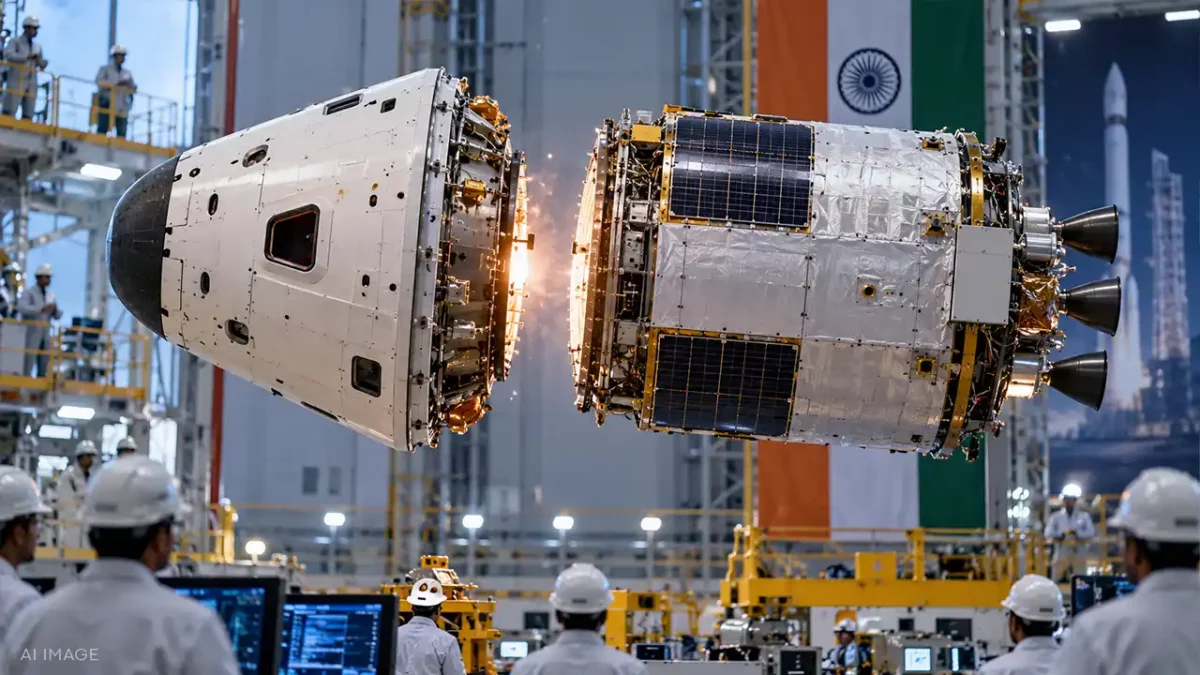
Bengaluru, October 16, 2026 — The Indian Space Research Organisation (ISRO) has successfully completed a series of Crew Module (CM)–Service Module (SM) separation tests for the Gaganyaan human spaceflight programme. The tests, conducted at the Vikram Sarabhai Space Centre (VSSC) in Thiruvananthapuram, validate a critical sequence required before atmospheric re-entry and provide confidence for the first uncrewed Gaganyaan mission (G1), targeted for launch in 2026.




The Gaganyaan Orbital Module consists of the Crew Module, which will house astronauts (or, on uncrewed flights, systems and the half-humanoid robot Vyommitra), and the Service Module, which provides power, propulsion and other support functions. The two modules are connected by a separation system and linked through umbilical connections that supply electrical power and fluids. They are integrated before launch and operate as a single unit from liftoff through the completion of the on-orbit phase. Prior to re-entry into Earth’s atmosphere, the Crew Module must separate cleanly from the Service Module.
Separation involves multiple precisely sequenced events using pyrotechnic devices and jettisoning systems. To validate the overall design, ISRO realised a test setup at VSSC that simulated the integrated CM–SM assembly with extensive instrumentation. The tests replicated the separation scenario, including the severing of several umbilical connections between the modules.
According to ISRO, the tests confirmed the design adequacy of the CM–SM separation systems. They also demonstrated the robustness and shock-survivability of several critical Crew Module subsystems. These include avionics systems, inertial navigation systems, the thermal protection system on the aft and conical heat shields, the Crew Module deployable umbilical shield, and pyrotechnic devices associated with the Crew Module uprighting system as well as the thermal and humidity control system.
ISRO stated that the successful tests provide the necessary confidence in the implemented CM–SM separation system for the upcoming G1 mission. Gaganyaan aims to demonstrate India’s human spaceflight capability by launching a crew of three to a 400 km orbit for a three-day mission and returning them safely to Earth for splashdown in Indian sea waters. The uncrewed G1 flight is intended to validate spacecraft systems, life-support functions and recovery procedures before any crewed mission. The first uncrewed flight is targeted within 2026, with additional uncrewed flights planned before the maiden crewed flight.
This latest series of tests follows earlier qualification work on Crew Module systems, including the uprighting system, umbilical connect-disconnect mechanisms and apex cover separation loads conducted earlier in 2026. Together, the progressive ground tests support preparations for the human-rated LVM3 launch vehicle and the overall Gaganyaan programme as India advances toward its first indigenous orbital human spaceflight.