
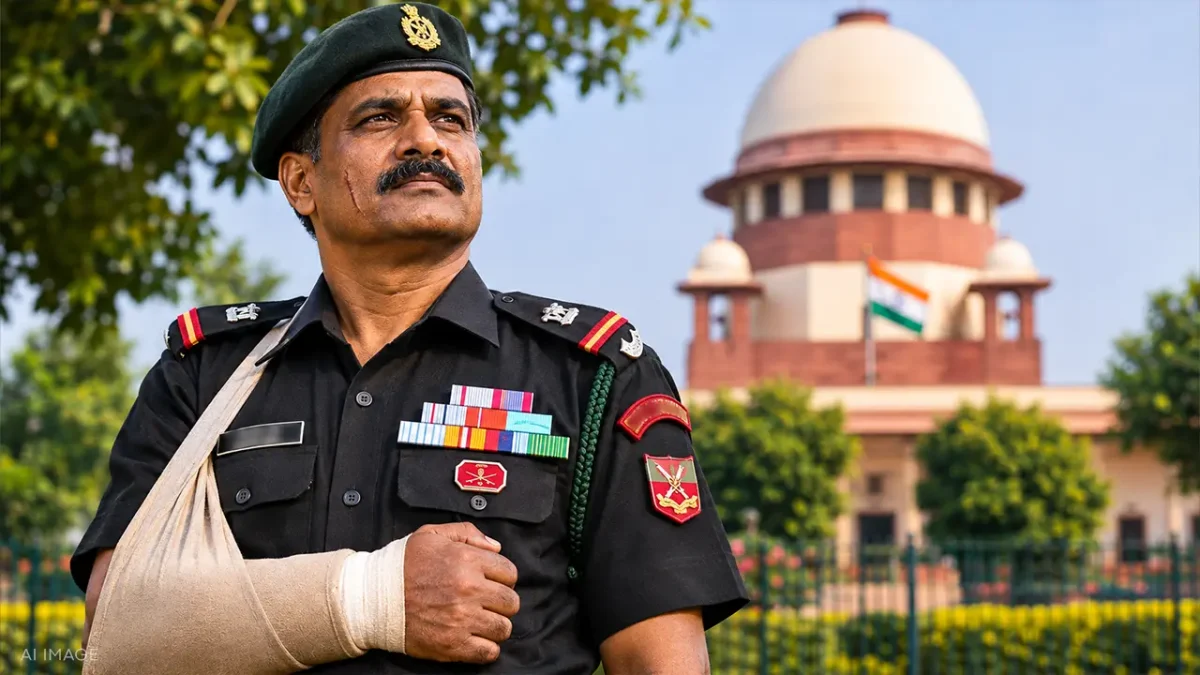
New Delhi, November 21, 2026: The Supreme Court has held that an Army personnel injured by the accidental discharge of his own service weapon while on operational duty is entitled to the higher War Injury Element of pension. The ruling establishes that such an injury is not a “self-inflicted” injury merely because the weapon belonged to the soldier.

A Bench of Justices Satish Chandra Sharma and Nongmeikapam Kotiswar Singh allowed the appeal of JC-377745M Ex Subedar Major and Honorary Lieutenant Devi Singh and set aside the orders of the Armed Forces Tribunal, Regional Bench, Lucknow. The Court directed the Union of India to sanction and pay the War Injury Element under Regulation 103 of the Pension Regulations for the Army from the date of retirement, after adjusting the ordinary Disability Element already paid. The revised Pension Payment Order and net arrears must be issued and paid within three months.
Background of the Case
Devi Singh was enrolled in the Indian Army on 24 June 1985 and retired on 31 March 2019 as Subedar Major and Honorary Lieutenant after 33 years of service. On 7 August 2002, while on duty with 31 Sub Area Signal Company in Jammu and Kashmir during Operation Rakshak/Operation Parakram, his loaded service weapon accidentally discharged. The bullet passed through his left thigh and damaged the femoral vein, resulting in a permanent disability assessed at 40 per cent for life (rounded to 50 per cent for pension purposes).
The Release Medical Board found the injury attributable to military service. He was granted the ordinary Disability Element of pension but was denied the higher War Injury Element. The Lucknow Bench of the Armed Forces Tribunal rejected his claim primarily on the grounds that final approval had not been granted by the Adjutant General’s Branch (MP-5), his name did not appear in a subsequent digital database, and original Court of Inquiry and unit records had been destroyed in the 2014 floods while in official custody.
Supreme Court’s Reasoning
The Supreme Court held that the surviving official records were sufficient to establish the claim. Part II Order No. BC-59 dated 16 December 2002 carried the heading “Battle Casualty Wound Op Rakshak Op Parakram” and recorded the injury as a gunshot wound sustained on duty. Read with subsequent Entitlement Cards and a Battle Casualty/Attributability Certificate issued by Signals Records, these documents established the operational nexus with Operation Rakshak/Parakram and brought the case within Category ‘E’ (specifically clause (h)) of Regulation 82 injury sustained in action against extremists or anti-social elements.
On the central objection that the injury was self-inflicted, the Bench drew a clear distinction: “The exclusion is of a self-inflicted injury, not of every injury in which a serviceman’s own weapon happens to be the source of the bullet.” It observed that weapon ownership and intention are distinct facts, and the former cannot prove the latter without evidence of intention. Accidental discharge can occur through impact or fall, snagging of the trigger, inadvertent pressure, or mechanical defect situations distinguishable from deliberate self-harm, which requires knowledge or intention.
The Court noted that Army Order 1/2003/MP expressly contemplates gunshot or splinter injuries “sustained accidentally” while carrying out operations against the enemy or militants, or injuries caused by firing by own troops. In either situation, the injury must be sustained during such operations. The present case fell under the first limb. Both parameters of Paragraph 69 of the Army Order operational circumstance and grievous severity were satisfied by the surviving field and medical records, including the Severity Certificate.
The absence of the appellant’s name from a later digital database and the destruction of primary records in floods while in official custody could not defeat the claim. The Court held that an officially recorded accident cannot be converted into a self-inflicted injury merely because the weapon belonged to the soldier, and that the appellant could not be made to suffer for no fault of his own. Contemporaneous certificates recording the circumstances of a casualty carry authoritative weight, consistent with the principle laid down in Union of India v. Saroj Devi.
Directions and Significance
The Court set aside the AFT’s judgment dated 10 May 2023 in O.A. No. 1066 of 2022 and its order dated 19 July 2023 in M.A. No. 1034 of 2023. It directed that the War Injury Element be sanctioned and paid from the date of retirement under Regulation 103, with adjustment of the Disability Element already disbursed to avoid double payment. The revised PPO and net arrears are to be issued and paid within three months.
This is a precedent-setting ruling for defence pension jurisprudence. It clarifies that an accidental discharge of a soldier’s own weapon while on operational duty against militants or the enemy qualifies as a battle casualty and is not automatically excluded as a self-inflicted injury. The decision protects veterans whose claims rest on genuine surviving field records even when primary files are lost in official custody or later digitisation is incomplete. It reinforces that enhanced pensionary benefits under the War Injury Element cannot be denied on technical or restrictive grounds when the operational nexus and nature of the injury are established by official records.