

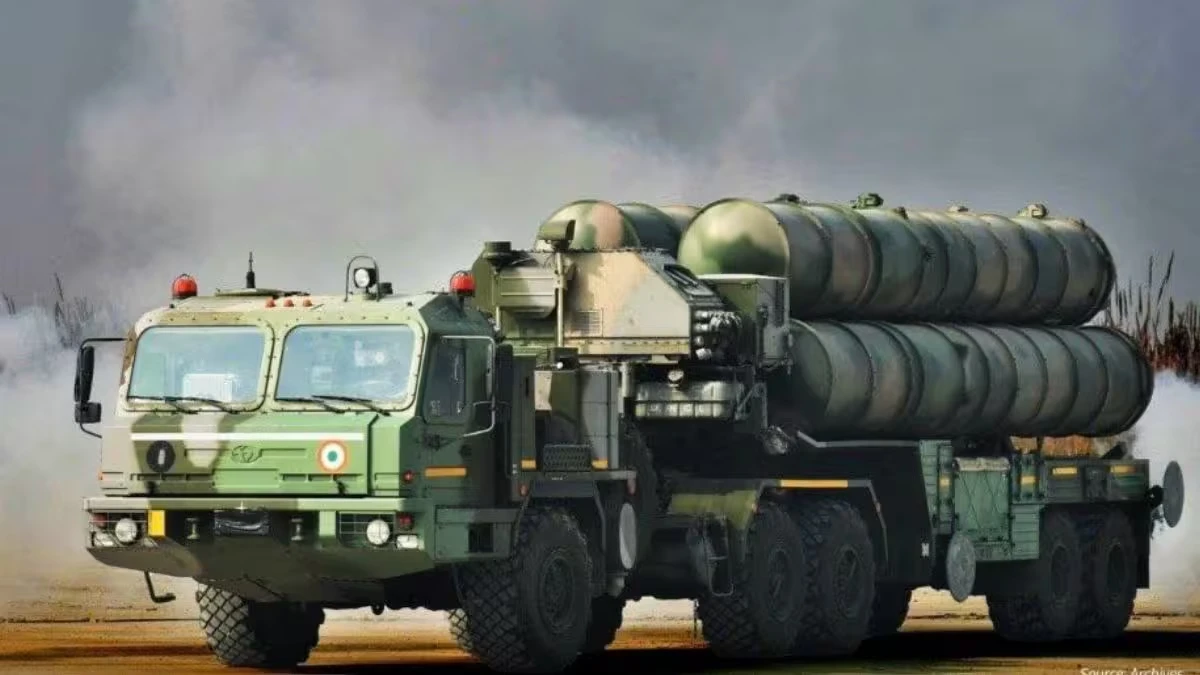
India is preparing to deploy its fifth S-400 long-range air defence system along the Pakistan border by February 2027, in a move aimed at strengthening the country’s aerial defence network along the western frontier, according to a report by Hindustan Times citing two officials familiar with the development.





The planned deployment is expected to strengthen air defence coverage along the 740-kilometre Line of Control (LoC) in Jammu and Kashmir. At present, India has three S-400 systems deployed in Punjab, Rajasthan and Gujarat, while a fourth system is stationed in Assam to provide protection against aerial threats along the Line of Actual Control (LAC) in Arunachal Pradesh.
According to the officials cited in the report, an Indian Air Force (IAF) pre-dispatch inspection team is scheduled to visit Russia next month. The fifth system is expected to be ready for deployment by February 2027. The Union government has not officially commented on the reported development.
The S-400 Triumf is a long-range air defence system capable of engaging a range of aerial threats, including ballistic missiles, aircraft, unmanned combat aerial systems, kamikaze drones and loitering munitions. The system can reportedly engage targets at ranges extending from 40 kilometres to 400 kilometres, depending on the interceptor missile used.
India is also reportedly seeking to procure five additional S-400 systems from Russia in the coming year, which would further expand the country’s long-range air defence capabilities.
The report also highlighted the role attributed to the S-400 during Operation Sindoor, stating that the system contributed to India’s air defence operations against Pakistani aerial threats. It claimed that the system helped prevent ballistic missiles and rockets from striking Indian territory and brought down Pakistani fighter aircraft, an airborne early warning and control (AEW&C) aircraft, and electronic intelligence (ELINT) platforms.
India Strengthens Preparedness Against Emerging Aerial Threats
The reported deployment comes amid India’s assessment of evolving military capabilities in its neighbourhood, particularly the expanding defence cooperation between Pakistan and China.
The report noted that China is planning to supply J-35 fifth-generation fighter aircraft to Pakistan in 2027. It also referred to Pakistan’s use of Chinese-origin J-10 fighters in combination with Swedish airborne early warning aircraft during Operation Sindoor, including the reported employment of PL-15E extended-range air-to-air missiles.
India is consequently working to strengthen its capabilities in long-range stand-off weapons and loitering munitions. These capabilities are intended to address emerging threats posed by extended-range air-to-air missiles and advanced air defence systems, including China’s HQ-9BE.
A senior military officer quoted by Hindustan Times said that future conflicts would increasingly involve stand-off weapons, with longer-range missiles and stronger missile-defence capabilities likely to play an important role.
The report also referred to China’s supply of military hardware to Pakistan, including Wing Loong II armed drones and the planned acquisition of eight Yuan-class, also known as Hangor-class, air-independent propulsion (AIP) diesel-electric attack submarines. The submarine programme is reportedly valued at more than $5 billion, with one submarine said to have been deployed by the Pakistan Navy in June 2026.
Turkey is also reportedly involved in upgrading Pakistan’s Agosta 90B submarines and supplying long-range kamikaze drones. The report further cited a proposed US upgrade package for Pakistan’s F-16 fleet and financial support from Saudi Arabia as part of the broader regional security environment.
Focus on Stand-Off Weapons and Border Infrastructure
Alongside the expansion of its air defence network, India is preparing to strengthen its long-range offensive and defensive capabilities. The reported plans include the development and acquisition of air-to-air, air-to-ground and ground-to-ground stand-off weapons, as well as loitering ammunition.
India is also looking to upgrade infrastructure along the Line of Actual Control, reflecting the need to address security challenges across both its western and northern borders.
The proposed fifth S-400 deployment would add another layer to India’s existing air defence architecture. Its reported positioning along the Pakistan border is part of the country’s wider efforts to strengthen its ability to detect, track and engage aerial threats at extended ranges.