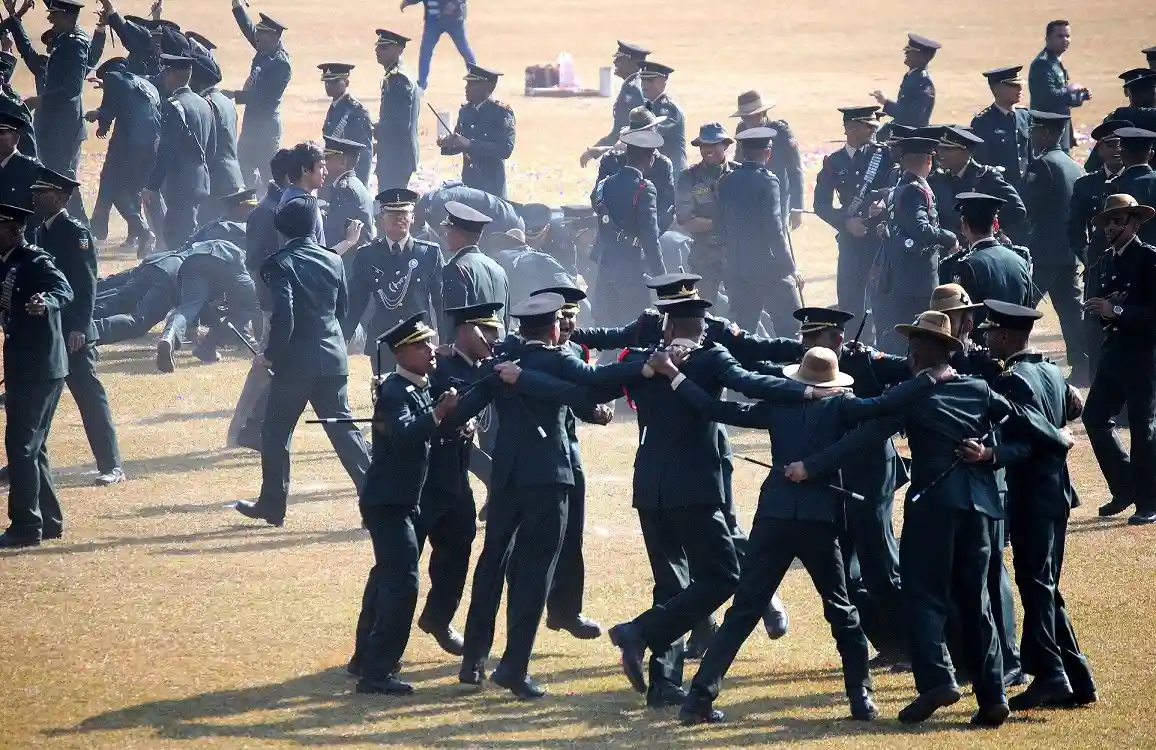
“Bharat Mata teri kasam, tere rakshak rahenge hum…” — these powerful words echo across the Drill Square of the Indian Military Academy (IMA) in Dehradun every time a batch of Gentleman Cadets (GCs) takes its final step into Chetwode Hall. More than a song, Bharat Mata Teri Kasam is the official anthem of the IMA. It is the emotional and motivational heartbeat of the academy’s Passing Out Parades (POPs), a solemn oath set to music that captures the essence of an Indian Army officer’s lifelong commitment to the nation.





Origin and Adoption
The Indian Military Academy was established in 1932. For decades, the academy used general Army marching songs during its ceremonial events. That changed in 2007 during the academy’s platinum jubilee celebrations marking 75 years of its existence.
On the evening of 30 September 2007, an audio CD of a specially commissioned song was released in Dehradun. The next day, 1 October 2007, coinciding with the formal platinum jubilee observances, the IMA officially adopted Bharat Mata Teri Kasam as its own song for all future Passing Out Parades.
Then Commandant of IMA, Lieutenant General Pitambar Kishor Rampal, stated at the launch: “Earlier, we used to sing and play the army song, now we will play our own IMA song.” The music was slightly adapted to match the precise foot-tapping rhythm required during the parade.
The initiative was closely associated with the then Chief of Army Staff, General J.J. Singh. Lyricist Javed Akhtar later recalled that the academy had invited him and that the young cadets had marched to the anthem. He described writing the song as “the biggest honour” of his life at that point, noting that his earlier experience in Kargil while researching the film Lakshya had given him a deep understanding of the Indian Army’s culture, ethos, and way of life.
The Creators
- Lyrics: Javed Akhtar
- Music: Raju Singh
- Singer: Sonu Nigam
Akhtar’s words combine patriotic fervour with the intimate language of a son addressing his mother. The composition by Raju Singh gives it a stirring yet dignified quality that works both as a marching tune and as a solemn pledge. Sonu Nigam’s powerful yet controlled rendition made the song instantly memorable.
Full Lyrics
Bharat Mata teri kasam,
Tere rakshak rahenge hum,
Vande Mataram, Vande Mataram (2)
Maa, humne tan-man-jeevan tujhse hi paaye hain,
Teri dharti se janme hain, tere phal khaaye hain,
Hum par teri mamta, tere karuna ke saaye hain,
Tere baahon mein hain pale, Maa hum tere hain ladle (2)
Deewarein hum banenge Maa,
Talwarein hum banenge Maa,
Chhoo le tujhko hai kis mein dum!
Bharat Mata teri kasam,
Tere rakshak rahenge hum,
Vande Mataram, Vande Mataram (2)
Humko pyara hai tera har zarra Bharat Maa,
Humko pyare hain tere parvat, jungle, nadiyaan,
Humko pyare tere gaon, nagar, tere raste, galiyaan,
Koi dushman kabhi agar, bhool se dekh le idhar (2)
Deewarein hum banenge Maa,
Talwarein hum banenge Maa,
Chhoo le tujhko hai kis mein dum!
Bharat Mata teri kasam,
Tere rakshak rahenge hum,
Vande Mataram, Vande Mataram (2)
Meaning and Message
The song is structured as a direct oath to Mother India. The opening lines are a solemn vow: “Mother India, we swear by you — we shall remain your protectors.” The cadets acknowledge that their body, mind, and life come from the motherland itself. They have been nurtured in her arms and are her beloved sons.
The most striking and repeated declaration follows:
“We shall become the walls, Mother.
We shall become the swords, Mother.
Who has the power to touch you?”
This imagery of becoming both the protective wall and the striking sword perfectly captures the dual role of the soldier — defender and warrior. The song ends by affirming love for every particle of the land — mountains, forests, rivers, villages, and cities — and warns any potential enemy that even a casual glance towards India will be met by her protectors.
The repeated cry of “Vande Mataram” links the modern anthem of the IMA to the historic freedom struggle, creating a continuous thread of nationalism.
Significance at the Indian Military Academy
At every Passing Out Parade, the Army band plays Bharat Mata Teri Kasam as the Gentleman Cadets march. The song is heard during the final phase of the parade when the cadets take the antim pag — the last step into Chetwode Hall — and are commissioned as officers of the Indian Army.
For the cadets who have spent months and years under the rigorous training regime of the IMA, the song is not mere ceremonial music. It is the culmination of their transformation from civilians into commissioned officers. It reinforces the academy’s credo, immortalised in the words of Field Marshal Sir Philip Chetwode:
“The safety, honour and welfare of your country come first, always and every time. The honour, welfare and comfort of the men you command come next. Your own ease, comfort, and safety come last, always and every time.”
The song also aligns with the IMA motto Veerta aur Vivek (Valour and Wisdom) and the honour code that every Gentleman Cadet internalises.
Even years after commissioning, officers often speak of the emotional impact of hearing the song. It is frequently recalled during unit functions, regimental events, and moments of reflection. Videos of recent POPs continue to show the same powerful response — cadets and officers alike visibly moved as the familiar notes fill the Drill Square.
A Living Legacy
Nearly two decades after its adoption, Bharat Mata Teri Kasam remains firmly established as the IMA’s own song. It is not a commercial patriotic track or a film number; it belongs exclusively to the academy and to the officers it has produced.
For defence aspirants preparing for the SSB and looking toward a career in the Indian Army, the song offers a clear window into the emotional and ethical core of the institution they aspire to join. It is a reminder that the profession of arms is ultimately a personal oath to the motherland — an oath that begins at the Drill Square of the Indian Military Academy and continues for a lifetime.
Bharat Mata teri kasam, Tere rakshak rahenge hum.
That simple, powerful promise continues to define generations of Indian Army officers.