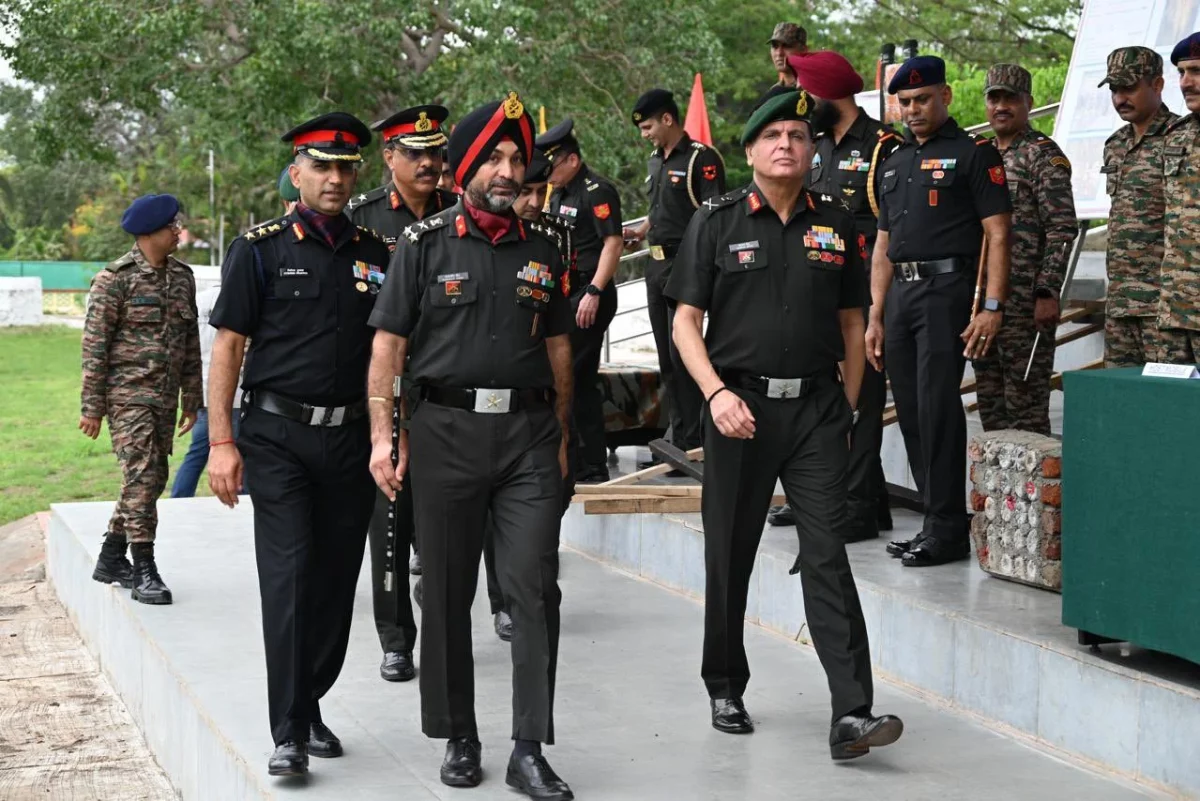
A significant reshuffle in the top leadership of the Indian Army is expected to take place from April 1, 2026, according to a post shared by national security analyst and defence journalist Nitin A. Gokhale on social media. The reshuffle involves key appointments among several senior three-star generals and will affect major operational commands as well as top positions at Army Headquarters in New Delhi.





Such rotations are a routine part of the Indian Army’s leadership management system, where senior officers move between command and staff appointments as they progress through the highest ranks of the service. The upcoming changes will see new commanders taking charge of the Western, Eastern, and Southern Commands while the position of Vice Chief of the Army Staff will also see a transition.
Lt Gen Dhiraj Seth to Become Vice Chief of the Army Staff
Lieutenant General Dhiraj Seth, who is currently serving as the General Officer Commanding-in-Chief (GOC-in-C) of Southern Command headquartered in Pune, is expected to move to Army Headquarters in New Delhi to assume the appointment of Vice Chief of the Army Staff (VCOAS).
The Vice Chief is the second-highest ranking officer in the Indian Army after the Chief of the Army Staff. The role is critical in overseeing operational planning, modernization, policy implementation, and coordination across various Army formations. The position also plays a key role in bridging operational commands with strategic decision-making at the highest level.
Lt Gen Seth’s move to this apex staff appointment is seen as a significant step in his career, bringing his extensive operational experience into the central leadership structure of the Army.
Lt Gen Pushpendra Singh to Lead Western Command
The current Vice Chief of the Army Staff, Lieutenant General Pushpendra Singh, will move to take over as the General Officer Commanding-in-Chief of Western Command, headquartered in Chandigarh.
Western Command is one of the most operationally significant formations of the Indian Army. It is responsible for guarding the western front along the border with Pakistan and oversees key operational sectors including Jammu & Kashmir, Punjab, and parts of Rajasthan.
Despite some misconceptions among observers, such a move from the Vice Chief’s role to command Western Command is not considered a demotion. In fact, it reflects the Indian Army’s tradition of providing senior officers with both staff and field command experience at the highest levels. Several past Chiefs of the Army Staff have served in similar rotational appointments before rising to the top position.
Taking charge of Western Command will place Lt Gen Singh at the helm of one of the most strategically sensitive and operationally active military regions in the country.
Lt Gen VMB Krishnan to Head Eastern Command
Lieutenant General VMB Krishnan, currently serving as the Quartermaster General at Army Headquarters, will be appointed as the new General Officer Commanding-in-Chief of Eastern Command, headquartered in Kolkata.
As Quartermaster General, Lt Gen Krishnan has been responsible for overseeing the Army’s logistics, supplies, maintenance systems, and operational sustainment. His experience in logistics management is considered particularly valuable for Eastern Command, which is responsible for the entire eastern frontier with China, including sectors in Arunachal Pradesh and Sikkim.
Eastern Command also manages operations across the Northeast region, which presents unique operational challenges due to mountainous terrain, difficult logistics routes, and complex security dynamics. The appointment of a senior officer with a strong logistics background highlights the importance of sustainment and infrastructure in high-altitude and remote border deployments along the Line of Actual Control.
Lt Gen Sandeep Jain to Become Southern Army Commander
Lieutenant General Sandeep Jain, who currently serves as Chief of Staff of Southern Command, will be elevated to the position of General Officer Commanding-in-Chief of Southern Command.
As Chief of Staff, Lt Gen Jain has been serving as the second-in-command of the formation and has been closely involved in the operational and administrative functioning of the command. His elevation to Army Commander represents a natural progression in the Army’s leadership structure.
Southern Command, headquartered in Pune, oversees military formations across peninsular India. While the region is relatively less active in terms of direct border tensions compared to northern commands, it plays an important role in training, logistics infrastructure, operational preparedness, and strategic reserves.
Routine but Important Leadership Rotation
The upcoming reshuffle reflects the Indian Army’s long-standing practice of rotating senior Lieutenant Generals between major command appointments and key staff roles at Army Headquarters. These changes typically occur every one to two years based on seniority, experience, and the requirements of the service.
The timing of the transitions on April 1 also aligns with the start of the new financial and operational year, which is a common period for major administrative changes across the armed forces.
There is no indication that the reshuffle is related to any crisis or unusual circumstances. Instead, it appears to be a routine but important leadership transition designed to refresh the command structure and ensure that experienced officers are placed in critical operational and strategic roles.
Strategic Significance
The reshuffle ensures that both of India’s most sensitive operational fronts — the western border with Pakistan and the eastern frontier with China — will see leadership changes led by experienced senior commanders.
At the same time, the move of Lt Gen Dhiraj Seth to the Vice Chief position places an experienced field commander at the centre of strategic planning and operational coordination at Army Headquarters.
Such rotations help maintain a balanced leadership structure where senior officers gain exposure to both field commands and central staff responsibilities, strengthening the overall decision-making framework of the Indian Army.
As the world’s second-largest standing army continues to modernize and adapt to evolving security challenges, these leadership transitions play an important role in sustaining operational readiness and strategic continuity across the force.