
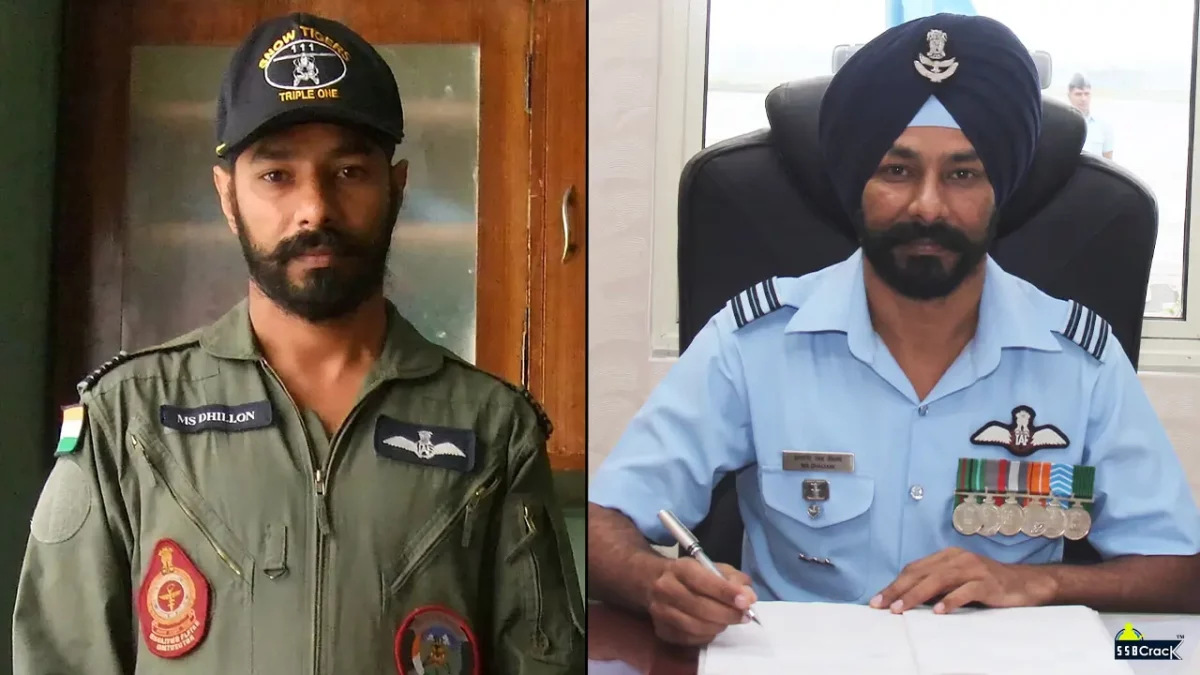
Wing Commander Mandeep Singh Dhillon (Service No. 25307 F(P)) was a distinguished helicopter pilot of the Indian Air Force who exemplified the highest standards of courage, professionalism, and humanitarian commitment. On 4 July 2017, while leading a high-risk rescue mission during devastating floods and landslides in Arunachal Pradesh, he laid down his life in the line of duty. His actions not only saved numerous civilian lives but also reinforced the enduring ethos of the Indian Air Force—service before self.


Born in Patiala, Punjab, Wing Commander Dhillon came from a proud military lineage. He was a second-generation air warrior, with his father, Squadron Leader Puran Singh Dhillon (Retd.), having served as a flight engineer on Mi-4 helicopters before later becoming a national athletics coach. Growing up in such an environment instilled in him discipline, resilience, and a deep-rooted sense of duty towards the nation.
He received his early education at the prestigious Rashtriya Indian Military College (RIMC), Dehradun, where he excelled both academically and in sports, notably earning recognition as a gold medallist in cross-country running. He later joined the National Defence Academy (NDA), Khadakwasla, as an Air Force cadet in Foxtrot Squadron. Following his rigorous training, he was commissioned into the Indian Air Force on 19 December 1998, opting for the helicopter stream in the flying branch.
Over the course of nearly two decades of service, Wing Commander Dhillon built an exceptional operational profile. He accumulated close to 4,000 flying hours, including over 1,200 captain hours on the Advanced Light Helicopter Dhruv. His professional qualifications included being a Qualified Flying Instructor, Aircrew Examiner, and Instrument Rating Instructor and Examiner. His operational experience spanned diverse and challenging terrains, ranging from high-altitude Himalayan sectors to dense jungles of the North-East.
He also contributed significantly to training and mentoring future officers. He served as a Divisional Officer at the National Defence Academy’s Foxtrot Squadron in two tenures, shaping the careers of young cadets. In 2016–17, he took over as the Commanding Officer of No. 115 Helicopter Unit, popularly known as the “Hovering Angels,” based at Air Force Station Tezpur in Assam. The unit specialises in counter-insurgency operations, internal security tasks, and humanitarian assistance and disaster relief missions.
Wing Commander Dhillon was widely respected among peers and seniors alike for his leadership and willingness to undertake demanding missions. He was known as a “go-getter” who volunteered for high-risk operations. In May 2016, he successfully evacuated 13 injured Indian Army personnel from the Tawang sector under extremely challenging weather and terrain conditions, showcasing his skill and composure under pressure.
In early July 2017, relentless monsoon rains caused widespread devastation across Arunachal Pradesh and parts of Assam, triggering landslides and isolating remote villages. No. 115 Helicopter Unit was tasked with conducting rescue and relief operations in these inaccessible regions. On 4 July 2017, Wing Commander Dhillon led a critical mission to evacuate stranded civilians from Sagalee village in Papum Pare district.
Accompanied by co-pilot Flight Lieutenant Pramod Kumar Singh and Flight Gunner Sergeant R.Y. Gujjar, he flew multiple sorties in an Advanced Light Helicopter under rapidly deteriorating weather conditions. The crew successfully completed five sorties, rescuing more than a hundred civilians and transporting them to safer locations near Naharlagun and Itanagar.
As conditions worsened, the crew made a crucial and responsible decision during their sixth sortie—not to carry any additional civilians onboard, ensuring that no lives would be endangered. The helicopter took off with only the three air warriors for the return journey. Shortly after departure, contact with air traffic control was lost. The wreckage was discovered the following day near Sopo Yuha village, approximately 30 kilometres from Itanagar. All three crew members had tragically lost their lives.
On that very morning, Wing Commander Dhillon had made a personal sacrifice even before stepping into the cockpit. Despite his daughter being unwell and his family requesting him to take her to the medical centre, he chose to prioritise the rescue mission, reflecting the profound sense of duty that defined his life.
He is survived by his wife, Prabhpreet Kaur Dhillon, daughter Sehaj, and son Eshar. His wife, recalling their years together, described him as a compassionate and selfless individual who always placed the needs of others before his own. Known affectionately as “Mandy” among friends and colleagues, he was also an avid long-distance runner and a skilled hockey player. Beyond his professional life, he actively participated in community service, including langar seva at gurdwaras.
The Indian Air Force accorded him full military honours at his funeral at Tezpur. His sacrifice continues to be remembered and honoured by the defence community, especially on occasions such as Balidan Diwas. The “Hovering Angels,” the unit he commanded, resumed operations shortly after the tragedy, continuing their mission of saving lives in some of the most challenging environments.
Wing Commander Mandeep Singh Dhillon’s life stands as a powerful testament to courage, leadership, and humanity. In choosing to save others at great personal risk, he embodied the very spirit of the Indian Air Force. His legacy endures as an inspiration to future generations of air warriors and a reminder of the silent sacrifices made by those who serve the nation.