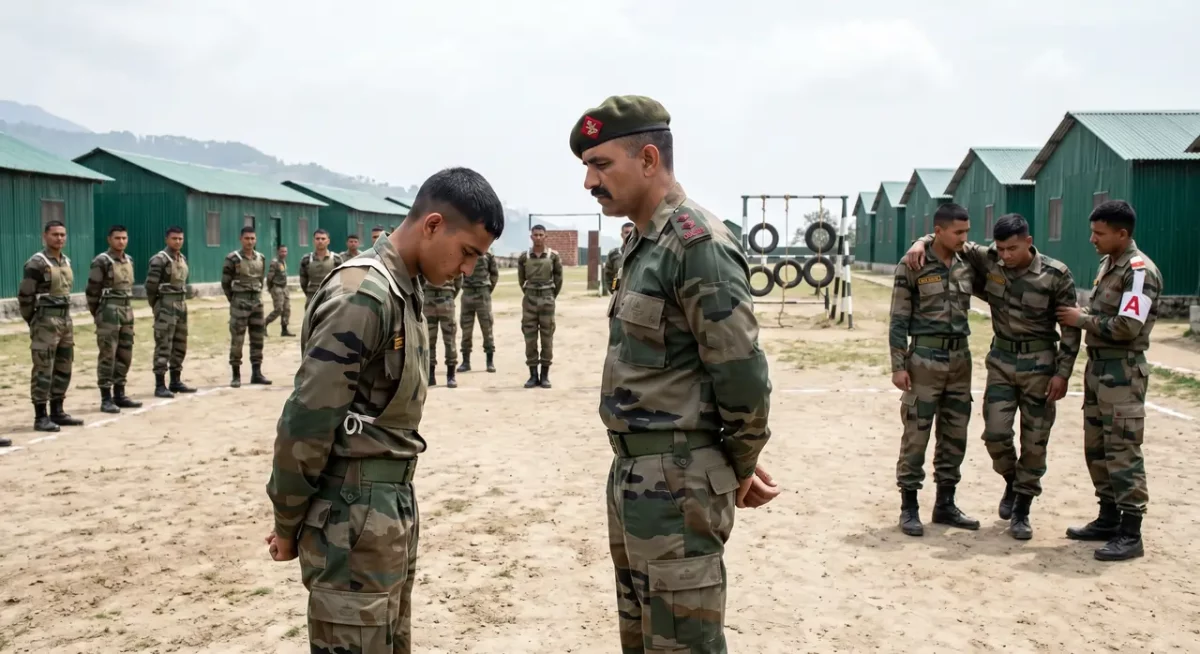
A physical altercation during basic military training proved costly for a former Indian Army recruit after the Madras High Court upheld his dismissal from service, observing that discipline in the armed forces has to be viewed with a different standard.





The case involved a recruit who had joined the Indian Army on December 19, 2016, and was undergoing basic military training. During this period, on April 12, 2017, he got into an altercation with a fellow recruit. The incident resulted in serious injury to the other trainee, who suffered a fracture of the right mandible, a grievous injury involving the jaw.
Following the complaint made to superior authorities, a Court of Inquiry was conducted on May 5, 2017. Two charges were framed against the recruit. The first charge was that he failed to appear at the appointed place of duty without sufficient cause. The second charge was that his conduct amounted to an act prejudicial to good order and military discipline.
When the charges were put to him, the recruit pleaded guilty. He did not place any mitigating circumstances before the authorities. Instead, he sought pardon and gave an undertaking that he would not repeat such conduct in the future.
However, the Summary Court Martial took the view that his behaviour was not in keeping with the standards expected in the Army. On January 10, 2018, he was dismissed from service.
The former recruit later challenged the dismissal. His appeal was rejected, and the Armed Forces Tribunal also refused to interfere with the punishment imposed on him. He then approached the Madras High Court seeking relief.
A division bench of Justices G R Swaminathan and R Poornima, while considering the matter, refused to interfere with the dismissal. The court noted that the petitioner was only undergoing training at the time and was more like a probationer. During such a period, the court said, he was expected to conduct himself with utmost care.
The bench observed that there may have been some provocation behind the altercation, but that could not justify inflicting grievous injury on another recruit. The injury suffered by the fellow trainee was not minor, and the court found that such conduct could not be ignored in a military environment.
The court also placed strong emphasis on the need to maintain discipline in the armed forces. It said that while courts can review punishment in cases where an accused pleads guilty and the sentence appears disproportionate, the considerations are different when the matter concerns military discipline.
According to the court, once the recruit pleaded guilty, the competent authority had the discretion to award an appropriate sentence. The Deputy Solicitor General of India, appearing for the authorities, argued that considering the nature of the act, the petitioner could even have been sentenced to imprisonment. Instead, the authorities chose to dismiss him from service.
The High Court accepted this reasoning and noted that the punishment could not be called excessive in the facts of the case. The bench said that the authorities had taken a lenient view by restricting the punishment to dismissal rather than imposing a harsher sentence.
The court further observed that the petitioner had not even been formally admitted into the armed forces in the full sense, as he was still under training. This made his conduct more serious because discipline, obedience and self-control are core requirements from the very beginning of military training.
In its order dated June 1, the Madras High Court concluded that there was no sufficient ground to interfere in favour of the petitioner. It upheld the dismissal and dismissed the plea.
The case highlights the strict standards of conduct expected from recruits during military training. Unlike ordinary employment, training in the armed forces is not only about physical fitness and professional learning. It is also a test of discipline, temperament, obedience and ability to function under pressure.
For aspirants and recruits, the judgment carries an important message. A single act of indiscipline, especially one involving violence and grievous injury, can have serious consequences. In this case, a fight during training ended the recruit’s military career before it could properly begin.