
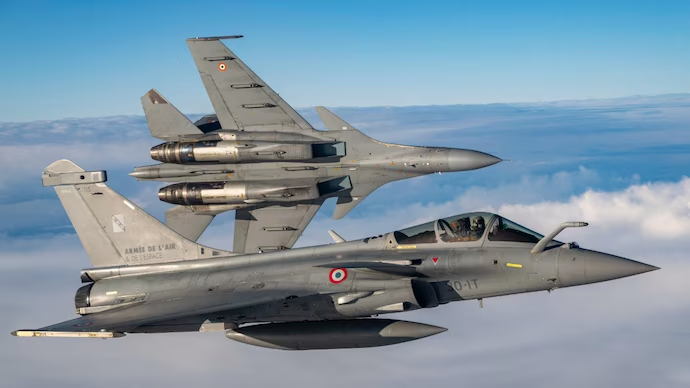
The Indian Air Force (IAF) has once again been ranked as the third most powerful air force in the world by the World Directory of Modern Military Aircraft (WDMMA) in its 2026 global airpower rankings, maintaining its position ahead of China’s People’s Liberation Army Air Force (PLAAF) for the fifth time since 2022.



The WDMMA evaluates military aviation capabilities using its proprietary True Value Rating (TVR) system, which assesses fleet size, aircraft composition, modernisation, logistical support, special mission capabilities and indigenous aerospace manufacturing. The ranking covers 129 air arms across 103 countries, tracking more than 48,000 military aircraft worldwide.
According to the report, the IAF operates a fleet of 1,716 aircraft, including 542 fighter aircraft, 498 helicopters, 282 transport aircraft, 374 trainer aircraft and 20 special mission platforms such as airborne early warning and aerial refuelling assets. The assessment also factors in India’s ongoing modernisation programmes and domestic aerospace capabilities.
Despite the high global ranking, the report highlights several capability gaps. The IAF currently operates 29 fighter squadrons against a sanctioned strength of 42 squadrons, creating a significant shortfall in combat aircraft. It also notes the need for additional airborne early warning and control (AEW&C) aircraft, mid-air refuellers, electronic warfare platforms and Intelligence, Surveillance, Target Acquisition and Reconnaissance (ISTAR) systems.
To address these gaps, the IAF is undertaking a major modernisation drive, including the induction of 180 Tejas Mk-1A fighters, plans to acquire 114 additional Rafale aircraft, and the procurement of new AEW&C, tanker and ISTAR platforms. At the same time, legacy fleets such as the Jaguar, Mirage 2000 and MiG-29 are scheduled for phased retirement over the coming decade.
The latest ranking underscores the Indian Air Force’s growing operational capabilities while highlighting the importance of sustained modernisation to meet future security challenges and maintain air superiority in an evolving strategic environment.