
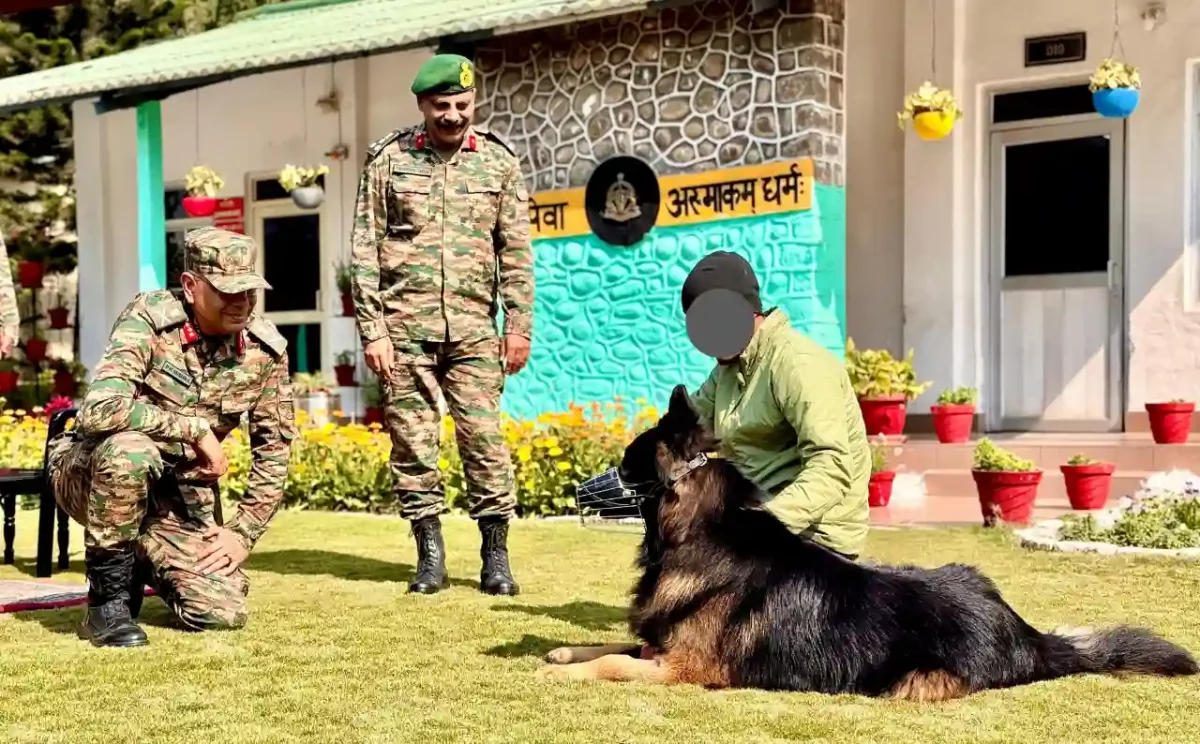
New Delhi / Jammu: In a rare recognition of four-legged valour on the frontlines, Indian Army assault dog Tyson, a German Shepherd attached to the elite 2 Para (Special Forces) and belonging to the Remount Veterinary Corps, has been awarded a Mention-in-Despatches (MiD) by President Droupadi Murmu. The honour, announced on the eve of India’s 80th Independence Day in August 2026, places Tyson as the only animal among 89 personnel recognised for bravery and meritorious service in combat zones.

The commendation specifically acknowledges Tyson’s actions during a high-risk counter-insurgency operation in Jammu and Kashmir under Operation Rakshak earlier this year. Unlike conventional gallantry medals, a Mention-in-Despatches does not carry a separate medal but confers an official certificate and the right to wear a distinctive emblem (often described as a lotus leaf insignia) on the ribbon of the recipient’s campaign medal. It formally records distinguished service or gallantry in operational circumstances that may not rise to the threshold of higher awards such as the Sena Medal or Shaurya Chakra.
The February 22, 2026 Encounter in Kishtwar
Tyson’s moment of exceptional courage unfolded on 22 February 2026 during Operation Trashi-I in the rugged Chatroo (also spelled Chhatroo) belt of Kishtwar district, specifically in the Passerkut area. The operation formed the culminating phase of a prolonged, multi-agency effort that had tracked a Jaish-e-Mohammed (JeM) module across difficult high-altitude terrain for months—reports indicate a sustained campaign lasting up to 326 days involving the Army’s White Knight Corps (Counter Insurgency Force Delta), Jammu and Kashmir Police, and the Central Reserve Police Force (CRPF).
Intelligence inputs had indicated the presence of terrorists in a concealed hideout—a mud house or traditional ‘dhok’ used by nomadic communities on steep, forested slopes. As troops of 2 Para SF advanced through challenging terrain, Tyson was sent ahead as the assault dog to scout and locate the threat. He crawled forward toward the suspected position. The terrorists opened fire, and Tyson took the first bullet, sustaining a gunshot wound to his leg (reported as the front leg or paw).
Undeterred by the injury, the German Shepherd pressed on. He continued advancing and launched a fierce assault that forced the terrorists to open fire more openly, thereby confirming their exact location and presence inside the hideout. This critical action allowed the joint force—White Knight Corps troops, J&K Police, and CRPF—to engage precisely. In the ensuing gunfight, three Pakistan-sponsored JeM terrorists were neutralised. One of them was identified as Saifullah Baloch (also referred to as Saifullah or Saifullah Balochi), a senior JeM commander who had allegedly infiltrated years earlier, operated across the Chenab Valley and adjoining areas, and was linked to multiple attacks on security forces, including a July 2024 incident that killed soldiers. He carried a reported bounty and had repeatedly evaded earlier operations. The structure caught fire during the intense exchange, and war-like stores including AK-47 rifles were recovered.
The White Knight Corps, in a contemporaneous statement on X, captured the essence of Tyson’s contribution: “Tyson displayed extraordinary courage by taking the first bullet while leading the entry into the terrorists’ hideout. Undeterred by his injuries, he pressed forward and launched a fierce assault, compelling the terrorists to open fire and thereby confirming their presence. His fearless action enabled troops of White Knight Corps, J&K police and CRPF to precisely engage and neutralise three Pakistan-sponsored terrorists.” The Corps later described him as “wounded yet in high spirits, alert and recovering well,” calling him “a true warrior and a soldier in every sense” who exemplified unwavering devotion to duty.
Recovery and the Quiet Heroism of Military Working Dogs
Immediately after the contact, Tyson was evacuated and airlifted to the Command Hospital in Udhampur for emergency treatment. He has since recovered fully and returned to high spirits. The survival and recovery of Tyson stand in contrast to several other Army K9s who have made the supreme sacrifice in similar operations and received posthumous Mentions-in-Despatches in previous years—among them Zoom (Belgian Malinois, 2023), Phantom (2025), Axel (Belgian Malinois), Kent (Labrador), and earlier Mansi.
Tyson belongs to the specialised cadre of Army assault and tracker dogs trained by the Remount Veterinary Corps. These dogs—primarily German Shepherds, Belgian Malinois, Labradors, and other selected breeds—are not companions but highly trained military assets. Their roles include locating hidden terrorists in dense forests or caves, detecting explosives and threats, leading entries into high-risk structures, and operating in terrain where human soldiers face elevated immediate danger. Their acute sense of smell, agility, endurance, and ability to form tight bonds with handlers make them invaluable in counter-terror and counter-insurgency environments, particularly in the mountainous and forested belts of Jammu and Kashmir. Assault dogs like Tyson are specifically conditioned for the most dangerous forward roles.
Significance of the Honour
President Murmu’s approval of the 89 Mentions-in-Despatches (including 75 for the Army across operations such as Rakshak, Snow Leopard, Meghdoot, and others) formally acknowledges the often-unseen frontline contribution of military working dogs. Tyson is the sole animal on this year’s list, underscoring both the rarity of such recognition for canines who return from the battlefield and the consistent operational value they provide. The broader Operation Trashi-I itself represented a model of prolonged, intelligence-driven, multi-agency coordination that ultimately dismantled a persistent JeM module after months of tracking through harsh weather and terrain, with zero human casualties reported among the security forces in the final phases—apart from Tyson’s injury.
For defence aspirants and observers of the Indian Army’s special forces and Remount Veterinary Corps, Tyson’s story illustrates the full spectrum of soldiers who serve—two-legged and four-legged. His actions on 22 February 2026 in the Chatroo heights of Kishtwar, followed by official presidential recognition six months later, stand as a concrete example of courage under fire, tactical utility, and the quiet professionalism that underpins successful counter-terror operations in one of India’s most challenging operational environments.
Tyson continues to exemplify the principle that devotion to duty knows no species. The Indian Army’s K9 warriors remain an integral, if sometimes under-celebrated, element of its operational edge.