
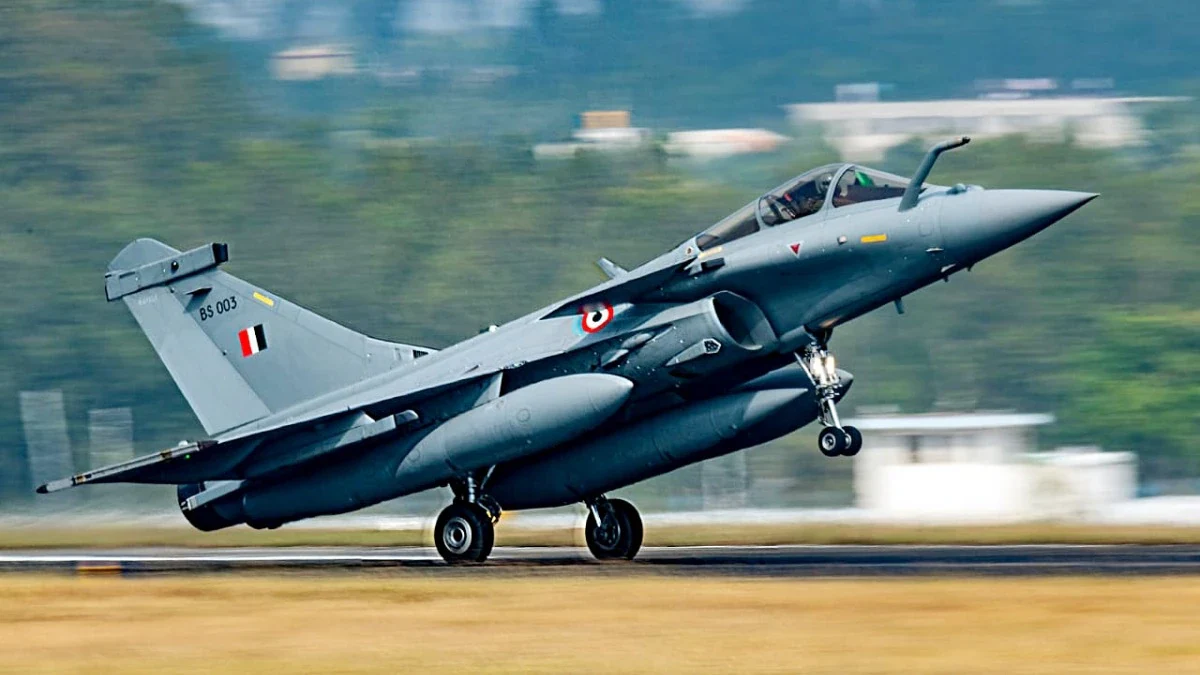
New Delhi, November 20, 2026: The latest edition of the World Air Forces directory published by British aviation outlet FlightGlobal has revised the number of active Rafale fighter aircraft in the Indian Air Force (IAF) inventory downward to 32. The assessment, compiled using data from Cirium’s military fleet database, represents a reduction from the 35 active aircraft listed in the directory’s 2026 edition (published in late 2025) and from the 36 aircraft originally procured by India.




The Ministry of Defence has disputed the figures. Sources in the Ministry stated that the information did not originate from the IAF or the Ministry and questioned the authenticity of the independent assessment. Senior officials emphasised that the directory does not specify which aircraft were excluded from the active inventory or the reasons for the revision.
India had contracted for 36 Rafale fighters from France comprising 28 single-seat EH variants and eight twin-seat DH variants. The previous FlightGlobal edition, released after Operation Sindoor in May 2025, had already reduced the active count from 36 to 35. The latest edition further lowers the figure to 32.
Officials have pointed to a tender issued by the IAF in June 2026 seeking “bridge support” for all 36 Rafale aircraft. This document, which outlined support requirements including planned flight hours, is being cited as evidence that the entire fleet continues to form part of the IAF’s operational and maintenance planning, even if individual airframes may be undergoing depot-level maintenance, structural repair, or upgrades at any given time.
Cirium tracks military aircraft at the individual airframe level using publicly available information, including aircraft sightings, flight-tracking data, open-source reporting, and defence-related publications. Aircraft can be moved out of the “active” category if they lack confirmed sightings or activity over a prolonged period (often assessed over approximately 12 months), without this necessarily indicating combat loss. The directory itself provides no detailed explanation for the three-aircraft reduction from its previous edition.
The revised figures have drawn attention in the context of Operation Sindoor, the May 2025 military engagement between India and Pakistan. India had acknowledged that “losses are a part of combat” but did not disclose specific numbers or types of aircraft lost. Pakistan has previously claimed shootdowns of Indian aircraft, including Rafales; these claims have not been independently verified in full.
In July 2025, then Defence Secretary RK Singh publicly stated that assertions of multiple Rafale losses were incorrect. Retired Air Marshal Narmdeshwar Tiwari, who served as Vice Chief of the Air Staff during Operation Sindoor, has described the FlightGlobal assessment as “patently false” and urged the publication to re-evaluate its sources.
The same directory has also reduced the reported number of Saab 2000 Erieye airborne early warning and control aircraft operated by the Pakistan Air Force from nine to seven. Some observers have noted other apparent inconsistencies in the publication’s inventory data for the IAF, such as its listing of Su-30MKI numbers.
FlightGlobal has clarified that its World Air Forces directory offers an independent assessment based on available data and does not constitute an official disclosure by the Indian government. Separately, India continues to pursue the acquisition of 114 additional Rafale fighters for the IAF, while the Indian Navy has already signed a contract for 26 Rafale-Marine aircraft for carrier-based operations.
The discrepancy between the independent directory’s active count and India’s official accounting of its 36-aircraft Rafale fleet remains unresolved in the absence of specific airframe-level explanations from either Cirium/FlightGlobal or an official IAF inventory disclosure.