
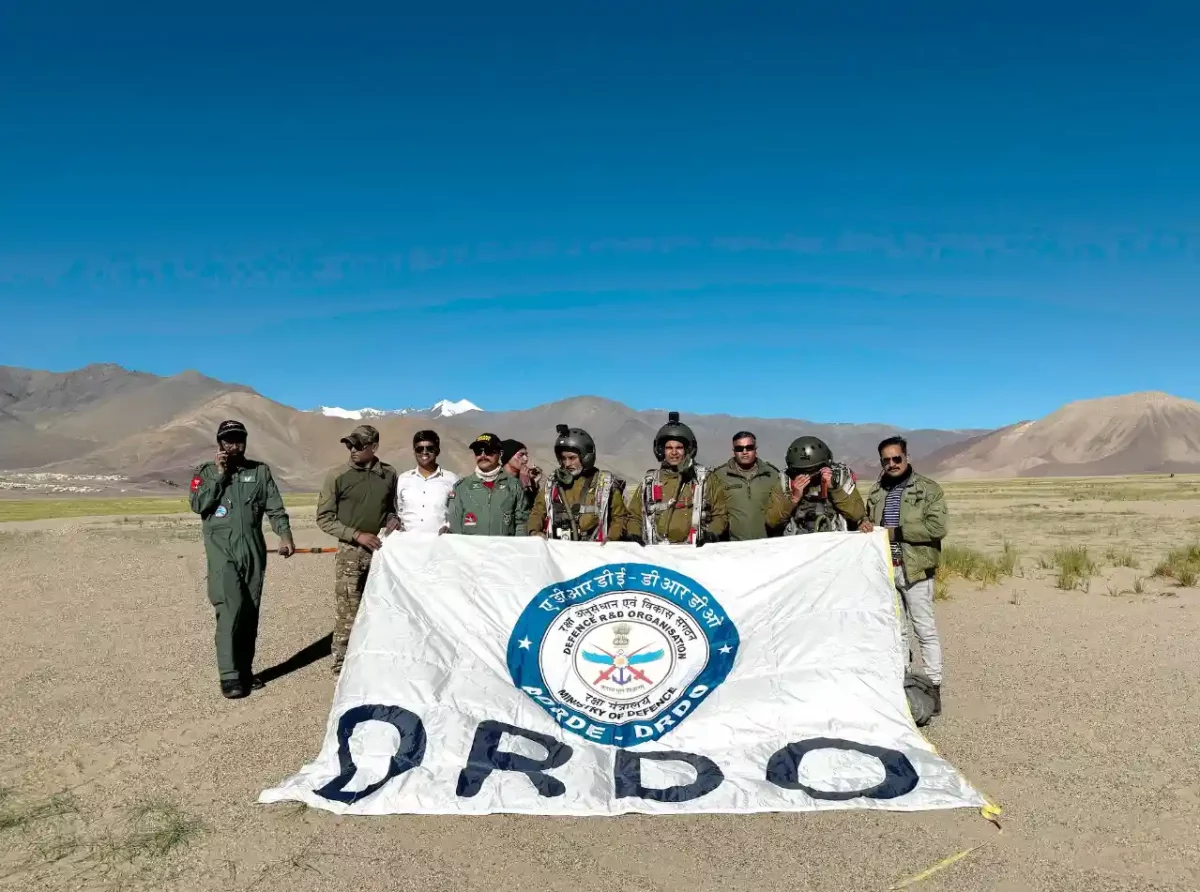
New Delhi / Leh, August 26, 2026 — The Defence Research and Development Organisation (DRDO) on Wednesday successfully tested its indigenous Military Combat Parachute System (MCPS) at one of the world’s highest drop zones, with test jumpers leaping from 22,000 feet above mean sea level in temperatures of minus 15°C.




The trial was conducted at the Nyoma-Mudh drop zone in Leh district of eastern Ladakh, close to the Line of Control. The parachute opened at 20,000 feet and the jumpers landed safely at 13,700 feet — the same elevation as the nearby Indian Air Force airbase at Nyoma, among the highest fighter bases in the world.
The jump and the team
Three ADRDE test jumpers carried out the mission: Wing Commander Rahul Jha, Chief Test Jumper; Master Warrant Officer R. J. Singh, VM(G); and Master Warrant Officer Vivek Tiwari. They used the full MCPS suite, including an indigenous para computer, oxygen system and specialised jumpsuits designed for extreme cold and thin air.
DRDO said the trial demonstrated the system’s “efficacy, reliability and tactical employability” in extreme high-altitude conditions and underlined India’s push for self-reliance in critical defence technologies.
What the MCPS is designed to do
The Military Combat Parachute System was developed by DRDO’s Aerial Delivery Research and Development Establishment (ADRDE) in Agra, with life-support and physiological systems from the Defence Bioengineering and Electromedical Laboratory (DEBEL) in Bengaluru.
Its main tactical features include:
- A lower rate of descent, which reduces landing shock on thin, high-altitude ground
- Improved steering so jumpers can fly to a designated zone rather than drift with the wind
- Compatibility with NavIC, India’s regional satellite navigation system, so the system is less vulnerable to foreign GPS jamming or denial
- Support for high-altitude high-opening (HAHO) and high-altitude low-opening (HALO) profiles used in special operations
- Indigenous oxygen, computing and clothing subsystems that keep the jumper functional in hypoxia and extreme cold
Together, these allow paratroopers to leave an aircraft at high altitude, open at a planned height, navigate independently and land on a small, predetermined patch of ground — a requirement for covert insertion over the Himalayas.
A follow-on to the 32,000-foot jump
This was not the first extreme-altitude validation of the MCPS. In October 2025, Indian Air Force test jumpers completed a combat freefall from 32,000 feet, with canopy deployment around 30,000 feet. That trial made the MCPS the only parachute system then in operational use with the Indian Armed Forces that could be deployed above 25,000 feet.
Wednesday’s trial added a different and operationally relevant layer: a jump into a real high-altitude drop zone in Ladakh, in sub-zero temperatures, with a landing at 13,700 feet. Thin air changes canopy behaviour, descent rate and the jumper’s physical limits. Validating the system in those conditions is closer to how it would be used on the northern borders than a high-altitude freefall over a conventional range.
Why Nyoma matters
Nyoma sits in south-eastern Ladakh, near the Line of Control. The IAF has upgraded the former advanced landing ground into a full airbase capable of fighter operations. The drop zone has already been used for para-dropping troops, vehicles and equipment. Testing the MCPS there links the parachute programme to the same high-altitude infrastructure India is building for rapid reinforcement along the China-facing frontier.
High-altitude airborne insertion is unusually demanding. Air density is lower, so canopies generate less lift. Temperatures can freeze equipment and reduce dexterity. Oxygen is scarce. Navigation errors are costly in mountainous terrain. A system that works at 32,000 feet in a test jump still has to prove it works when the landing zone itself is at 13,700 feet and the mercury is at −15°C. That is the gap this trial was meant to close.
Strategic context
For years, India has relied on a mix of imported and older indigenous parachute systems with more limited high-altitude envelopes. The MCPS is intended to give special forces and airborne units an indigenous option for HALO/HAHO missions without depending on foreign navigation or foreign canopy technology. NavIC integration is part of that logic: in a conflict, GPS can be jammed or restricted; a domestic constellation is harder for an adversary to deny.
The successful Ladakh trial does not by itself complete induction. Armed forces still need production scale, training pipelines, maintenance doctrine and more operational jumps with combat loads. What it does do is show that the hardware and the supporting life-support kit can function where Indian troops would actually have to jump — over the high desert and ridgelines of eastern Ladakh.
DRDO framed the result as another step under Aatmanirbhar Bharat in a niche but operationally sensitive area: getting soldiers onto the ground, intact and on target, from altitudes where most parachute systems are not certified to work.