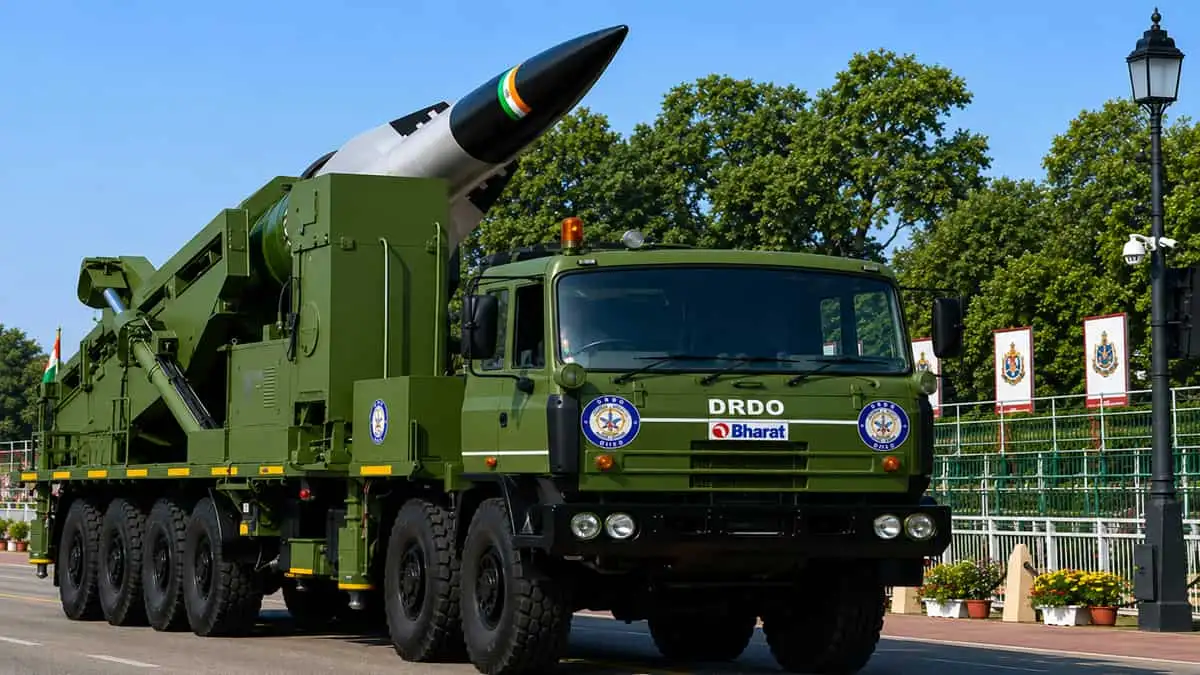
New Delhi, August 26, 2026 — India has opened the production of all conventional missile systems developed by the Defence Research and Development Organisation (DRDO) to the domestic defence industry, ending a decades-old arrangement in which series manufacture of most tactical missiles was concentrated in public-sector hands.





Defence Minister Rajnath Singh approved the Transfer of Technology (ToT) on Tuesday, August 25. The Ministry of Defence described the decision as a milestone in moving missile programmes from laboratory development to industrial-scale production inside the country.
The official release said the ToT will “promote greater participation of the domestic industries in the defence ecosystem by enabling them to undertake indigenous production, as per applicable qualifications, certifications and regulatory requirements.” The stated aims are higher operational stocks, lower import dependence, greater domestic value addition, and a wider role for Indian MSMEs and technology partners in the missile supply chain.
What the government has actually opened
The approval covers all conventional missile systems developed by DRDO. In official usage, that means non-strategic, non-nuclear guided weapons built for tactical battlefield use — air defence, anti-armour, anti-ship, air-to-air and conventional land-attack roles — rather than nuclear-capable strategic systems.
Reporting based on defence sources indicates the portfolio now open to industry includes:
- Air defence: Akash and Akash-NG surface-to-air missiles; the Very Short Range Air Defence System (VSHORADS), a man-portable system against low-flying aircraft, helicopters and drones
- Air-to-air: the Astra family of beyond-visual-range missiles, including Astra Mk-I and Mk-II
- Suppression of enemy air defences and strike: the Rudram anti-radiation series
- Anti-tank: Nag, SANT and the man-portable ATGM
- Naval strike: Naval Anti-Ship Missile–Short Range (NASM-SR)
- Land attack: indigenous long-range land-attack cruise missiles (LRLACM / LR-LACM) and the Pralay quasi-ballistic surface-to-surface missile
Some accounts also place a long-range anti-ship hypersonic missile in the conventional basket now being industrialised.
The Ministry of Defence itself did not publish an official list. That omission is important: eligibility for each system will still depend on security classification, certification and the specific ToT contract.
What remains closed. Strategic nuclear-capable systems such as the Agni series and the K-series submarine-launched ballistic missiles are outside the policy. Joint programmes governed by separate inter-governmental arrangements — notably BrahMos (with Russia) and MRSAM (with Israel) — are also not part of this blanket ToT.
From nomination to competition
For decades, DRDO typically designed a missile, proved it in trials, and handed production know-how to a nominated Defence Public Sector Undertaking — most often Bharat Dynamics Limited (BDL), with Bharat Electronics Limited (BEL) handling radars, fire-control and related electronics. Private firms supplied components, sub-systems and, later, some development support. They rarely received the right to integrate and series-produce a complete missile.
That “nomination” culture is what Tuesday’s decision is meant to break. Ministry sources told Business Standard that Indian firms will compete through bidding for the right to receive technology, to be selected as Development-cum-Production Partners (DcPPs), and to undertake systems integration with DRDO.
Private companies that already co-develop and test prototypes with DRDO scientists are expected to be well placed for series-production contracts once the Services place bulk orders — a clearer path from laboratory partner to factory floor than existed earlier.
The policy does not shut out DPSUs. BDL and BEL remain central. What changes is that they will no longer be the default, uncontested production agencies for every conventional missile that leaves a DRDO lab.
Industry is already inside the programmes
The August 25 announcement is a policy umbrella over work that had already begun.
In June, reporting established that 10 to 12 DRDO tactical missile projects had been distributed among public and private companies on capability, rather than routed almost entirely through BDL. Four private firms — Adani Defence, Bharat Forge, ICOMM and Solar Defence and Aerospace — were identified as DcPPs on programmes expected to mature over three to five years. In some projects, BDL is already partnering with private companies rather than working alone.
Private participation is already visible on NASM-SR (India’s first indigenous helicopter-launched anti-ship missile), the Rudram I/II/III family, VSHORADS, the Long-Range Glide Bomb and the UAV-launched precision guided missile ULPGM-V3. L&T has contributed to Pinaka and Akash work; Solar Industries has a deep footprint in Pinaka and energetics. Component specialists such as Astra Microwave and Apollo Micro Systems sit in fire-control, seekers and propulsion chains and stand to gain if volumes rise.
A day after the ToT approval, Hindustan Times reported that the government is identifying private producers for the 1,000–1,500 km Long Range Land Attack Cruise Missile and for Pralay (roughly 150–500 km). Requests for proposals for Astra Mk-I (about 110 km) and Mk-II (about 150 km) have already gone to Indian industry on a ToT basis.
Separately, on August 17 — a week before the minister’s approval — Research Centre Imarat in Hyderabad invited Indian companies to become long-term partners on missile and bomb projects of DRDO’s Missiles and Strategic Systems cluster. That Expression of Interest set a high bar: turnover above ₹100 crore, proven industrial capacity, a defence manufacturing licence and a PESO explosives licence. Selected firms are to be embedded in DRDO teams, with technology transferred free of cost after development, under existing DRDO rules. Tuesday’s cabinet-level ToT approval and that EoI are related but not identical: one opens the full conventional inventory; the other is a partner-selection process for new development-and-production work.
Names frequently mentioned as likely competitors for licences include Tata, Adani, Bharat Forge, Mahindra, ICOMM, L&T and Solar, alongside BDL and BEL. Qualification will matter more than brand. Officials have stressed that only firms with the capital, infrastructure, quality systems and regulatory clearances to build guided weapons will be licensed.
Why New Delhi is doing this now
Three pressures sit behind the decision.
First, inventory. Modern air defence, anti-ship and precision-strike campaigns consume missiles far faster than Cold War staff tables assumed. India cannot keep filling that demand from a thin public-sector production base and imported stocks.
Second, cost and export competitiveness. Limited cost competitiveness at public-sector plants has constrained missile exports. Where production know-how has already been shared — Pinaka rockets are the usual example — private bids have often undercut PSUs. Opening complete missile ToT is meant to repeat that effect at system level.
Third, the wider Aatmanirbhar manufacturing push. Indigenous defence production reached a record ₹1.78 lakh crore in FY 2025-26, up 15.6 per cent from ₹1.54 lakh crore the year before and more than double the ₹84,643 crore of FY 2020-21. The private sector’s share rose to 24 per cent, or about ₹42,000 crore. Defence exports hit a record ₹38,424 crore, with Indian equipment going to more than 80 countries. The government’s published targets are ₹3 lakh crore in annual production and ₹50,000 crore in exports by FY 2028-29. Missiles are among the highest-value items that can move those numbers if they can be built at scale and at a competitive price.
The ToT decision also sits on an earlier policy change. A revised DRDO technology-transfer policy waived the old 20 per cent fee for Development-cum-Production Partners, Development Partners and Production Agencies. Defence Minister Singh said earlier in 2026 that more than 2,200 DRDO technologies had already been transferred to industry under that framework. Patents have been opened to Indian industry, and DRDO test facilities are available to firms on payment. Tuesday’s missile decision applies that philosophy to the most politically and industrially sensitive conventional product line DRDO owns.
What “transfer” will actually require
A ToT letter is not a factory. Guided-weapon manufacture demands:
- licensed handling of explosives and propellants
- seeker, warhead and guidance integration under classified conditions
- environmental, electromagnetic and flight-trial qualification
- configuration control so that every production lot matches the user trial standard
- a vendor base for composites, inertial sensors, RF seekers, actuators and special materials
The ministry has been explicit that production will be allowed only subject to qualifications, certifications and regulatory requirements. That is both a quality filter and a security filter. Firms that only assemble kits, or that cannot hold a PESO licence and a defence manufacturing licence, will stay in the sub-system tier.
DRDO has said it will keep working with industry on absorption of the technology, not merely hand over drawings. In practice that means resident teams, joint design reviews, and DRDO remaining the design authority for the baseline configuration even when a private firm becomes the production agency. Variants tailored to Service requirements — a theme officials have already flagged — would still need DRDO or user clearance before they leave the factory.
MSMEs are expected to gain more as Tier-2 and Tier-3 suppliers of structures, harnesses, actuators, electronic modules and ground-support equipment than as prime integrators. That is how missile supply chains work worldwide; the policy’s MSME language is realistic only if primes are forced to multi-source rather than vertically integrate everything in-house.
Implications — and the limits of the announcement
For the armed forces. More qualified production lines should, over time, raise annual output of Akash-class SAMs, Astra-class AAMs, Pralay-class strike missiles and anti-tank weapons. That matters for war-reserve stocks and for replacing missiles expended in training. It does not automatically shorten development cycles. Seekers, propulsion and software still take years; the bottleneck being attacked is industrialisation after the design is frozen.
For BDL and BEL. They lose an uncontested franchise but keep deep process knowledge, existing infrastructure and a pipeline of current orders. They can bid as primes, partner with private firms, or concentrate on the most complex strategic and joint programmes that remain closed to open ToT. Market analysts covering the sector have named BEL, BDL, Solar Industries, L&T, Astra Microwave and Apollo Micro Systems among those positioned to benefit if order books widen.
For exports. India already sells air-defence and rocket-artillery systems. A competitive private production base is the missing piece if New Delhi wants to offer Astra-class, Akash-class or Pralay-class weapons in government-to-government packages without waiting on a single PSU line. Export of any missile will still require political clearance, end-use controls and, in some cases, technology-security assessments that are stricter than those for trucks or rifles.
For strategy. Opening conventional missiles is not the same as opening the strategic force. Several reports note that private industry already supplies dozens of missile sub-systems even on programmes it does not integrate. Some officials describe conventional ToT as a first step that builds the industrial muscle that strategic production may one day draw on. That is a political inference, not a stated government decision. Agni and K-series production remains a state preserve.
Risks. Competitive bidding can fragment learning if too many firms are licensed for the same missile and none reaches economic scale. Quality failures on a seeker or warhead lot would damage both the user and the Atmanirbhar narrative. Over-classification could also blunt the policy: if “conventional” systems with sensitive seekers or software stay locked behind special clearances, industry will receive airframes and motors but not the parts that determine performance. Execution will show which of those risks materialises.
The larger industrial argument
India now claims 50 to 60 classes and platforms of indigenously developed missiles, many of them described by officials as contemporary by global standards. The gap has not been invention so much as repetition: building the same missile, to the same drawing, a thousand times, cheaply enough that the Services can afford the stockpile and foreign buyers can afford the brochure price.
Tuesday’s approval is an attempt to treat conventional missiles the way India has already begun to treat artillery rockets, small arms and some electronics — as products that can be competed, licensed and exported, not as artefacts that only a nominated arsenal may touch.
Whether that shift is real will be visible in the next two or three years in a short list of facts: how many ToT contracts are actually signed, whether Astra and Pralay RFPs produce more than one qualified production source, whether MSME content in a finished missile rises, and whether export offers for DRDO-origin conventional missiles start quoting private-sector delivery schedules instead of PSU wait-lists.
Until those contracts are inked, the policy is a door that has been unlocked. The factories still have to be built behind it.