
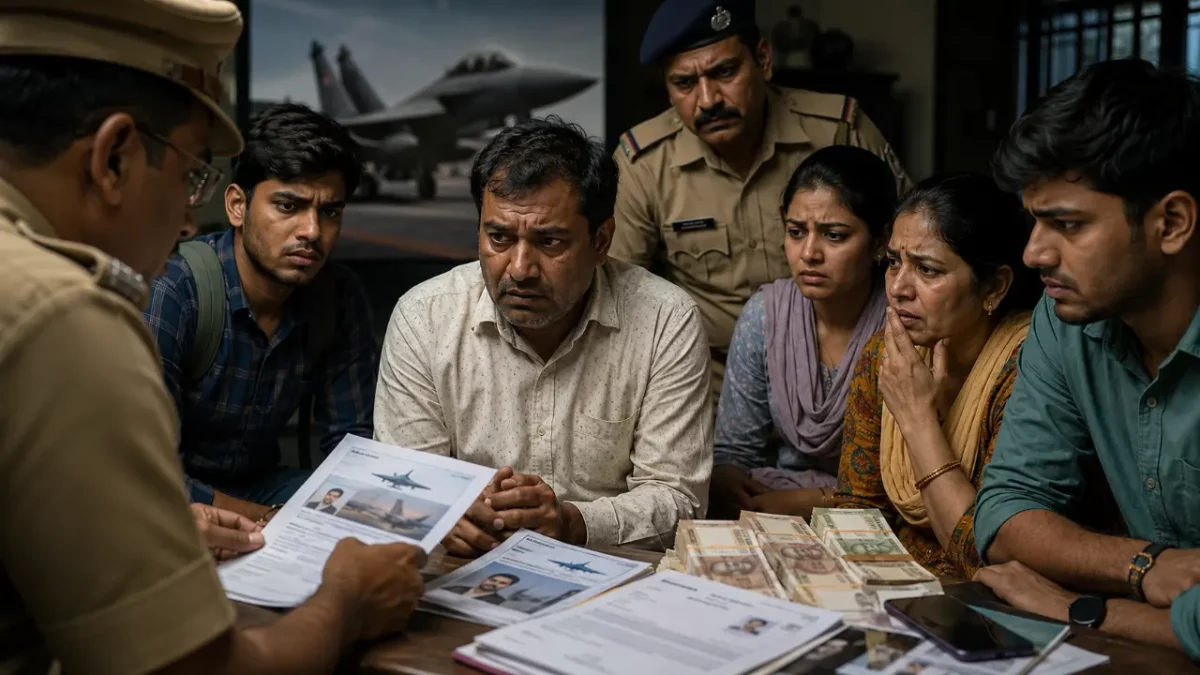
Gandhigram-2 (University) police in Rajkot have registered a case against a man for allegedly cheating his childhood friend and four others of ₹16 lakh by promising them jobs in the Indian Air Force. The accused allegedly posed as an Air Force official and collected the money over roughly two months after reconnecting with the primary complainant after two decades.


According to the FIR, the complainant, Arjunsingh Jadeja (40), a resident of Kalawad Road who runs a business named Shiv Travels, received a call on June 8 from his childhood friend Pragnesh Gadhvi. The two had not been in contact for at least 20 years. Gadhvi allegedly claimed he was working as a principal in the Air Force at Gandhinagar and offered to arrange a driver’s job for Jadeja in exchange for money.
Jadeja agreed and collected funds from relatives and acquaintances who also sought jobs. Over the following two months, a total of ₹16 lakh was paid to the accused ₹12.30 lakh through online transactions and ₹3.70 lakh in cash. This sum included contributions from four of Jadeja’s acquaintances, bringing the number of alleged victims to five.
To sustain the deception, Gadhvi reportedly sent a fake electronic call letter to Jadeja via WhatsApp. When no jobs materialised and Jadeja demanded the money back, the accused began offering excuses. Jadeja later learned that Gadhvi had been detained by police in Ahmedabad in connection with another financial dispute. Realising that Gadhvi had no genuine connection to the Indian Air Force and that the call letter was forged, Jadeja approached the police.
Police have booked Pragnesh Gadhvi for cheating, cheating by personation, forgery, and personating a public servant. Further investigation is underway to trace the full trail of transactions and establish whether additional victims exist.
How the Alleged Scam Unfolded
The case illustrates a classic confidence-based fraud that exploits personal trust and the high desirability of defence force employment. After a long gap in contact, the accused leveraged the childhood friendship to establish credibility. By claiming a senior position (“principal” in the Air Force at Gandhinagar) and offering a concrete post (driver), he created an appearance of insider access. The subsequent sharing of a forged electronic call letter via WhatsApp was designed to reinforce the illusion of an official process.
Jadeja’s decision to pool money from relatives and acquaintances expanded the scale of the alleged fraud. Such collective payments are common in recruitment-related scams, as aspirants or their families often believe that “influence” or “contacts” can secure government or defence jobs outside the transparent recruitment system.
Broader Context of Defence Job Frauds
Fake job offers linked to the Indian Armed Forces remain a recurring problem across India. Unemployed youth and their families, drawn by the prestige, job security, and benefits associated with the Army, Navy, and Air Force, frequently fall victim to middlemen who claim special access to recruitment boards, SSB interviews, or direct appointments. Scammers commonly use forged call letters, admit cards, appointment orders, uniforms, or letterheads, and demand money under heads such as “processing fees,” “security deposits,” “training costs,” or “influence payments.”
Official recruitment into the Indian Air Force occurs strictly through notified channels: the IAF’s official website (indianairforce.nic.in or careerindianairforce.cdac.in), UPSC examinations (NDA, CDS, AFCAT), Agniveer Vayu intakes, and subsequent SSB interviews or other authorised selection processes. There is no provision for paid “arrangement” of jobs by private individuals, principals, or intermediaries. Any claim of securing an Air Force post through payment is a red flag.
Similar cases have surfaced in multiple states in recent years, involving impersonation of officers, forged documents, and large-scale collections from aspirants. Police and defence authorities periodically issue advisories warning the public against such rackets.
Advice for Aspirants and Families
Defence aspirants preparing for NDA, CDS, AFCAT, Agniveer, or other entries should remember:
- All genuine recruitment notifications, admit cards, and results are published only on official websites or through authorised portals.
- No one can guarantee selection or bypass the selection process for money.
- Never share original documents, pay cash or online transfers to unverified individuals promising jobs, or act on WhatsApp messages claiming official status without independent verification.
- If approached with such offers, report the matter immediately to local police or the cyber crime helpline (1930) and preserve all communication records, transaction details, and screenshots.
The Rajkot case underscores how even long-standing personal relationships can be exploited when combined with the allure of a defence career. As investigations continue, authorities are expected to examine the full financial trail and any wider network linked to the accused. Victims of similar frauds are encouraged to come forward so that a clearer picture of the scale can emerge.