

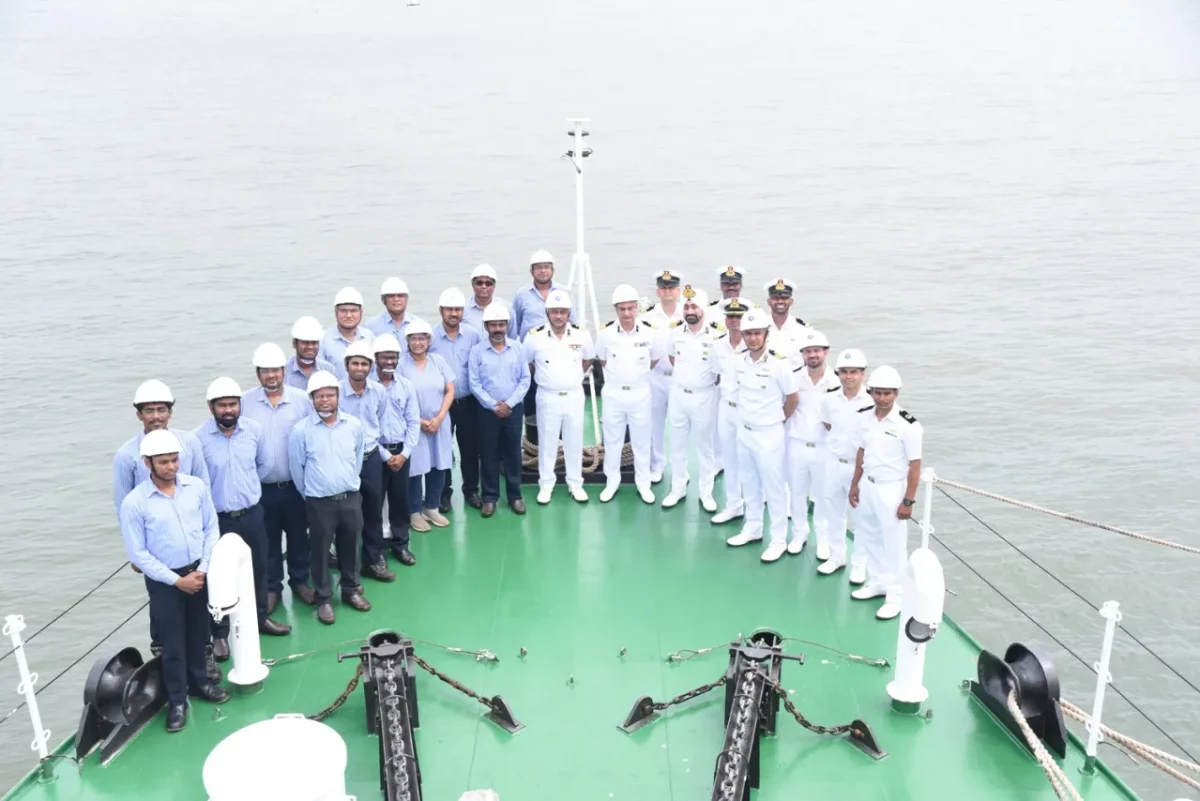
Goa Shipyard Limited (GSL), a Defence Public Sector Undertaking under the Ministry of Defence, formally handed over the indigenously designed and built Fast Patrol Vessel (FPV) ICGS Ajit (Yard 1277) to the Indian Coast Guard on 25 August 2026. The delivery marks another significant milestone in India’s push for self-reliance in defence shipbuilding under the Atmanirbhar Bharat and Make in India initiatives.





The vessel, equipped with advanced Controllable Pitch Propeller (CPP) propulsion and more than 65% indigenous content, will bolster the Coast Guard’s capabilities for Exclusive Economic Zone (EEZ) surveillance, coastal security, anti-smuggling, anti-piracy, and search-and-rescue operations.
Handover Ceremony
The formal handing-over ceremony at GSL’s facility in Vasco da Gama was preceded by the First Reading Ceremony. It was attended by senior officials from GSL and the Indian Coast Guard, including:
- Brajesh Kumar Upadhyay, Chairman and Managing Director, GSL
- Rear Admiral Nelson D’Souza, NM, IN (Retd), Director (Operations), GSL
- Jahangeer Alam Ansari, Director (Finance), GSL
- Nagesh Das Pai, Director (CPP&BD), GSL
- DIG V. K. Parmar, TM, Principal Director (Material), Indian Coast Guard
- Commandant (Junior Grade) Manish Talan, Commanding Officer of ICGS Ajit
- Other senior officers from both organisations.
GSL officially announced the delivery on its social media platforms, highlighting the vessel’s role in strengthening maritime security and the shipyard’s commitment to indigenous design and construction.
Key Specifications of ICGS Ajit
ICGS Ajit is part of the Adamya-class series of eight Fast Patrol Vessels designed and built entirely in-house by GSL. Key technical details include:
- Length: 51.43 metres
- Beam (Width): 8 metres
- Displacement: Approximately 320–330 tonnes (at a draught of about 2.5 metres)
- Propulsion: Twin marine diesel engines (each around 3,000 kW) driving Controllable Pitch Propellers (CPP) — a first-of-its-kind feature for this class of FPVs in the Indian Coast Guard. The CPP system enhances manoeuvrability, propulsion efficiency, and operational flexibility by allowing speed and direction changes without altering engine RPM.
- Maximum Speed: Over 27 knots (some references note up to 28 knots)
- Endurance/Range: 1,500 nautical miles at cruising speed
- Crew: 6 officers and 35 sailors (complement figures vary slightly across sources between 5 officers + 34 personnel and 6 + 35)
- Indigenous Content: More than 65%
- Advanced Systems: Integrated machinery control systems, Integrated Bridge System, and other modern automation for improved operational readiness and efficiency.
Armament typical of the class includes a 30 mm CRN-91 naval gun and two 12.7 mm stabilised remote-controlled machine guns.
These vessels are designed for multi-mission roles in shallow waters and coastal areas, with dual classification standards supporting robust performance.
Operational Roles and Strategic Importance
ICGS Ajit is purpose-built for a wide range of Coast Guard missions critical to India’s maritime domain awareness and security:
- Surveillance and patrol of the Exclusive Economic Zone (EEZ)
- Coastal and island territory security
- Fisheries protection and monitoring
- Anti-smuggling and anti-trafficking operations
- Anti-piracy missions
- Search and Rescue (SAR) operations
- Support roles such as communication links or convoy escorting during contingencies
With India’s extensive coastline and growing maritime traffic, the induction of agile, high-endurance FPVs like Ajit enhances the Coast Guard’s ability to respond rapidly to threats, protect offshore assets, and maintain a secure and clean maritime environment.
Background: The Adamya-Class Programme
The contract for eight Adamya-class FPVs was signed in March 2022 between the Ministry of Defence and GSL under the Buy (Indian-IDDM) category at a total cost of approximately ₹473 crore. The vessels were to be designed, developed, and manufactured indigenously, with deliveries targeted within a defined timeframe.
ICGS Ajit (Yard 1277) and its sister vessel ICGS Aparajit (Yard 1278) were the last two ships in the series. They were launched together on 24 October 2025 at GSL by Smt. Manju Sharma in the presence of Dr. Mayank Sharma, Financial Advisor (Defence Services), and senior officers from the Indian Coast Guard, Indian Navy, and Ministry of Defence.
Earlier ships in the class — including Adamya, Akshar, Amulya, Akshay, Achal, and others — have progressively entered service, demonstrating GSL’s accelerated production rate and growing expertise. The class represents a step up from previous FPV designs through the introduction of CPP propulsion and higher indigenous content.
Significance for Atmanirbhar Bharat and Maritime Security
The successful delivery of ICGS Ajit underscores the maturing capabilities of Indian shipyards in designing and delivering complex, modern defence platforms. GSL, a Mini-Ratna PSU with a long track record of building vessels for the Indian Navy and Coast Guard, continues to contribute to employment generation, skill development, and the MSME ecosystem through high local content.
For the Indian Coast Guard, which is steadily expanding and modernising its fleet to meet rising operational demands across the Indian Ocean Region, each new indigenous FPV adds tangible capability. The vessel’s induction supports the broader national goal of reducing dependence on foreign technology while strengthening the security of India’s maritime frontiers, EEZ resources, and coastal communities.
ICGS Ajit is expected to undergo final formalities before full operational deployment under the Coast Guard’s command structure. Its entry into service reinforces India’s progress toward a more self-reliant and capable maritime security architecture.