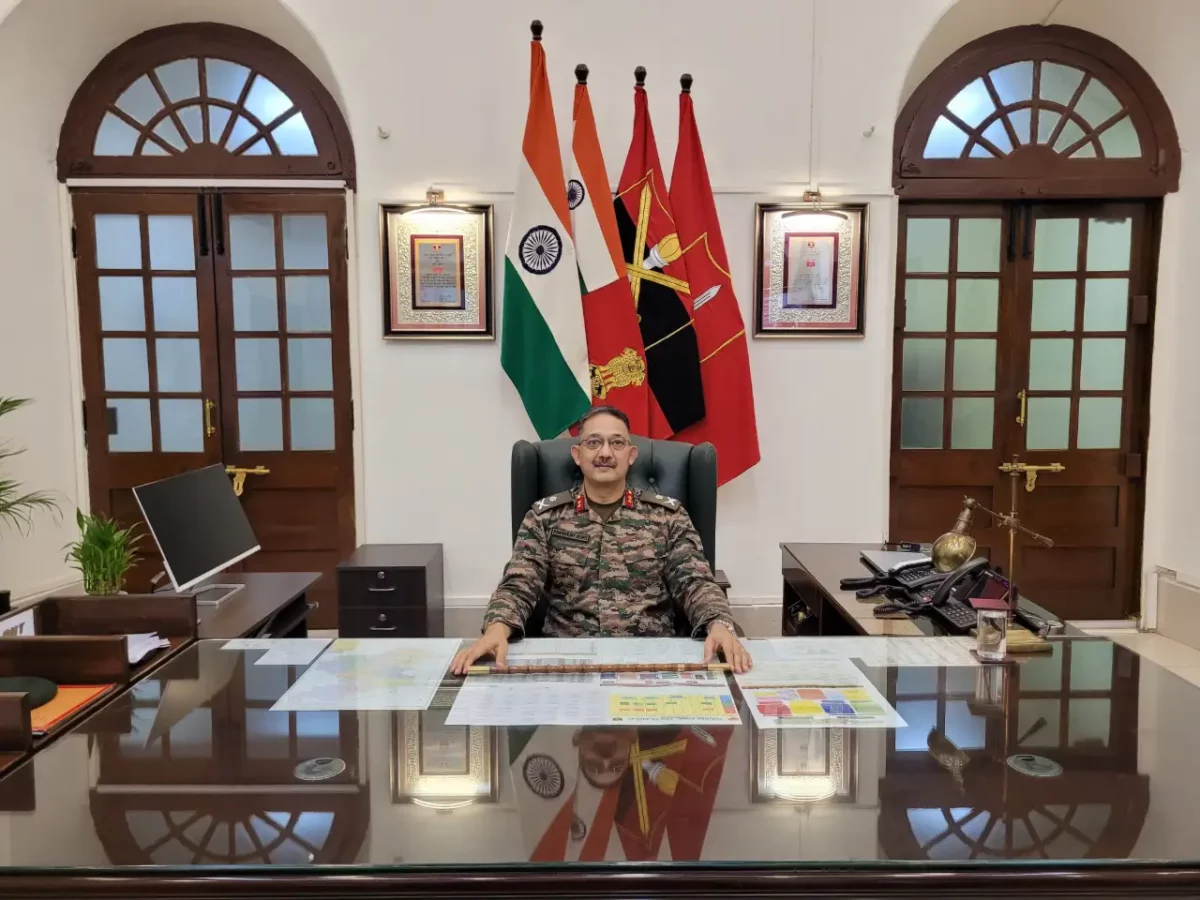
Major General Dhananjay Joshi, AVSM, VSM, has assumed charge as the Commander of the Junior Leaders Wing (JLW), Belagavi, one of the Indian Army’s premier leadership training institutions. The appointment marks a significant transition for the Army Training Command (ARTRAC), with Lt Gen Devendra Sharma, PVSM, AVSM, SM, General Officer Commanding-in-Chief, ARTRAC, extending his congratulations and best wishes to the senior officer on taking over the prestigious assignment.





Maj Gen Joshi succeeds Major General Rakesh Manocha, SM, VSM, who superannuated on 31 July 2026 after rendering more than 36 years of distinguished service to the nation. During his tenure, Maj Gen Manocha played a key role in strengthening leadership training and professional military education for Junior Commissioned Officers (JCOs) and Non-Commissioned Officers (NCOs), who form the backbone of the Indian Army’s operational effectiveness.
The appointment comes after Maj Gen Joshi earned national recognition for his operational leadership as the General Officer Commanding (GOC) of the Victor Force in Kashmir. During his tenure, he oversaw several successful counter-terrorism operations and played a pivotal role in enhancing the security forces’ operational strategy following the devastating terrorist attack at Baisaran in Pahalgam on 22 April 2025, which claimed the lives of 26 people, including 25 tourists.
Following the Pahalgam attack, the Indian Army, Jammu and Kashmir Police and Central Reserve Police Force (CRPF) revised their operational approach by concentrating resources and intelligence efforts in South Kashmir. Speaking during a joint press conference in May 2025 alongside Kashmir Inspector General of Police V.K. Birdi and CRPF Inspector General Mitesh Kumar, Maj Gen Joshi explained that the security forces had identified specific focus areas based on intelligence inputs indicating that terrorist groups had moved into higher forested regions following the melting of snow.
The revised strategy led to two successful counter-terrorism operations conducted in Shopian and Pulwama districts during May 2025. The first operation in the Kellar area of Shopian resulted in the elimination of three Lashkar-e-Taiba terrorists, while the second operation in Tral, Pulwama, neutralised three Jaish-e-Mohammed terrorists. Together, the operations eliminated six terrorists and demonstrated the effectiveness of coordinated intelligence-driven operations involving the Army, Jammu and Kashmir Police and CRPF.
Addressing the media after the operations, Maj Gen Joshi highlighted the importance of adapting military strategy to changing operational conditions. He noted that domination patrols had been deployed in high-altitude forested areas after intelligence indicated increased terrorist movement following the end of winter. The operations, conducted in both mountainous terrain and populated villages, reflected the flexibility and coordination of the security forces in responding to evolving threats.
His operational leadership during this period also coincided with the broader national security environment shaped by Operation Sindoor, under which the Indian Armed Forces intensified counter-terrorism measures and enhanced preparedness along multiple fronts. The successful operations in South Kashmir were widely regarded as an important component of the security forces’ comprehensive response to heightened terrorist activity.
As Commander of the Junior Leaders Wing, Belagavi, Maj Gen Joshi now assumes responsibility for shaping the next generation of junior military leaders. The institution plays a critical role in training Junior Commissioned Officers and Non-Commissioned Officers in leadership, tactical planning, decision-making, instructional techniques and operational management. The training imparted at JLW equips junior leaders with the professional skills required to lead troops effectively across conventional, counter-insurgency and high-altitude operations.
The Junior Leaders Wing functions under the Army Training Command and is widely recognised for producing highly competent battlefield leaders capable of operating in increasingly complex and technology-driven combat environments. The institution continuously updates its training curriculum to incorporate lessons from recent military operations, emerging technologies and modern warfighting concepts.
Maj Gen Joshi’s extensive operational experience, particularly in leading counter-terrorism operations in Jammu and Kashmir, is expected to bring valuable battlefield insights to the institution’s training programmes. His firsthand experience in intelligence-based operations, joint force coordination and operational leadership will help prepare future junior leaders to meet the challenges of modern warfare.
The change of command at the Junior Leaders Wing also marks the conclusion of Major General Rakesh Manocha’s distinguished military career. Having served the Indian Army for more than three and a half decades, he leaves behind a legacy of professional excellence, institutional development and dedicated service to military education.
With Major General Dhananjay Joshi assuming command, the Junior Leaders Wing enters a new phase under a highly experienced operational commander whose leadership in counter-terrorism operations and commitment to professional excellence are expected to further strengthen the Indian Army’s efforts to develop capable, adaptive and future-ready military leaders.