
Anupgarh (Sri Ganganagar), August 2026 — A 65-year-old retired Indian Army personnel died by suicide at his residence in Ward No. 7 of Anupgarh in Rajasthan’s Sri Ganganagar district on Saturday, 1 August 2026, leaving behind an eight-page suicide note that has drawn significant attention. In the note, Amar Singh alleged prolonged mental harassment by three individuals and claimed that one of them was a Pakistani spy who repeatedly sought sensitive information related to the Indian Army and military activities.



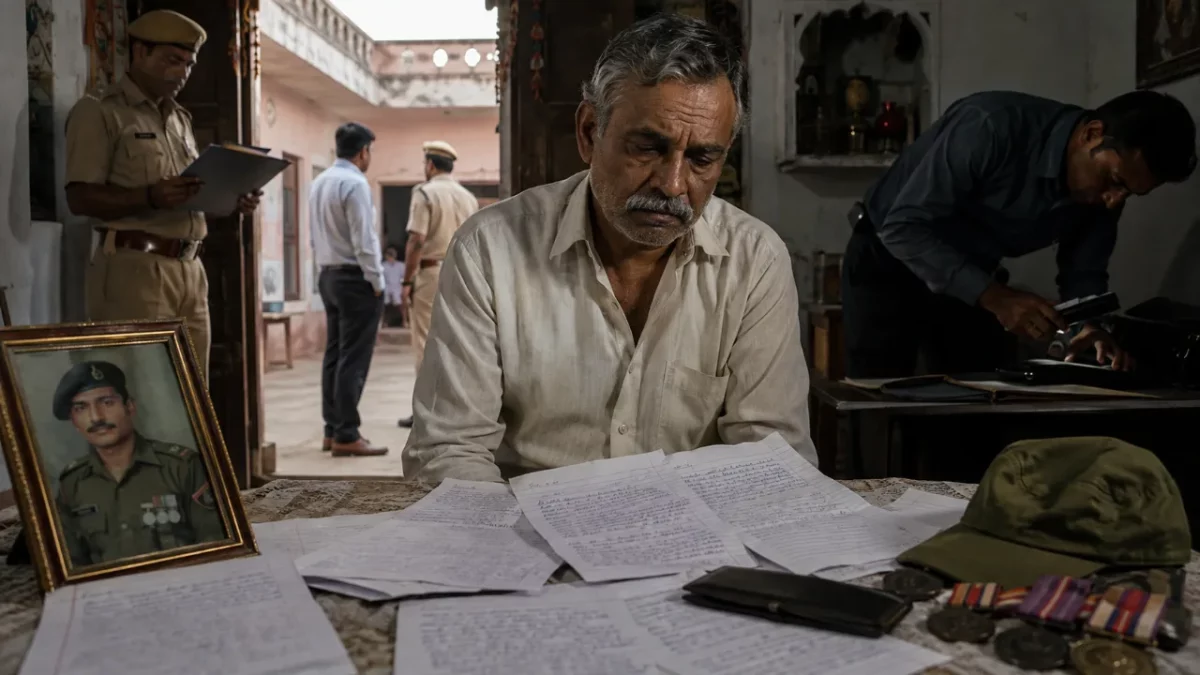
Police recovered the body after neighbours spotted him hanging in the verandah of his house. Station House Officer (SHO) Kartar Singh of Anupgarh police station confirmed that officers completed the required legal formalities at the scene and sent the body for post-mortem examination. The body was handed over to the family on Sunday, 2 August, after the post-mortem.
The Incident and Discovery
Amar Singh was alone at home at the time of the incident. His wife, Kalawati Devi, was in Bikaner with their elder son. Neighbours living in the house opposite noticed him hanging from a noose attached to a fan in the verandah when they went to their roof. They informed the police, and a crowd gathered at the spot.
Before taking the extreme step, Amar Singh had placed a flower garland on his own photograph. In the suicide note, he specifically mentioned that he would hang himself on Saturday afternoon at around 2:10 pm.
Contents of the Eight-Page Suicide Note
The detailed note, found near his photograph, contained separate sections addressed to his family and to the police. It outlined a sequence of events that, according to Amar Singh, left him under severe mental pressure and fearful of abduction.
Key points from the note, as reported across multiple accounts, include:
- He alleged that three people had been mentally harassing him for a prolonged period.
- One individual repeatedly demanded information related to the Indian Army, including codes, postings, and other military details.
- He described this person as a Pakistani spy and wrote that he could never betray the country. He stated he would rather sacrifice his life than reveal any confidential military information.
- He expressed fear that the individuals might abduct him at night to extract Army-related information.
- On the final page, he urged the police to take strict legal action against those he held responsible for driving him to suicide.
The note also provided a timeline of recent events as he experienced them:
- Approximately two years earlier, he had come into contact with a woman named Savitri Devi through work associated with an NGO linked to the “Beti Bachao, Beti Padhao” campaign. He had assisted with related activities, including donations for daughters’ weddings.
- On 16 July, Savitri Devi contacted him seeking help to bring a girl (and in some accounts a teenager) to Anupgarh, claiming assistance was needed for ITI admission or related matters. Amar Singh helped them, provided food, and later dropped them near a lawyer’s chamber. He later learned the girl had left home without informing her family and was seeking security; police and family were subsequently involved.
- In the following days (around 23–27 July), while his wife was away for medical treatment in Bikaner, he began receiving calls from unknown numbers. Callers initially posed as relatives of the girl. Later, one man claimed to be speaking from the Indian Army, demanded Army code numbers, details of items and postings, and offered liquor while pressing for military information.
- On 28 July, three men came near his house and inquired about him in the neighbourhood.
- On 29 July, his mobile phone was stolen. He had filed an online complaint, and the receipt was kept in his mobile cover.
In emotional messages to his family, Amar Singh apologised to his wife Kalawati Devi, writing that he could not stand by her in her old age. He requested that both sons take lifelong care of their mother, ensure she received her medicines on time, and take her for evening walks, as she remained unwell. He asked that no unnecessary expenses be incurred after his death and directed that his Pulsar motorcycle be given to his younger son, Ramkumar.
He wrote of his patriotism in clear terms, stating variations of: “I can die for my country, but I will not give army information. My Army is the pride, honour and glory of India.” He insisted he would not utter a single word about the Indian Army to anyone.
Background of the Deceased
Amar Singh had served in the Indian Army as an MT (Mechanical Transport) Driver and retired in 2009. After retirement, he worked as a security guard with SBI Life. He lived in Ward No. 7 of Anupgarh. His elder son, Rajkumar, is associated with the Army and was in Bikaner; the younger son, Ramkumar, works as a driver in a nearby village (referred to as 65 GB or similar).
Family and Associate Statements
Former councillor Paramjeet Kaur (Ward No. 8), whom Amar Singh referred to as his sister in the suicide note, told media that he had contacted her three days before his death. He complained of persistent harassment and threatening phone calls. She stated that he appeared to be under severe mental stress. According to accounts in the note and her statements, when one of the callers spoke to her, the conversation turned abusive, and she scolded the person.
Police Investigation
Anupgarh police have described the matter as sensitive and stated that a thorough investigation is underway from all angles. SHO Kartar Singh has emphasised that the allegations contained in the suicide note — including the claim involving a Pakistani spy — will be verified during the probe. Officials have indicated it would be inappropriate to comment further or draw conclusions until the investigation is complete. Police have not publicly confirmed the identities of the three individuals named in the note or the veracity of the espionage-related claims.
Broader Context
Anupgarh falls in Sri Ganganagar district, a border region of Rajasthan adjacent to Pakistan. Cases involving retired military personnel and alleged attempts to extract sensitive information naturally attract heightened scrutiny due to national security sensitivities. At the same time, investigators treat suicide notes containing such serious accusations with caution until independent evidence corroborates or refutes the claims.
As of the latest available reports (early August 2026), the probe remains ongoing. No arrests or formal charges related to the specific allegations of harassment or espionage have been publicly confirmed.
The case has drawn local attention and coverage across multiple news outlets, with focus remaining on the contents of the detailed note left by the retired soldier and the official investigation into the circumstances surrounding his death.