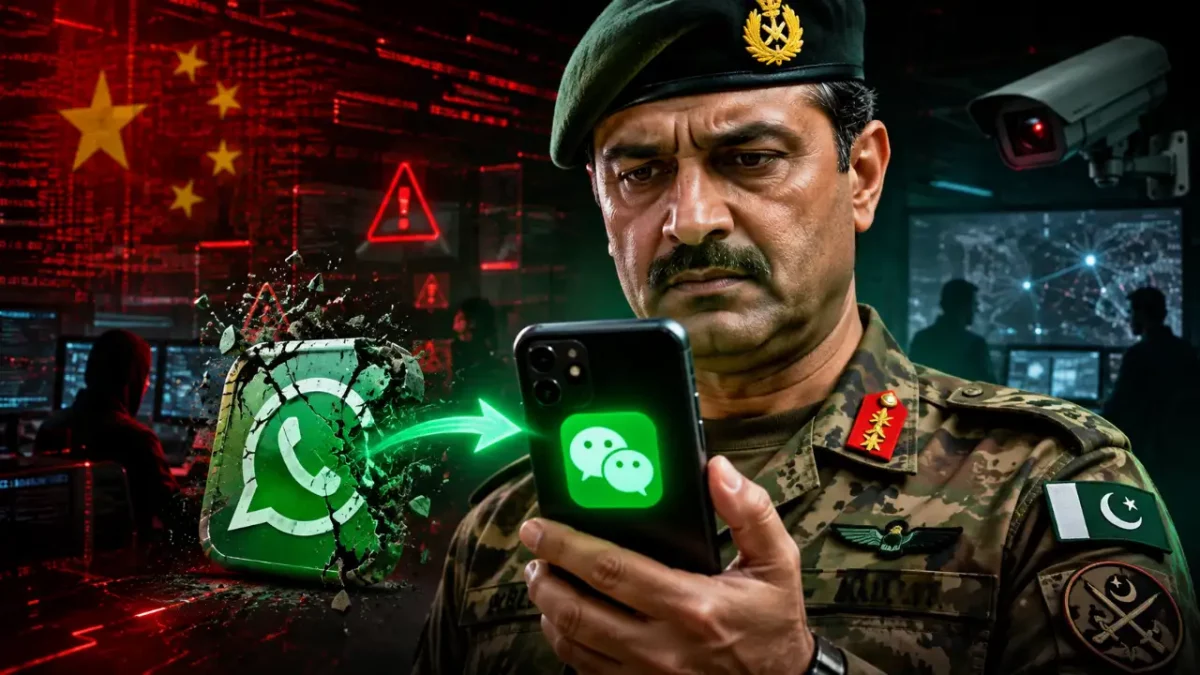
The Pakistan Army has instructed its officers, soldiers, and administrative staff to stop using Meta-owned WhatsApp for official and operational communications and gradually shift to the Chinese messaging platform WeChat. The directive, reported by multiple outlets citing an internal military order and intelligence sources, cites heightened risks of surveillance, data leaks, and hacking associated with the Western platform.





According to reports, the military views WhatsApp as posing elevated vulnerabilities for sensitive defence-related conversations. Personnel have been advised to phase out the app for official chats and migrate to WeChat as the preferred platform. The move forms part of broader efforts to secure military communications amid rising cyber threats.
WeChat, developed by China’s Tencent and often described as a “super app,” supports text messaging, voice and video calls, file sharing, and digital payments. This multifunctional design allows it to serve as a comprehensive communication tool beyond simple messaging.
Deepening Defence and Digital Ties with China
The decision aligns with expanding Pakistan-China defence cooperation, which has moved beyond traditional military hardware such as fighter jets, naval vessels, and air defence systems into cybersecurity, intelligence-sharing, and digital infrastructure. Adopting a shared communication platform could facilitate smoother coordination during joint military exercises, border engagements, and other collaborative activities between the Pakistan Armed Forces and China’s People’s Liberation Army.
Recent years have seen strengthened bilateral links in these domains, including agreements on intelligence cooperation, cybercrime prevention, and technology transfers under frameworks linked to the China-Pakistan Economic Corridor’s evolving digital dimensions.
Contrast with India’s Ban on WeChat
In a notable contrast, India banned WeChat in June 2020 (later making the ban permanent) along with dozens of other Chinese apps. New Delhi cited national security concerns, data privacy risks, and sovereignty issues, including allegations of user data transmission outside the country. While India blocked the app over espionage fears, Pakistan’s military has selected it for internal official use.
Context of Pakistan’s Own Secure Messaging Efforts
Separately, Pakistan has been developing a domestic alternative called “Beep” (or Beep Pakistan), inspired by WeChat and intended primarily for government and official use. The app, developed by the National Information Technology Board, aims for local servers, end-to-end encryption features for messages and video calls, and phased rollout starting with federal ministries. Pilot operations in some divisions were reported earlier in 2026, with full government deployment targeted around mid-2026. This parallel effort underscores Islamabad’s broader push for greater control over official digital communications and reduced reliance on foreign platforms whose servers lie outside the country.
Security Considerations Around Messaging Platforms
WhatsApp provides end-to-end encryption for message content by default, meaning Meta cannot access the content of chats. Critics of Western platforms often highlight potential risks related to metadata, law enforcement access mechanisms, or vulnerabilities if devices themselves are compromised. WeChat, by contrast, does not use end-to-end encryption; its servers can decrypt and access messages. Independent research has documented that Tencent, as a Chinese company, must comply with local laws requiring cooperation with government data requests, and the platform has built-in censorship and surveillance capabilities, particularly for China-registered accounts. Custom encryption protocols used by WeChat have also drawn scrutiny from security researchers for deviations from industry-standard practices.
The Pakistan Army’s reported preference for WeChat therefore reflects a strategic choice prioritising alignment with its primary defence partner over the technical encryption model of WhatsApp. It also illustrates the broader geopolitical contest over digital infrastructure and trusted communications channels in South Asia.
This development underscores how military communications policies are increasingly shaped by great-power technology competition, alliance dynamics, and assessments of cyber risk in an era of hybrid threats. Further official clarity from Pakistani authorities would help confirm the scope, timeline, and precise implementation of any such transition.