
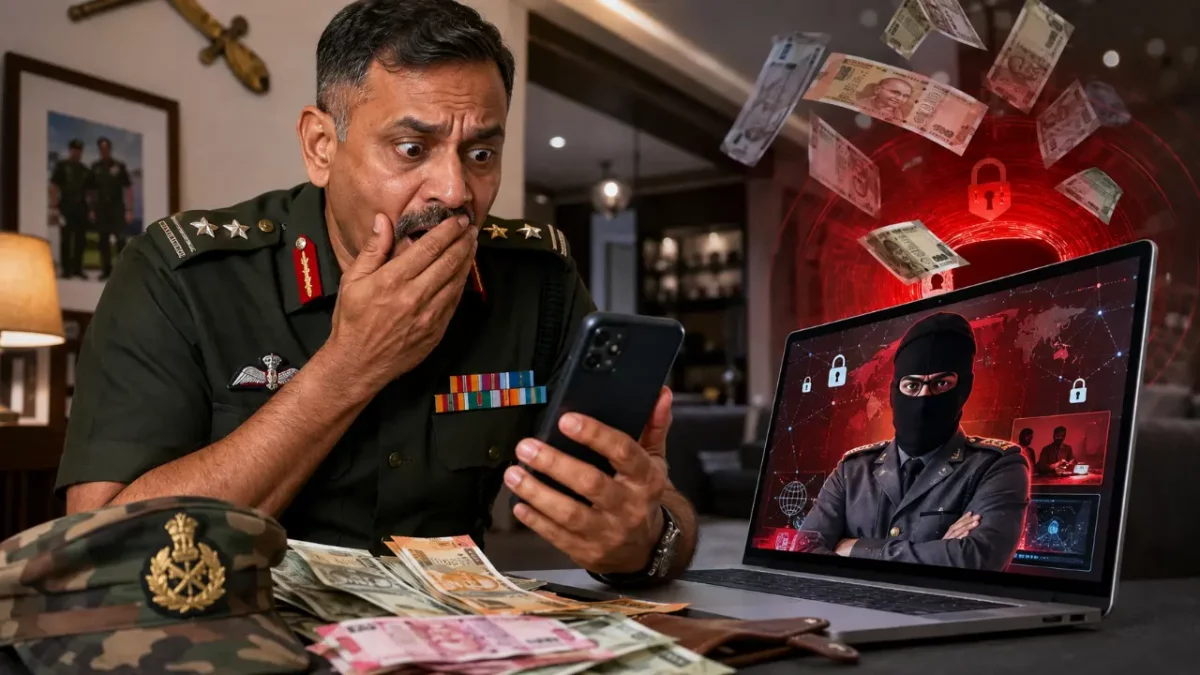
New Delhi: A retired Indian Army Colonel residing in Munirka Enclave was cheated of ₹15.50 lakh in a sophisticated “digital arrest” cyber fraud after scammers impersonated police and enforcement officials, placed him and his wife under sustained psychological pressure for two days, and coerced the transfer of funds under the pretext of complying with fabricated Reserve Bank of India (RBI) directions. Delhi Police’s Cyber Police Station, South-West District, has arrested four men from Punjab and Rajasthan who allegedly acted as facilitators by procuring and supplying mule and current bank accounts to overseas cyber-fraud syndicates operating from Cambodia and the UAE (including Dubai).





The case highlights the growing sophistication of digital arrest scams that specifically target educated professionals and senior citizens, including retired defence personnel, by blending fear of legal action with forged official documents and continuous monitoring.
How the Scam Unfolded
On April 15, 2026, the retired Colonel received a call claiming that his telephone connection would be disconnected on the directions of Maharashtra Police. He was directed to another number, where a fraudster posing as a police officer alleged that the Colonel’s personal details had been misused to open an illegal bank account in Mumbai linked to money laundering, investment fraud, and terrorist financing.
To lend credibility, the scammers sent forged Enforcement Directorate (ED) arrest warrants, fabricated court documents, fake anticipatory bail papers, and communications purportedly issued by the Bombay High Court and the RBI. They also shared photographs of landmarks near the victim’s locality (apparently sourced from online material) to create the impression that they knew his exact location and were monitoring him.
The victim and his wife, a school teacher, were then placed under “digital arrest.” Fraudsters subjected the couple to continuous psychological pressure, instructed them to remain isolated, and monitored their communications. Under this coercion, the Colonel disclosed details of his assets and transferred ₹15.50 lakh to a designated bank account, believing he was complying with RBI instructions to verify or clear the alleged funds.
There is no legal concept of “digital arrest” under Indian law. No police force, ED, CBI, or other agency is authorised to place a citizen under custody, demand money transfers, or conduct interrogations via phone or video call in this manner.
Complaint and Investigation
The Colonel filed a complaint through the National Cyber Crime Reporting Portal (NCRP). An e-FIR (No. 165/26) was registered on April 19, 2026, at the Cyber Police Station, South-West District, under Sections 308, 318(4), 319, and 340 of the Bharatiya Nyaya Sanhita (BNS).
A dedicated team comprising Sub-Inspector Sombir, Head Constables Jitender, Puneet, Mayurpal, and Sandeep, supervised by Inspector Pravesh Kaushik (SHO, Cyber PS South-West) and under the overall guidance of ACP/OPS Sandeep Ghai, took up the investigation. The team analysed the money trail, beneficiary accounts, digital footprints, and technical data.
The defrauded amount was traced to a current bank account in Ludhiana belonging to one of the accused. The same beneficiary account was linked to 17 complaints on the NCRP from multiple states and Union Territories, involving fraudulent transactions running into crores of rupees.
The Arrested Facilitators
Police arrested four men who formed part of an inter-state facilitation network supplying mule and current accounts on a commission basis:
- Sarbjit (38), Ludhiana: Holder of the current account that received the ₹15.50 lakh. He allegedly handed over the account for use by the fraud network.
- Suraj (30), Ludhiana: Intermediary who procured accounts and passed them along the chain.
- Sandeep (32), Ludhiana: Bank employee who leveraged his position and contacts to facilitate the procurement of current accounts.
- Naresh alias Lucky, Sikar, Rajasthan: Procured accounts from Suraj (via Telegram) and supplied them to cyber-fraud operators based in Cambodia and the UAE/Dubai. He acted as the key domestic link to the overseas syndicates.
Sarbjit, Suraj, and Sandeep had travelled to Jaipur to hand over the account kit to Naresh. Police recovered four smartphones and six SIM cards used in the offences. DCP (South-West) Amit Goel and Additional DCP Kumar Abhishek have confirmed the arrests and the ongoing probe into the wider network and ultimate beneficiaries.
Broader Context and Implications
This case forms part of a larger pattern of digital arrest scams in which low-level facilitators in India supply bank accounts and SIM cards to sophisticated overseas call centres. The masterminds, often operating from Cambodia, the UAE, or other locations, impersonate officials of the police, ED, CBI, courts, or RBI and use forged documents, continuous video/audio monitoring, and threats of arrest on serious charges (terror financing, money laundering, etc.) to extract large sums.
Retired defence personnel and their families are frequently targeted because they are perceived as financially stable, disciplined, and less likely to immediately challenge official-sounding claims. The psychological pressure of isolation and the fear of reputational damage or legal consequences can override normal caution, even among highly trained officers.
The South-West District Cyber Police have repeatedly dismantled such facilitation networks in recent months. The recovery of devices and the mapping of the account-supply chain in this case provide leads that investigators are pursuing to identify higher-level handlers and freeze additional accounts.
Key Takeaways for Awareness
Genuine law-enforcement agencies never demand money transfers over phone or video calls, never place citizens under “digital arrest,” and never instruct victims to keep investigations secret from family or remain confined at home. Any such demand is a clear indicator of fraud.
Citizens who receive similar calls should immediately disconnect, avoid sharing personal or financial details, and report the incident on the National Cyber Crime Helpline 1930 or the portal cybercrime.gov.in. Early reporting significantly improves the chances of freezing funds and tracing the money trail.
Further investigation into the overseas operators and the complete money trail continues. The arrests of the four facilitators mark an important step in disrupting the domestic support structure that enables these high-value digital arrest scams.