
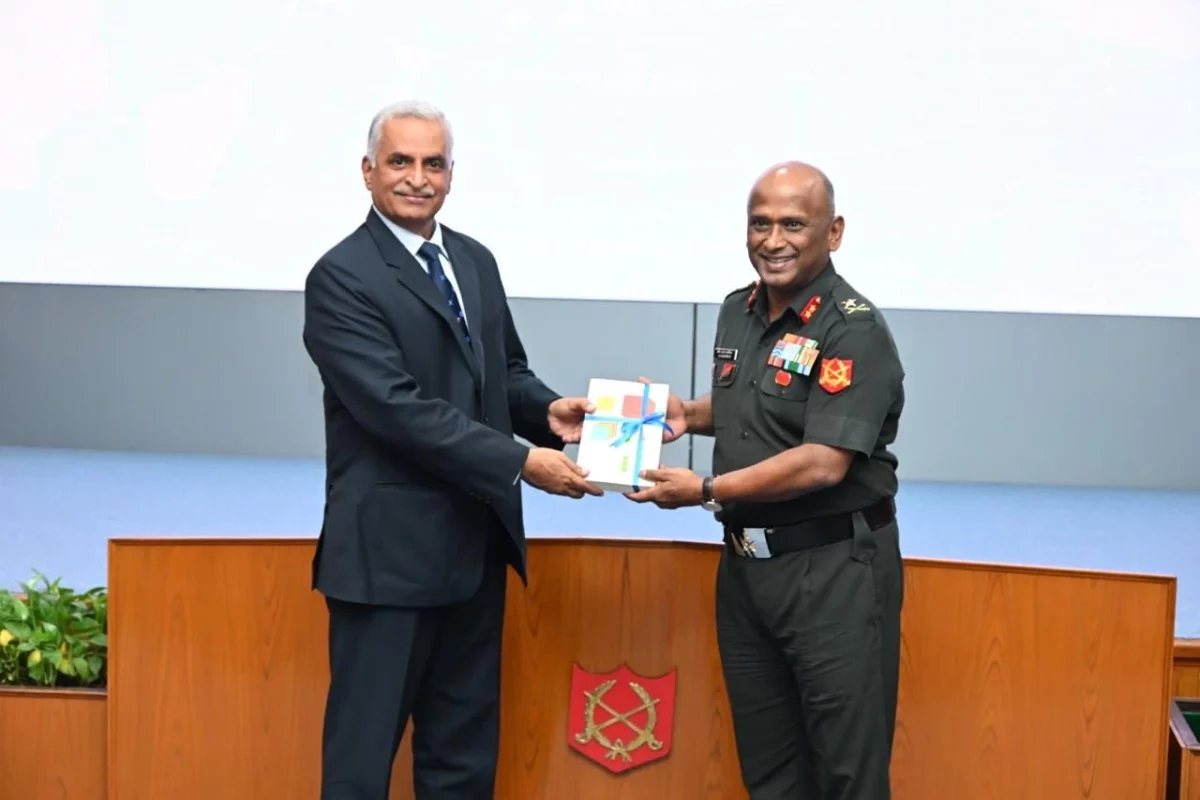
Vice Admiral G Ashok Kumar (Retd), former National Maritime Security Coordinator, addressed officers attending the ongoing Higher Command Course, delivering an assessment of the rapid expansion of the People’s Liberation Army Navy (PLA Navy) and its implications for the regional and global maritime security environment.
Speaking on the theme “Growth of PLA Navy, its Regional & Global Implications & the Way Ahead for the Indian Navy,” the former senior naval officer highlighted how China’s expanding maritime capabilities are increasingly influencing the balance of power across the Indo-Pacific and beyond.
During his interaction with the course participants, Vice Admiral Kumar emphasised the importance of rapid capability development for the Indian Navy, particularly as the maritime domain assumes greater significance in India’s national security calculations.
PLA Navy’s Rapid Expansion
The session focused extensively on the transformation of the PLA Navy from a predominantly regional force into an increasingly capable blue-water navy with the ability to operate at considerable distances from the Chinese mainland.
China has invested heavily in aircraft carriers, destroyers, frigates, submarines, amphibious warfare ships, replenishment vessels and other supporting capabilities. Alongside the expansion of its fleet, Beijing has also strengthened the infrastructure, logistics and technological systems required to sustain longer and more complex deployments.
Vice Admiral Kumar highlighted the strategic implications of this growth, particularly as the PLA Navy develops greater capacity for sustained operations beyond its traditional operating areas.

Such capabilities allow a navy not only to defend its immediate maritime approaches but also to protect sea lines of communication, support national interests overseas and maintain a military presence in strategically important regions.
Power Projection Through Blue-Water Operations
A key aspect of the address was the growing importance of blue-water operations and their connection with maritime power projection.
Vice Admiral Kumar stressed the need for rapid capability development that would enable the Indian Navy to maintain an effective presence across the wider maritime domain.
For India, this assumes particular significance because of the country’s geographic position astride some of the world’s most important maritime routes. A substantial portion of India’s trade and energy supplies moves through the Indian Ocean, making the security of sea lanes critical to the country’s economic and strategic interests.
A capable blue-water navy provides the ability to operate far from home ports for extended periods, maintain maritime surveillance, protect shipping, respond to crises and contribute to deterrence.
Overseas Bases and Maritime Logistics
Vice Admiral Kumar also drew attention to the significance of overseas bases and support facilities in enabling sustained naval operations.
As naval forces operate farther from their home waters, access to logistics, maintenance, replenishment and support infrastructure becomes increasingly important. Overseas facilities can substantially increase the endurance and operational reach of naval forces.
China’s development of an overseas military support facility in Djibouti and its broader maritime engagements have consequently attracted considerable strategic attention. The possibility of greater Chinese naval access to ports and facilities across different regions remains an important consideration for countries assessing the future maritime balance.
For India, these developments underline the importance of maritime partnerships, logistics arrangements, overseas access and infrastructure capable of supporting extended naval deployments.
Changing Balance of Power in the Indo-Pacific
Vice Admiral Kumar highlighted the role of the PLA Navy in reshaping the balance of power across the Indo-Pacific.
The Indo-Pacific has emerged as one of the world’s most strategically important regions, encompassing critical shipping routes, major economies and several areas of geopolitical competition.
China’s expanding naval presence means developments involving the PLA Navy can have implications well beyond the Western Pacific. Increasing deployments into the Indian Ocean Region could affect India’s immediate maritime security environment and require sustained monitoring.
The challenge therefore extends beyond the number of ships possessed by competing navies. Operational availability, logistics, surveillance, maritime domain awareness, technological superiority, training and the ability to sustain forces at long distances are equally important factors in determining maritime power.
Emerging Maritime Challenges
During the interaction, Vice Admiral Kumar offered critical insights into emerging maritime challenges and possible measures required to address them.
The modern maritime battlespace is rapidly evolving with advances in unmanned systems, long-range precision weapons, artificial intelligence, cyber warfare, space-based surveillance, electronic warfare and underwater technologies.
Future maritime competition is therefore likely to involve a combination of conventional naval power and increasingly sophisticated technological capabilities.
For the Indian Navy, maintaining credible deterrence will require continuous modernisation together with the ability to identify and respond to emerging threats across surface, underwater, air, space, cyber and information domains.
Capability Development for the Indian Navy
The address placed particular emphasis on accelerating capability development to ensure that the Indian Navy remains prepared for the changing security environment.
India has already been pursuing a broad naval modernisation programme involving indigenous warships, submarines, aircraft, helicopters, missiles, surveillance systems and unmanned platforms. Indigenous shipbuilding has also become an increasingly important component of India’s wider defence self-reliance programme.
However, the expanding capabilities and geographical reach of the PLA Navy mean that the Indian Navy will need to continually assess its force structure and operational requirements against evolving threats.
Aircraft carriers and carrier aviation, nuclear and conventional submarines, anti-submarine warfare, long-range maritime reconnaissance, unmanned platforms, network-centric warfare and maritime domain awareness are among the capabilities likely to remain central to future naval operations.
Strategic Importance of the Indian Ocean
India’s geographical position gives the country significant strategic advantages in the Indian Ocean Region. The Indian Navy routinely operates across a vast maritime area stretching from the Arabian Sea and western Indian Ocean to the Bay of Bengal and eastern approaches.
Maintaining awareness of naval movements across this enormous area requires extensive surveillance and intelligence capabilities as well as cooperation with friendly maritime nations.
Partnerships with countries across the Indo-Pacific can therefore complement India’s indigenous naval capabilities by improving information sharing, interoperability, logistics and maritime domain awareness.
At the same time, maintaining adequate forces for sustained deployments will remain essential as extra-regional navies increase their presence in the Indian Ocean.
Preparing Future Military Leadership
The interaction with Vice Admiral Kumar also provided Higher Command Course participants an opportunity to examine maritime competition from a broader strategic perspective.
The Higher Command Course is intended to prepare senior military officers for higher command and staff responsibilities, exposing them to evolving operational, technological and geopolitical challenges affecting India’s national security.
Sessions involving experienced military leaders and strategic practitioners allow participating officers to examine developments that could shape future warfare and India’s defence planning.
Vice Admiral G Ashok Kumar brings extensive experience to such discussions. During his naval career, he held several important operational and leadership appointments and served as Vice Chief of the Naval Staff before retirement. He subsequently served as India’s first National Maritime Security Coordinator, a position created to strengthen coordination among the numerous agencies involved in the country’s maritime security architecture.
His address underscored the increasingly central role of maritime power in India’s security environment.
As the PLA Navy continues to expand its capabilities and operational footprint, developments in the maritime domain are expected to remain a major factor shaping strategic competition in the Indo-Pacific. For the Indian Navy, the evolving environment reinforces the importance of accelerated modernisation, indigenous capability development, enhanced maritime awareness, sustained blue-water operations and the ability to project credible naval power across India’s wider areas of maritime interest.