
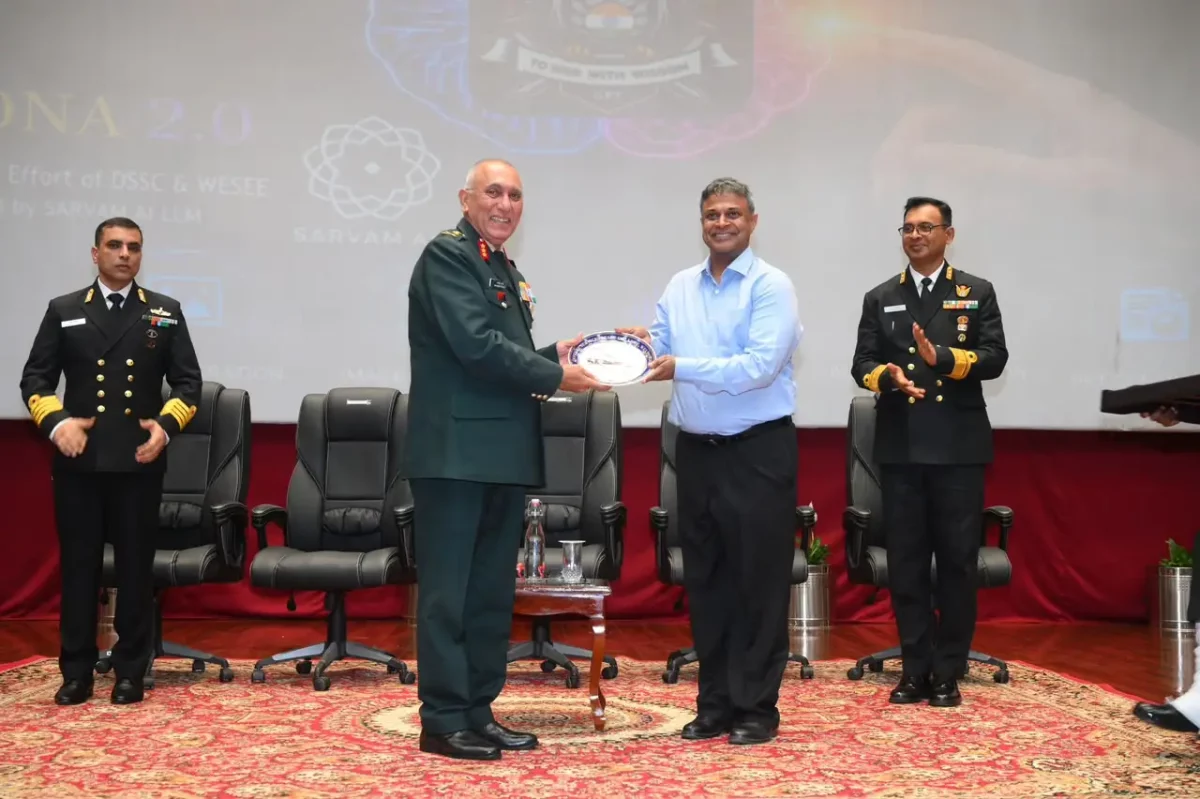
The Defence Services Staff College (DSSC) in Wellington, Tamil Nadu, has launched DRONA 2.0, a multimodal generative AI platform that marks a significant step in integrating indigenous artificial intelligence into professional military education. The system was formally inaugurated on 18 August 2026 by Lieutenant General Manish Erry, Commandant of DSSC, in the presence of Dr Vivek Raghavan, Co-Founder of Sarvam AI.

Alongside the launch, DSSC and Sarvam AI signed a Memorandum of Understanding (MoU) for continued collaboration on the further development of DRONA GPT and related AI-based applications.
Background: From DRONA 1.0 to Multimodal Capability
DRONA (DSSC Resource Optimising Neural AI) was first introduced in June 2025 as an indigenously developed customised GPT. Version 1.0 was jointly developed by DSSC and the Weapons Electronics Systems Engineering Establishment (WESEE) of the Indian Navy and launched on the DSSC Wide Area Network (WAN) on 16 June 2025. It was designed to give faculty and student officers rapid, intelligent access to the institution’s academic repository and to support research in defence, strategy, and leadership.
DRONA 2.0 builds on that foundation by incorporating multimodal capabilities and an indigenous large language model stack. Headquarters Integrated Defence Staff (HQ IDS) described the upgrade as part of the broader effort to infuse Artificial Intelligence into training while prioritising sovereign technological solutions.
Core Technology and Features
At the heart of DRONA 2.0 is the integration of Sarvam AI’s Sarvam 105B large language model with open-source models. Sarvam 105B is a Mixture-of-Experts (MoE) model developed as part of India’s push for sovereign AI under the IndiaAI Mission. The system runs on a state-of-the-art GPU server within DSSC’s secure network.
According to the official HQ IDS statement, the platform offers a comprehensive suite of multimodal tools, including:
- Advanced reasoning and document inferencing
- Image recognition and generation
- Speech-to-text and text-to-speech conversion
- Automated translation and transliteration
- Podcast and presentation (PPT) generation
- Tools for data analytics
HQ IDS noted that DRONA 2.0 is the first multimodal GPT of its kind in the Indian Armed Forces. Before deployment, the application underwent extensive security audits and received formal certification from Headquarters Integrated Defence Staff and the Defence Cyber Agency (DCyA).
The model has been pre-trained on a large repository of academic content held at DSSC. Officials stated that this specialised training provides “a major fillip to faculty [and] students of DSSC, aiding them towards access of information and progress [in] advanced studies/research in the field of Defence and Strategic Studies.”
Institutional and Strategic Context
DSSC, located in the Nilgiris, is India’s premier tri-services staff college. It trains mid-level officers from the Army, Navy, and Air Force, along with officers from friendly foreign countries, in jointmanship, staff duties, strategy, and higher leadership. Lieutenant General Manish Erry, who assumed command of the college in September 2025, has overseen the institution’s continued focus on adapting professional military education to technological change.
The adoption of an indigenous multimodal AI system aligns with the Indian Armed Forces’ wider emphasis on self-reliance in critical technologies. By hosting the system on a secure internal GPU server and subjecting it to rigorous cyber certification, DSSC has prioritised data security and operational sovereignty—key considerations when AI systems handle sensitive academic and strategic material.
Sarvam AI, co-founded by Vivek Raghavan and Pratyush Kumar, has positioned its 105B model as a capable reasoning and agentic system trained with strong emphasis on Indian languages and contexts. Its selection for this defence education application reflects growing collaboration between Indian AI startups and the military training ecosystem.
Implications for Professional Military Education
DRONA 2.0 is intended to function as more than a chatbot. Its multimodal capabilities—particularly document analysis, image generation, speech tools, and automated presentation/podcast creation—can support a range of academic and research workflows. Faculty and student officers can use it for rapid literature synthesis, scenario analysis, multilingual translation of material, and the generation of instructional content.
By combining a domain-specific knowledge base with a powerful indigenous foundation model, the system aims to reduce friction in information access while maintaining institutional control over the data and the model environment. The MoU with Sarvam AI signals an intent to iterate further, potentially expanding the range of applications beyond the current staff course environment.
The launch comes at a time when professional military education institutions worldwide are experimenting with generative AI. DSSC’s approach—starting with a custom GPT in 2025, then advancing to a certified multimodal system built on an indigenous 105B model—illustrates a deliberate, security-conscious path that prioritises both capability and sovereignty.
DRONA 2.0 is currently available for use by DSSC faculty and student officers on the college’s secure network. Further details on performance benchmarks within the defence academic domain or planned expansions have not been publicly released.