
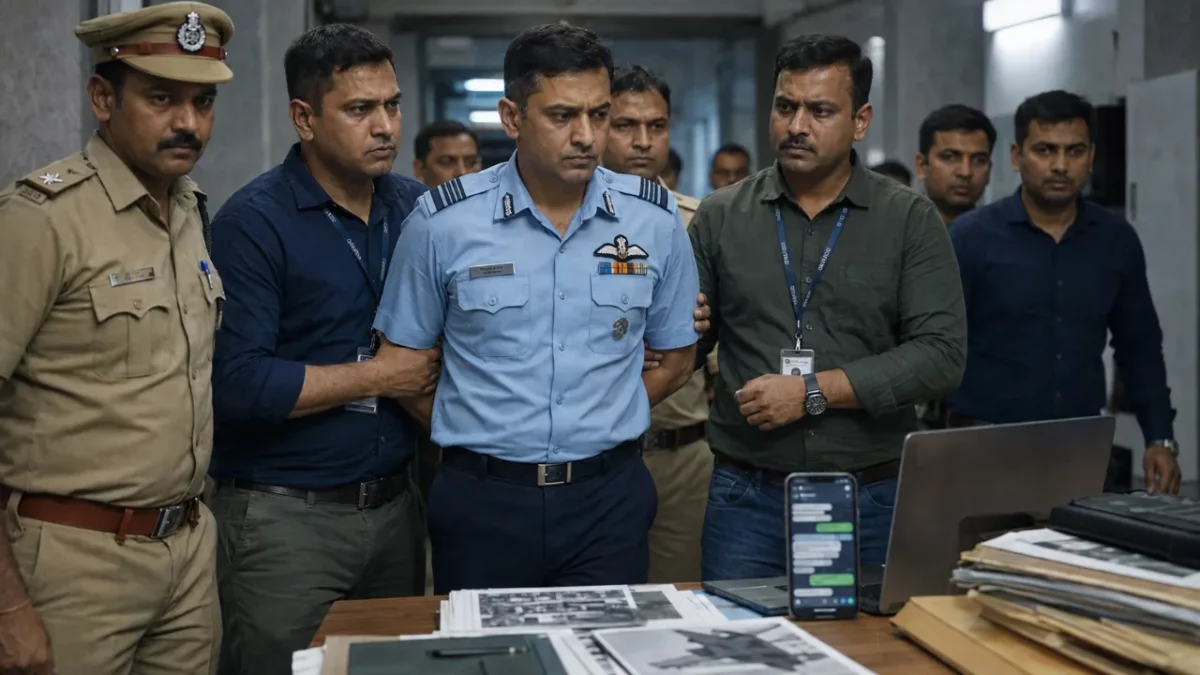
New Delhi: In a significant counter-espionage development, the Delhi Police Special Cell arrested a serving Wing Commander of the Indian Air Force (IAF) on the night of May 31, 2026, on allegations of leaking classified defence information and confidential documents related to national security. The officer has been booked under the Official Secrets Act and is currently lodged in judicial custody at Tihar Jail.



The arrest followed specific inputs shared by the IAF’s intelligence wing with Delhi Police. The officer had been placed under active surveillance by the Air Force before being handed over to civilian law enforcement agencies. An IAF spokesperson confirmed the force’s proactive role, stating: “He was under active surveillance and was handed over to the suitable law enforcement agencies. Due to proactive measures, he was caught. The IAF has zero tolerance for such activities.”
Senior Delhi Police sources have described the case as pointing to a larger espionage network aimed at collecting strategic military intelligence. Investigators allege that the Wing Commander, who was posted in a field unit at the time, was honey-trapped through social media by a woman acting at the behest of handlers based in Pakistan.
How the Alleged Honey Trap Unfolded
According to police sources, the officer was navigating a difficult phase in his personal life when he was approached online by a woman using a fake female persona. Communication began with chats and progressed to video calls. After gradually building trust, the woman sought sensitive information, including details on military movements and troop deployments, photographs, videos, and other data related to defence units.
Sources said the Wing Commander allegedly transmitted “crucial documents and data” to her through digital communication channels. The interaction then escalated further. After extracting information from him, the woman allegedly instructed the officer to install a specific application on a colleague’s mobile phone. Police described this as a form of targeted spyware or remote-access malware designed to steal device data, track locations, or intercept communications.
The woman is believed to have been operating as part of a coordinated honey-trap module designed to target defence personnel and extract classified information. Police sources emphasised that the operation formed part of a broader network focused on gathering strategic military intelligence for Pakistani handlers.
Legal Proceedings and Investigation Status
The officer was initially taken into police custody following the May 31 arrest and later remanded to judicial custody in Tihar Jail. He faces charges under the provisions of the Official Secrets Act for sharing classified information and confidential documents related to national defence.
The ongoing investigation is focused on several critical aspects: tracing the full digital trail of communications between the officer and the woman; identifying the overseas handlers allegedly involved; and determining the precise extent and nature of the information that may have been compromised. Sources indicated that investigators are examining whether the shared information could have compromised national security or was intended to facilitate hostile activities on Indian soil.
No official details regarding the officer’s identity, specific unit, or the exact nature of the leaked documents have been made public, consistent with standard protocol in sensitive national security cases.
Broader Context and Implications
Honey-trap operations targeting defence and security personnel have been a recurring concern for Indian intelligence and military agencies. Adversarial intelligence services, particularly those linked to Pakistan, have historically used social media platforms and fabricated online personas to exploit personal vulnerabilities of serving personnel. Such tactics often begin with emotional engagement during periods of personal stress and gradually escalate to demands for sensitive information.
The case underscores several ongoing challenges for the armed forces: the difficulty of monitoring personal digital activity of personnel without compromising operational security or individual privacy; the risks posed by field postings where access to classified material may intersect with limited oversight of private communications; and the persistent need for continuous awareness and counselling on social engineering threats.
IAF’s confirmation that the officer was already under surveillance before the arrest highlights the effectiveness of internal counter-intelligence mechanisms. The force’s public emphasis on “zero tolerance” and proactive detection sends a clear institutional message while the broader probe continues.
As of August 8, 2026, when details of the two-month-old arrest first emerged in the media through police and IAF sources, further investigation remains underway. Authorities are working to map the full contours of the suspected network, assess any potential damage to operational security, and identify additional links or compromised individuals, if any.
The Official Secrets Act provides the primary legal framework for prosecuting such offences, carrying stringent penalties that reflect the gravity of compromising classified defence information. The outcome of this investigation will be closely watched for its implications on both inter-agency coordination between military intelligence and civilian police, and on the evolving nature of hybrid espionage threats in the digital age.