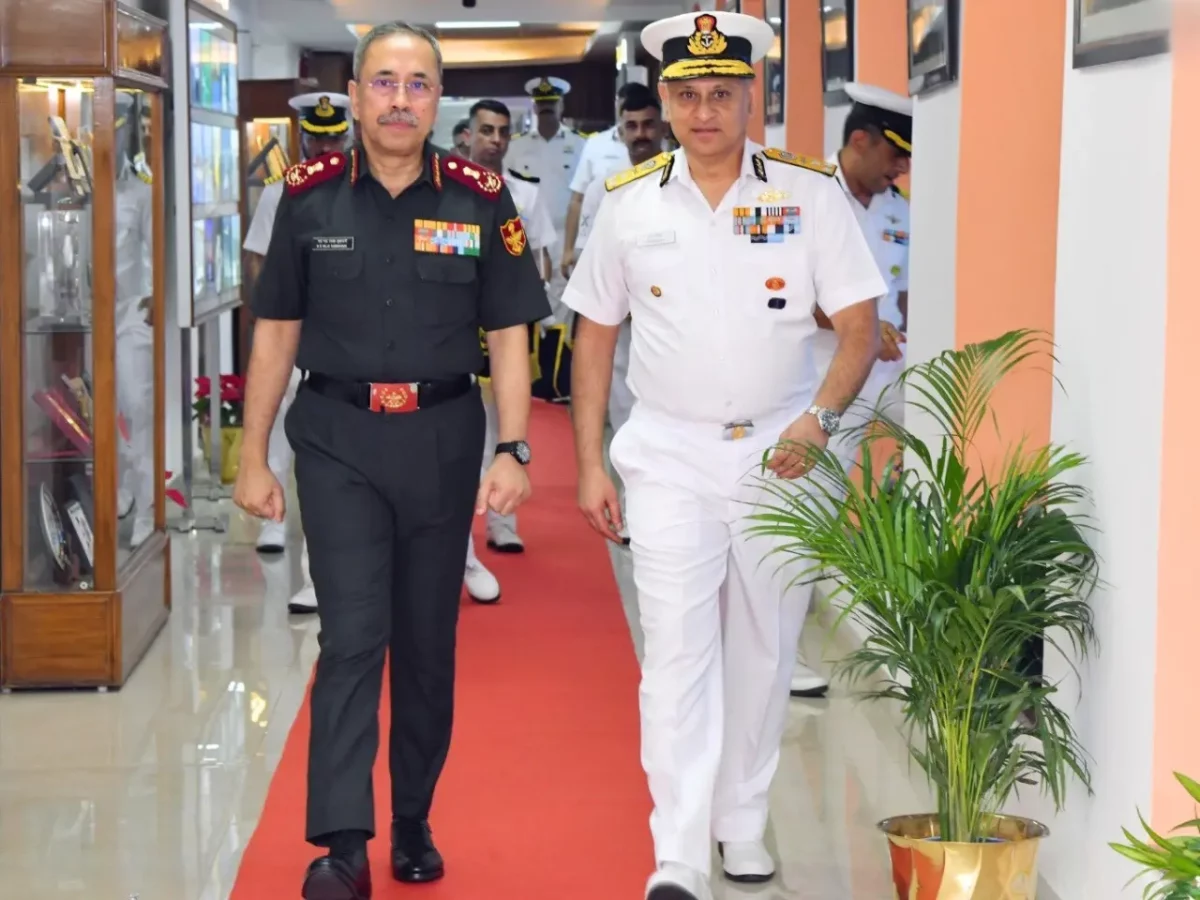
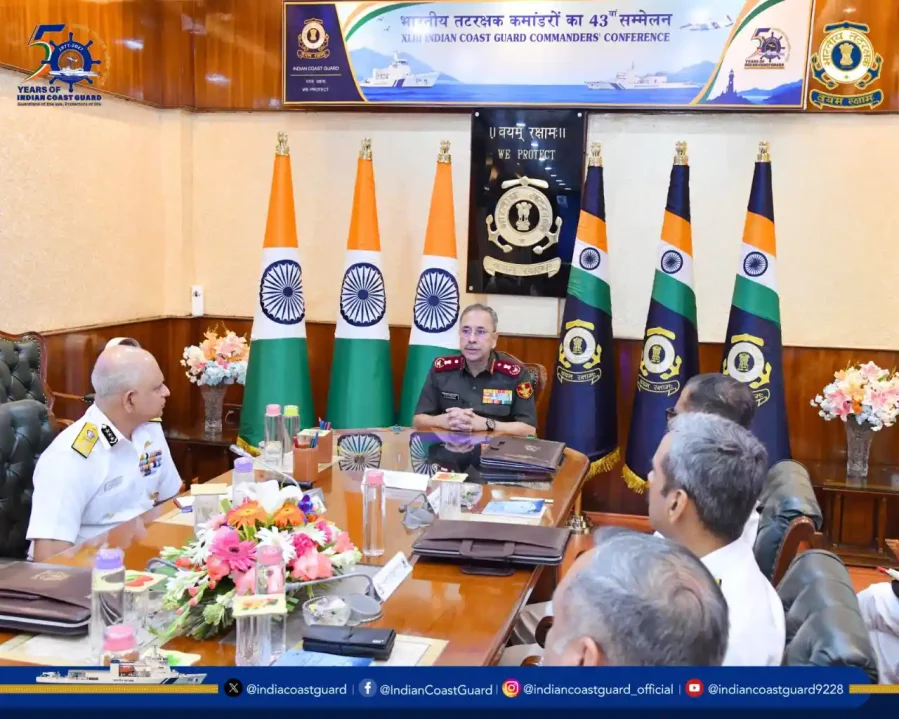
Chief of Defence Staff General NS Raja Subramani, PVSM, AVSM, SM, VSM, addressed the apex leadership of the Indian Coast Guard at the 43rd Coast Guard Commanders’ Conference held at Coast Guard Headquarters in New Delhi, outlining key priorities for building a future-ready and technologically enabled maritime security force.





During his address, the CDS emphasised the need for enhanced jointness, Atmanirbharta and innovation to strengthen the Coast Guard’s overall operational preparedness. He called for accelerated development and operational integration of emerging technologies, particularly Artificial Intelligence, alongside greater convergence among the Armed Forces.
General NS Raja Subramani highlighted the importance of seamless operational coordination between the services as India continues to strengthen its maritime security architecture. Greater jointness enables different elements of the defence establishment to coordinate capabilities and resources more effectively while responding to evolving security challenges across the maritime domain.
Artificial Intelligence was identified as an important area for accelerated capability development. The emphasis on AI reflects the growing role of technology in modern military and maritime operations, where faster processing of information, improved situational awareness and technology-enabled decision-making can contribute to operational effectiveness.
The CDS also stressed the importance of operational integration of emerging technologies rather than treating technological development as an isolated activity. Integrating new capabilities into existing operational structures and ensuring that personnel are trained to employ them effectively will remain important to translating technological advances into usable military capabilities.
Another key area highlighted during the conference was Atmanirbharta, or self-reliance. General NS Raja Subramani called for continued efforts towards technology-led indigenous capability development, strengthening the country’s ability to design, develop and sustain critical systems within India.
The emphasis on self-reliance was also linked to the need for resilient supply chains. Reliable access to critical equipment, components and support systems is an important element of sustained operational readiness, particularly for maritime forces that operate continuously across India’s extensive maritime zones.
Building resilient supply chains can help reduce vulnerabilities arising from disruptions in external sources while improving the ability of the Coast Guard to sustain its operational commitments. Indigenous manufacturing and stronger domestic industrial capabilities can therefore complement operational preparedness and long-term maritime security requirements.
The 43rd Coast Guard Commanders’ Conference provided a platform for the senior leadership of the organisation to deliberate on priorities related to capability development and operational preparedness. The participation of the CDS brought an additional focus on jointness and greater integration across India’s armed forces.
The Indian Coast Guard plays a key role in India’s maritime security framework, with responsibilities extending across the country’s maritime interests. Strengthening its capabilities through technology, innovation and greater integration is therefore closely connected to the broader objective of securing India’s maritime domain.
The conference also highlighted the importance of preparing the Coast Guard for an evolving operational environment. As maritime security challenges become increasingly technology-driven, the ability to combine human expertise with advanced technologies will be central to maintaining operational effectiveness.
The CDS’s emphasis on innovation further underlined the need to encourage new approaches to capability development and operational problem-solving. Technology adoption, indigenous development and institutional innovation can together contribute to building a more adaptable maritime force.
The focus on jointness also aligns with the broader transformation underway within India’s defence establishment towards greater integration among the three services and other maritime security stakeholders. For the Coast Guard, closer operational convergence can enhance coordination during missions involving multiple agencies and military formations.
The address reaffirmed the importance of a future-oriented approach to maritime security, combining operational readiness with technological advancement and self-reliance. The Coast Guard’s continued efforts in these areas are intended to strengthen its ability to safeguard India’s maritime interests in an increasingly complex strategic environment.
The 43rd Coast Guard Commanders’ Conference thus placed jointness, Atmanirbharta, Artificial Intelligence, innovation and resilient supply chains at the centre of discussions on future capability development. These priorities are aimed at strengthening integrated maritime operations and contributing to India’s wider vision of building a technologically advanced and self-reliant defence ecosystem in the lead-up to Viksit Bharat 2047.