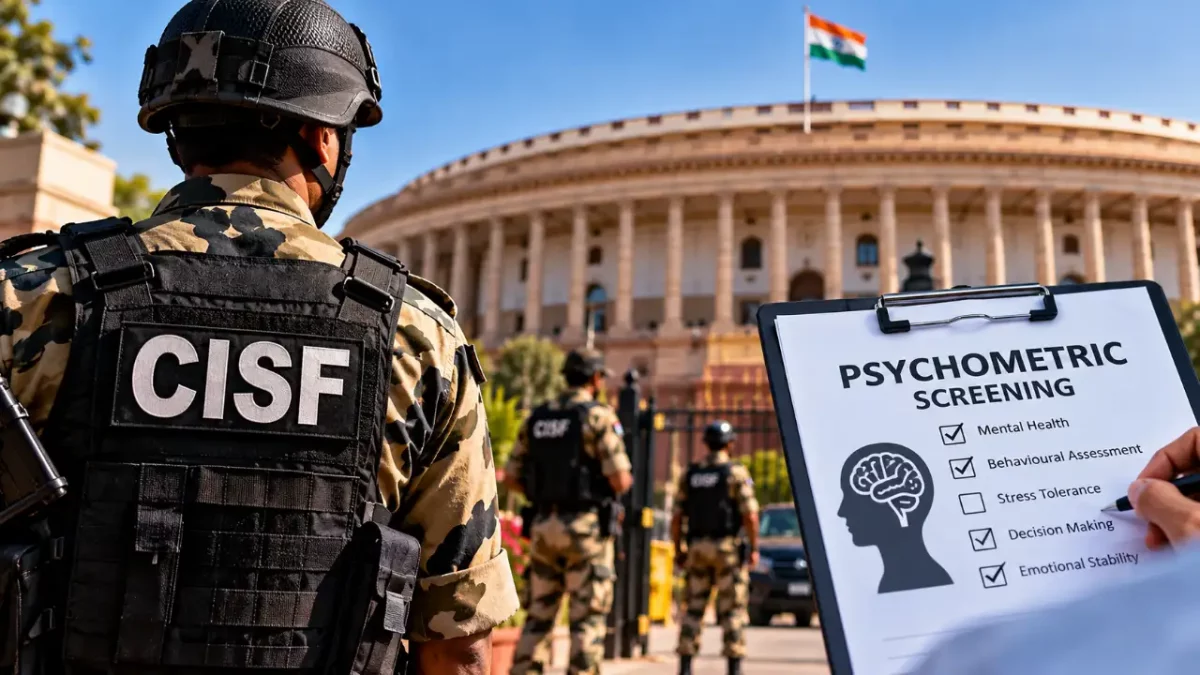
New Delhi, September 30, 2026: The Central Industrial Security Force will subject personnel deployed on some of its most sensitive assignments—including duty at the Parliament House Complex and commandos of the Special Security Group providing high-level VIP cover—to specialised psychometric assessments. The step is intended to identify psychological stress at an early stage and strengthen institutional mental-health support.





The decision has acquired added urgency after Tuesday’s fratricide at the Sewa-II hydroelectric project in Mashka village, Basohli, Kathua district, Jammu and Kashmir. A 2009-batch Head Constable allegedly opened fire with his service AK-47 following an argument, killing four colleagues: Assistant Commandant Ankit Kumar Pandey (the company commander), Sub-Inspector Lakshman Singh, and two constables. The accused was overpowered and handed over to police. A Court of Inquiry has been ordered, and officials are examining the work environment at the isolated project site.
Four days before the shooting, on 25 September, CISF signed a three-year memorandum of understanding with the Institute of Human Behaviour and Allied Sciences (IHBAS), Delhi. Under the pact, IHBAS will conduct specialised psychometric assessments of personnel posted or proposed for highly sensitive units, explicitly including those earmarked for the Parliament House Complex.
Medical officers, unit commanders and supervisory staff will be trained to recognise early behavioural changes, acute stress and psychiatric emergencies so that professional intervention can begin promptly. Personnel requiring clinical care will have direct access to IHBAS outpatient and inpatient facilities, including dedicated support for alcohol-dependence syndrome. The force will also promote the national Tele-MANAS helpline (14416).
Director General Praveer Ranjan stated at the signing that CISF personnel operate in exceptionally demanding environments and that the partnership would strengthen early identification, counselling and clinical treatment while encouraging an organisational culture free of stigma around seeking help.
The Special Security Group, raised in 2006, currently protects designated X, Y, Z and Z-plus category protectees. Among those listed in recent reports are Assam Chief Minister Himanta Biswa Sarma, former Manipur Chief Minister N. Biren Singh, National Security Adviser Ajit Doval and RSS chief Mohan Bhagwat. The assessments will therefore cover both static high-security locations such as Parliament and mobile close-protection teams. For comparison, personnel selected for the Special Protection Group already undergo rigorous in-house psychological evaluation and periodically take the Vienna Test System.
The initiative builds on existing measures. Psychological assessment, Battle Physical Efficiency Tests, Parliament-specific induction training and security clearance were already made mandatory for Parliament duty under the revised posting policy announced in late 2025, which also extended tenure from three to four years (extendable by one year). Project Mann, in partnership with the Aditya Birla Education Trust, has already screened tens of thousands of personnel at Parliament, airports and the Delhi Metro.
Officials note that occupational stress remains a persistent concern across the Central Armed Police Forces. In the past three years the CAPFs have recorded hundreds of suicides and several fratricides; resignations have also remained high. The new clinical layer with IHBAS is intended to complement earlier wellness programmes and to ensure that personnel in the highest-pressure roles receive structured psychological screening before and during deployment.
CISF officials emphasised that the Kathua incident is under investigation and that no causal link has been publicly established. The psychometric programme, they said, is a preventive and systemic response to the known demands of sensitive security duties rather than a reaction limited to a single event.