
New Delhi, 28 September 2026 — Hindustan Aeronautics Limited (HAL) has failed to qualify for the prototype-development phase of India’s Advanced Medium Combat Aircraft (AMCA) programme on technical grounds, Defence Secretary Rajesh Kumar Singh stated at the NDTV Defence Summit 2026. The exclusion marks the first indigenous fighter-jet project from which the state-owned manufacturer has been kept out.



Speaking in an interview in New Delhi on Sunday, Singh said HAL “didn’t qualify on some fairly routine technical grounds which they somehow failed to meet.” He did not specify the criteria that the company failed to satisfy.
The Ministry of Defence opened the AMCA prototype programme to private-sector participation in order to establish a second fighter-jet production line and reduce dependence on a single manufacturer. “We wanted to create a second fighter jet production line in the country rather than putting all our eggs in one basket, as has always been the case in this country,” Singh said. “We’ve been lucky to find three credible technically qualified bidders.”
Of the seven consortia that expressed interest, only three met the mandatory technical and financial criteria. HAL had bid in partnership with two smaller firms. The shortlisted entities are Tata Advanced Systems Limited (TASL), bidding independently; an L&T–Bharat Electronics Limited–Dynamatic Technologies consortium; and a Bharat Forge–BEML–Data Patterns consortium.
The Aeronautical Development Agency (ADA) issued a Request for Proposal to the three shortlisted bidders in May 2026. The government is fully funding the prototype phase, estimated at approximately ₹15,000 crore. The selected Development-cum-Production Partner will build five flying prototypes and one structural test aircraft in collaboration with ADA, and must incorporate a new company within three months of contract award. Prototypes will initially use General Electric F414 engines. ADA will retain design authority.
Singh indicated that the first AMCA prototype is expected to fly in September 2028. Programme documents require first flight within 30 months of contract award, completion of all five prototypes by 64 months, and 1,800 flight-test sorties within 84 months. Bid submissions under the RFP have been extended to 30 October 2026.
Earlier reporting in February 2026 linked HAL’s non-qualification in part to Expression of Interest criteria that awarded zero marks where an order book exceeded three times annual turnover. HAL’s order book has been reported at approximately ₹2.52 trillion, well above that threshold, while the company remains engaged on Tejas Mk1A, Tejas Mk2, and other programmes. HAL stated at the time that it had received no official communication on exclusion and highlighted its diversified order book and production visibility. The Defence Secretary’s latest remarks framed the outcome as a failure to meet routine technical requirements rather than restating the earlier financial-capacity analysis.
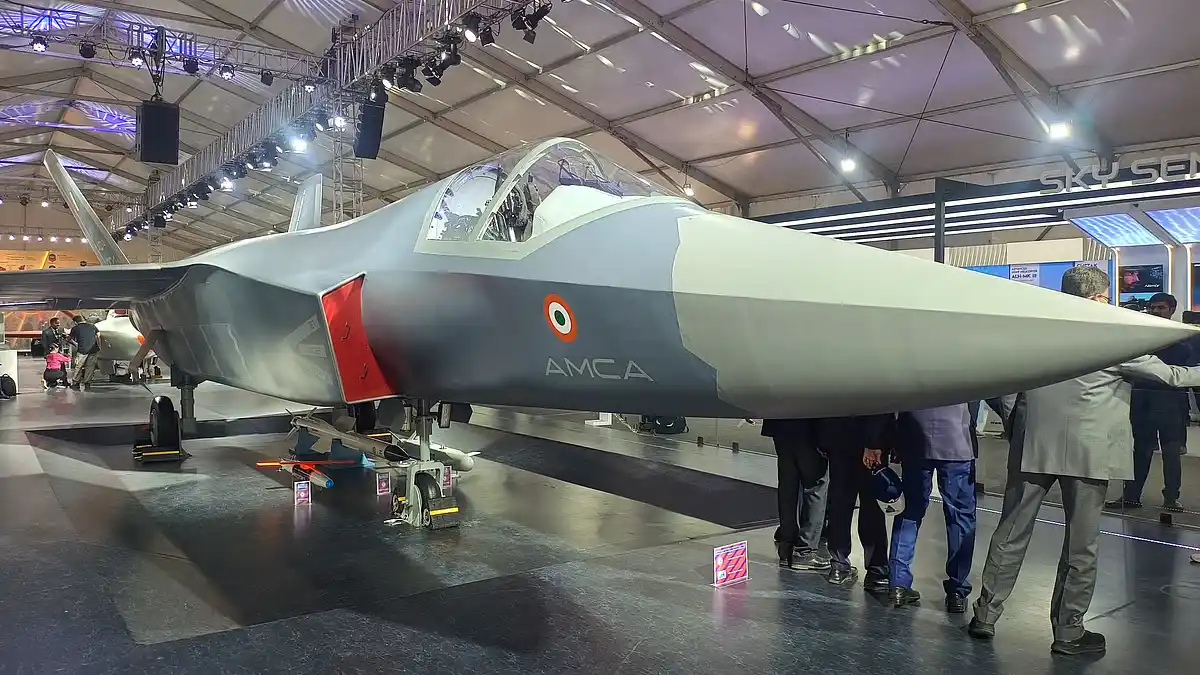
The AMCA is India’s planned indigenous fifth-generation stealth fighter. The Indian Air Force currently operates no radar-evading stealth aircraft. Officials have described induction of the AMCA as a national priority, citing the scale of stealth-fighter fleets fielded by China. A limited purchase of Russian Su-57 aircraft remains under consideration as an interim measure. HAL may still have an opportunity to participate at the series-production stage.
The decision reflects a broader policy of distributing high-value combat-aircraft work across public and private industry rather than nominating a single public-sector manufacturer. The three remaining bidders will now compete on technical and commercial proposals for what officials describe as one of the most consequential defence-industrial programmes currently under way.