
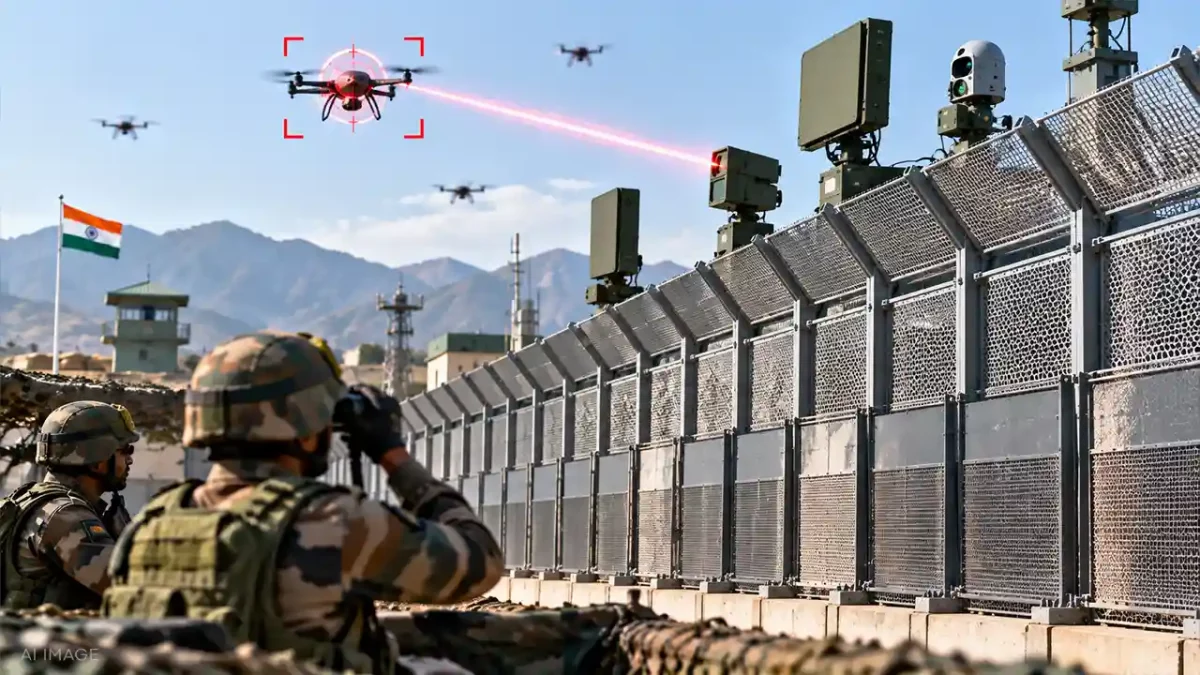
Chandigarh, 27 September 2026 — The Indian Army is preparing to construct multi-tier overhead steel mesh screens to protect high-value buildings in forward areas from kamikaze drones, small unmanned aerial vehicles and swarm attacks. The measure follows a Request for Information issued on 25 September and is intended as a passive physical layer that complements guns, lasers and jammers already in use.





The screens, measuring approximately 37 metres in length and 20 metres in width, will consist of three spaced layers of differing steel mesh. The design is intended to achieve staged interception, dissipate kinetic energy and progressively arrest incoming aerial objects before they reach the structure below. An outer layer will incorporate camouflage and concealment features, including non-reflective coatings and multi-spectral paint, so that the framework blends with surrounding terrain and reduces visual and thermal signatures.
An Army officer described the systems as “overhead steel meshes supported by a concrete or metal framework erected over certain high-value structures in forward areas such as command centres or ammunition storage to counter kamikaze drones and other small UAVs.” The officer added that the screens would provide additional protection against swarm drones and would operate alongside existing electronic and kinetic counter-drone systems. Initial deployment is planned at several locations in the Western Sector.
The requirement reflects a sharp rise in drone activity along the western frontier. Ministry of Defence figures for 2025–26 record 863 drone intrusions along the India–Pakistan border, of which 854 occurred in Punjab and Rajasthan. Of the 237 drones brought down, five carried war-like stores, 72 carried narcotics and 161 carried no payload.
Officials have linked the pattern to reconnaissance and the smuggling of arms, ammunition and narcotics. Small, low-flying platforms remain harder to detect and intercept than larger unmanned systems.
The Army already employs steel meshes and synthetic nets to give overhead protection to bunkers, observation posts, artillery pieces and vehicles, including tanks. Similar passive cages have been fitted to towed guns and self-propelled howitzers. The new building-scale screens represent an extension of that approach from mobile platforms to static, high-value infrastructure.
Lessons drawn from the Russia–Ukraine conflict, where metal cages first became widespread on armoured vehicles, and from the extensive drone exchanges of Operation Sindoor in May 2025 have accelerated the shift toward layered, low-cost physical barriers.
The initiative forms part of a broader effort to harden installations against non-contact threats. Existing air-defence weapons have been modified to engage small drones, indigenous counter-unmanned aerial systems continue to be fielded, and private industry is supplying both detection and hard-kill solutions.
The multi-layer steel screens are intended as a final, inexpensive physical barrier once other layers have been bypassed or saturated. Further technical specifications and the precise number of sites will be determined after industry responses to the Request for Information are evaluated.