

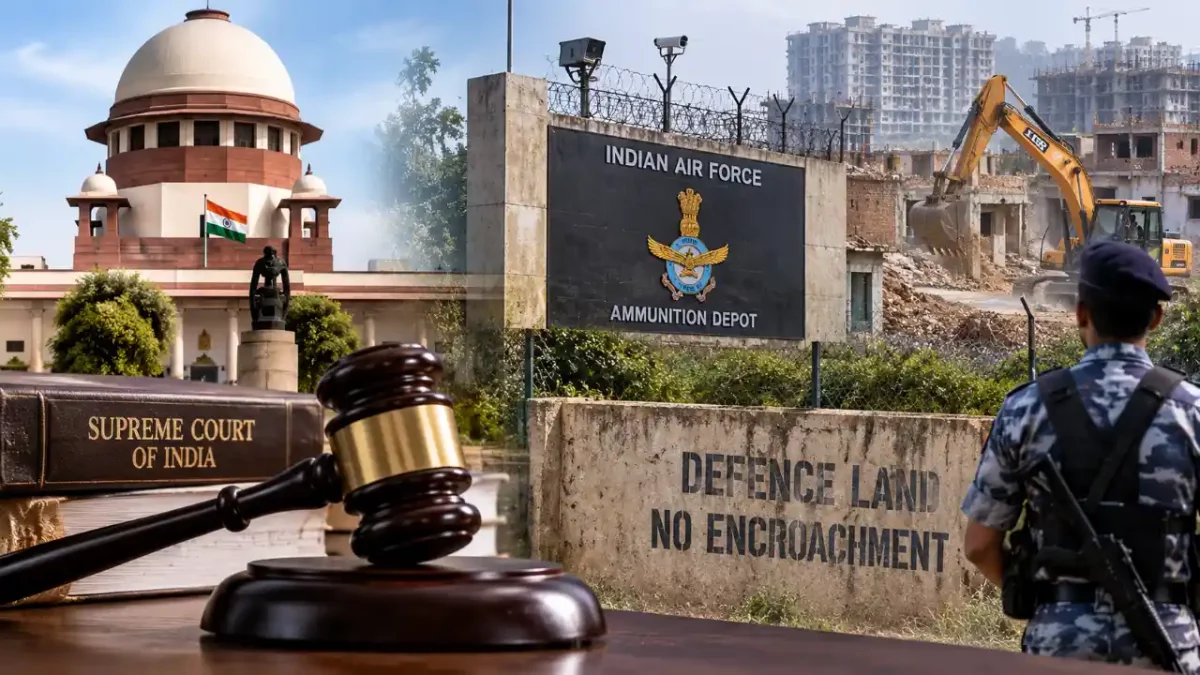
The Supreme Court has raised serious concerns over large-scale unauthorised construction around the Indian Air Force’s ammunition depot in Gurugram, questioning how thousands of structures and several illegal colonies were allowed to develop within the restricted security zone surrounding the sensitive defence installation.





The issue concerns the 900-metre belt around the IAF ammunition depot in old Gurugram, an area that has historically been subject to restrictions on construction and urbanisation because of its proximity to the strategic military facility. Reports from the area show that residential buildings, shops and other establishments have expanded extensively within this belt over the years.
During proceedings this week, the Supreme Court questioned the conduct of local authorities and raised concerns about possible collusion between officials and people involved in unauthorised development. The court’s observations came against the backdrop of the restricted zone becoming densely populated despite longstanding legal proceedings concerning construction around the depot.
According to reports, around 15 unauthorised colonies have developed within the restricted belt. In several locations, multi-storey houses and commercial establishments stand extremely close to the depot’s boundary wall, leaving only a small distance between civilian structures and the defence installation.
The scale of construction has increased significantly in recent years. An internal Municipal Corporation of Gurugram report cited earlier this year found that more than 5,000 illegal structures had come up within the 900-metre buffer zone during the previous five years alone. These reportedly include paying-guest accommodations, commercial establishments, offices, cloud kitchens and other unauthorised facilities.
The dispute surrounding construction near the ammunition depot is not new. The facility dates back to 1947, when the surrounding area was largely undeveloped. Gurugram’s rapid urban expansion subsequently brought residential development increasingly close to the installation. Courts and government authorities have dealt with the issue for years, including disputes over the extent of the restricted area and the treatment of existing structures.
In a 2010 judgment dealing with land around the depot, the Punjab and Haryana High Court described the ammunition depot as a strategic defence installation and stressed that defence and national-security considerations could not be compromised. The court also criticised statutory and executive authorities for allowing illegal construction to proliferate within the restricted area.
The Supreme Court has also dealt with litigation concerning the area for years. In a December 2024 judgment, it separated certain appeals concerning new construction within the 900-metre limit and demolition of allegedly illegal buildings so that those matters could be considered independently.
The latest observations have once again brought attention to the scale of unauthorised urbanisation surrounding one of Gurugram’s most sensitive defence facilities and to the role of civic and state authorities in enforcing restrictions intended to maintain a safety and security buffer around the ammunition depot.