

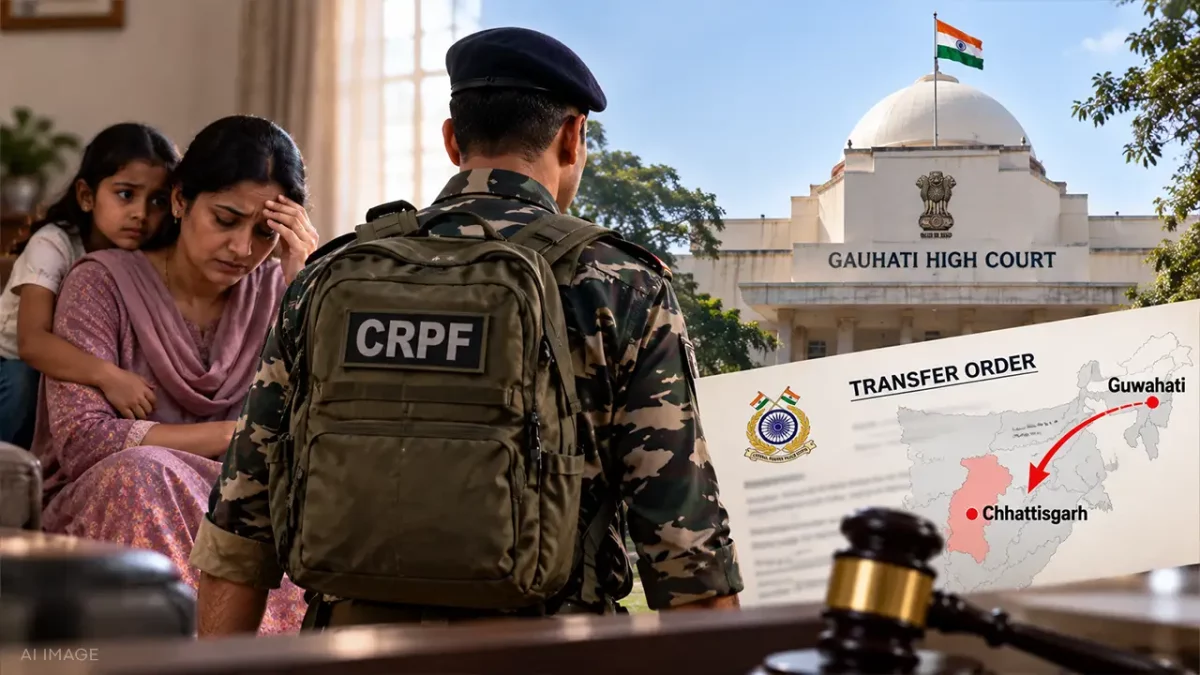
The Gauhati High Court has declined to interfere with the transfer of a Central Reserve Police Force (CRPF) Assistant Sub-Inspector from Guwahati to Chhattisgarh, holding that his wife’s anxiety disorder and related family difficulties are not sufficient grounds to stay the posting.





Justice Sanjay Kumar Medhi, in an order dated October 1, observed that a transfer is an incidence of service and that a writ court may interfere only where there is a violation of statutory rules or mala fide that is manifestly apparent. The Court granted the officer 15 days to join the new posting and directed that he be given a reasonable opportunity to arrange treatment for his wife.
Transfer and the challenge
The petitioner, an Assistant Sub-Inspector (General Duty), was posted at Amerigog in Guwahati. By an order dated December 24, 2025, the CRPF transferred him to its 231 Battalion in Chhattisgarh.
He challenged the order through advocates D. Gogoi and T. Wapangla. The principal ground was that he is the sole caregiver of his wife, who suffers from an anxiety disorder, and that the family faces other difficulties. He had also cited his daughter’s preparation for the NEET examination. The Court noted that the examination had since concluded.
Counsel submitted that additional time had earlier been allowed on account of these difficulties, and that the transfer had remained in abeyance in view of the elections in Assam. An interim order was passed on May 18.
Central Government Counsel R. Devi opposed the petition. It was submitted that the scope for challenging a transfer is limited, that no mala fide or breach of statutory rules had been alleged, and that the case had already been considered, with time already granted.
What the Court held
Justice Medhi recorded that interference with a transfer order is “absolutely limited” and that, absent a violation of statutory rules or manifest mala fide, the Court would be loath to intervene. The order noted that although the transfer was issued on December 24, 2025, the petitioner had in the meantime had sufficient time.
The Court held that the grounds placed before it may not be sufficient to justify interference. It declined to quash or stay the transfer.
On the medical aspect, the order stated that the petitioner be afforded a reasonable opportunity for treatment of his wife for the ailment projected in the writ petition at the new place of posting. He was given 15 days to move.
The ruling is consistent with the settled position that personal hardship, including the illness of a family member, does not by itself create a right to resist a transfer in a uniformed force, unless the order is shown to be contrary to rules or tainted by mala fide.
A similar approach was taken by the Gauhati High Court in June, when Justice Shamima Jahan declined to stay the transfer of a CRPF constable to Odisha despite his wife’s post-childbirth complications, noting the availability of medical facilities at the new station.