

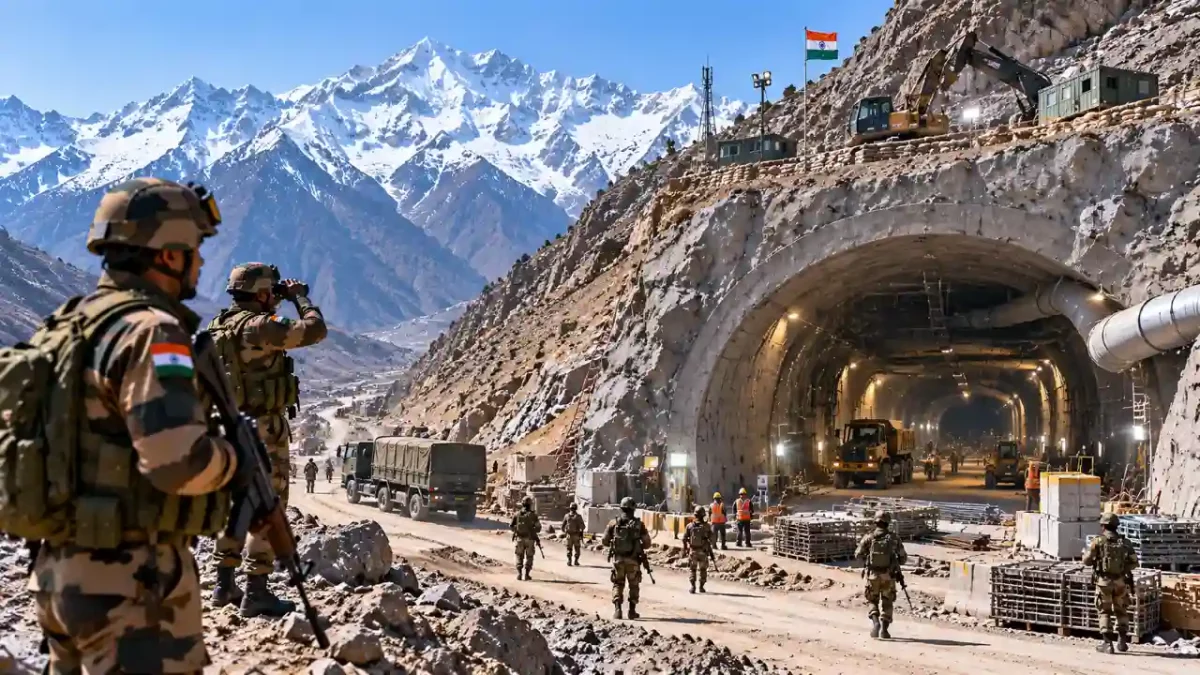
New Delhi, October 13, 2026 — The Indian Army has initiated a comprehensive force-preservation strategy centred on underground protective infrastructure to safeguard personnel, ammunition, and critical assets in areas close to the borders with China and Pakistan. The move responds to the heightened vulnerability of surface installations to precision-guided munitions, missiles, and mortar attacks, drawing lessons from contemporary conflicts in West Asia and Operation Sindoor.





In the Northern Command alone, which covers the northern theatre facing both adversaries, the Army has rolled out 19 distinct projects to create underground assets across the frontage of the entire operational area. These are customised solutions tailored to specific terrain conditions, geological factors, and operational requirements. They are intended to support the storage of assets and ammunition as well as training and practice needs, functioning as a hardened underground network capable of preserving operational readiness even under sustained enemy attack.
The Northern Command invited tenders for the 19 projects in August 2026, with vendors required to submit responses by November 7. Lieutenant General Pratik Sharma, General Officer Commanding-in-Chief of Northern Command, referred to the planned infrastructure within his jurisdiction during his address at the Society of Indian Defence Manufacturers (SIDM) Annual Session on October 9.
He emphasised that the procurement approach would prioritise transparency, a level playing field, and opportunities for all eligible participants, including Micro, Small and Medium Enterprises (MSMEs). Reports indicate a ₹1,080-crore allocation for force-preservation measures on the western front covering these 19 projects, which include protected underground facilities and modular structures developed in consultation with industry. Lt Gen Sharma has indicated an intent to place supply orders by December 2026.
Engineering concepts under development include prefabricated structures, subterranean facilities, and ultra-deep cavern architectures designed to withstand heavy aerial bombardment, artillery barrages, and deep-penetration or bunker-buster ordnance. Planners have also taken note of the robustness demonstrated by Iran’s extensive underground military infrastructure, often described as “missile cities” and tunnel networks, during prolonged air campaigns.
Parallel efforts are underway in the eastern sector to fortify the strategically sensitive Siliguri Corridor, popularly known as the “Chicken’s Neck.” Beneath-the-earth infrastructure is being planned that could host command, control, and logistics centres, enhancing the corridor’s resilience against potential disruption.
Separately, the Border Roads Organisation is already constructing underground bunkers at selected forward locations to protect combat drones and other high-value assets, though operational details remain restricted for security reasons.
The emphasis on underground protective infrastructure marks a broader shift toward survivability and operational continuity in modern warfare. By reducing exposure of personnel and critical assets to precision threats, the Army aims to sustain combat capability and logistics across diverse high-altitude and contested environments along the Line of Actual Control and the western borders.