
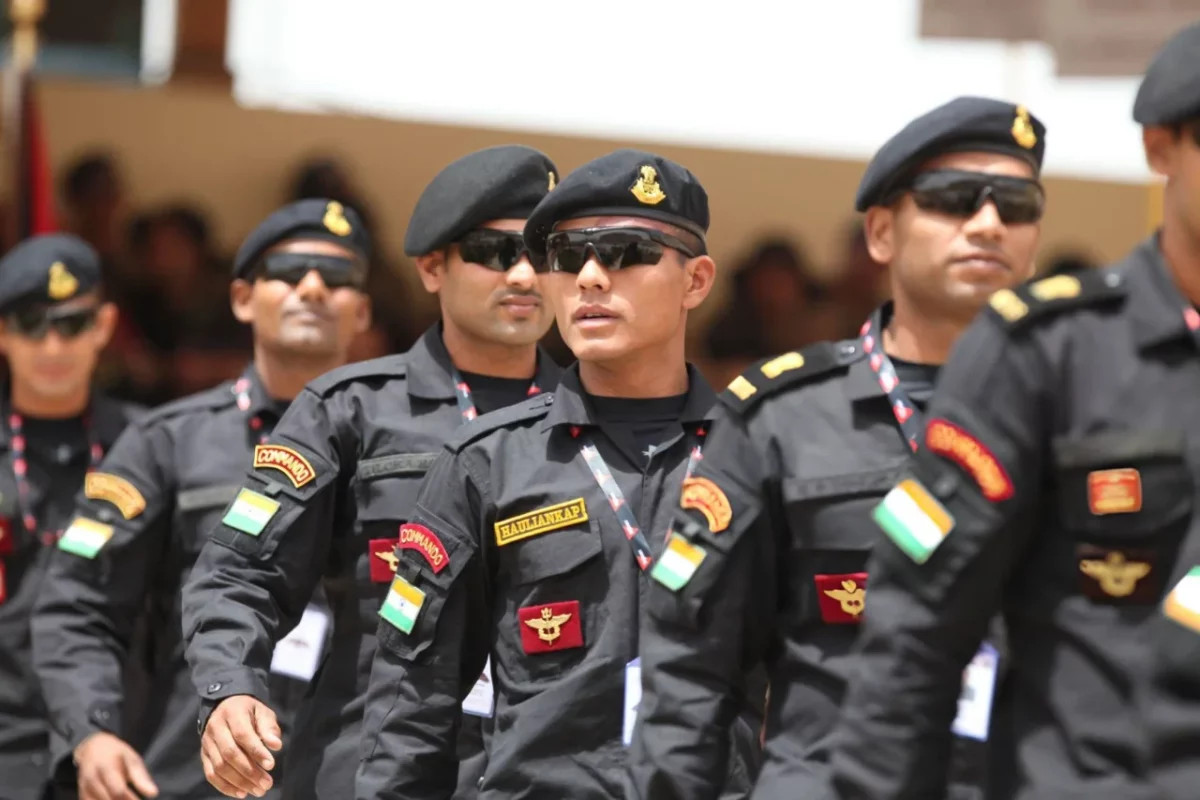
New Delhi, 16 October 2026: The National Security Guard (NSG), India’s elite federal counter-terrorism force popularly known as the Black Cats, observed its 42nd Raising Day today. Leaders across the political spectrum extended greetings to the force’s personnel, veterans, and families, acknowledging four decades of precision, discipline, and silent service in confronting the gravest threats to internal security.





Union Home Minister Amit Shah conveyed Raising Day greetings to the “warriors of the National Security Guard.” He stated that the NSG Black Cats have “blown up every terror threat to India with the fury of the storms and guarded the nation with steely courage, flawless professionalism and valiant sacrifices,” while saluting the martyrs of the force. The Indian Army, through the Additional Directorate General of Public Information, extended warm wishes on behalf of Chief of the Army Staff General Dhiraj Seth and all ranks to NSG personnel, veterans, and families, invoking the force’s motto Sarvatra Sarvottam Suraksha.
Several Chief Ministers and Union Ministers also paid tribute. Maharashtra Chief Minister Devendra Fadnavis honoured the Black Cats and the quiet sacrifice of their families. Rajasthan Chief Minister Bhajan Lal Sharma, Uttarakhand Chief Minister Pushkar Singh Dhami, Haryana Chief Minister Nayab Singh Saini, and others praised the force’s indomitable courage and unwavering dedication. Union Ministers including Nitin Gadkari, Dharmendra Pradhan, and G. Kishan Reddy similarly saluted the commandos’ professionalism and commitment.
Origins and Mandate
The NSG was raised following a Union Cabinet decision in 1984 to create a nodal national counter-terror force under the Ministry of Home Affairs, comprising highly motivated, specially equipped, and rigorously trained personnel. A nucleus was sanctioned in June 1984, and the force was formally constituted under the National Security Guard Act, 1986, which received Presidential assent on 22 September 1986. The decision came in the aftermath of Operation Blue Star and the assassination of Prime Minister Indira Gandhi, which exposed the need for a dedicated federal contingency capability beyond the capacity of state police and other central forces.
Modelled on the United Kingdom’s SAS and Germany’s GSG-9, the NSG is a task-oriented force organised into two complementary elements: the Special Action Group (SAG), comprising personnel drawn from the Indian Army, and the Special Ranger Groups (SRG), drawn from Central Armed Police Forces and State Police. Its basic philosophy is swift and speedy strike followed by immediate withdrawal from the theatre of action.
The force operates only in exceptional circumstances and is not intended to substitute for routine policing functions. Its vision is that of a “World Class Zero Error Force,” guided by the motto सर्वत्र सर्वोत्तम सुरक्षा (Sarvatra Sarvottam Suraksha — Best Security Everywhere).
Operational Legacy
Since its inception, the NSG has conducted high-risk counter-terrorism, hostage-rescue, and anti-hijacking operations. Notable missions include Operation Black Thunder I and II (clearing militants from the Golden Temple complex in 1986 and 1988), Operation Ashwamedh (the successful storming of a hijacked Indian Airlines aircraft at Amritsar in 1993 with no civilian casualties), Operation Vajra Shakti (response to the 2002 Akshardham Temple attack), and Operation Black Tornado during the 26/11 Mumbai terror attacks of 2008.
In the latter, NSG commandos conducted prolonged multi-site operations at the Taj Mahal Palace, Oberoi Trident, and Nariman House. The force has also been deployed in other contingencies, including the Pathankot airbase attack response.
Personnel serve on deputation and undergo intensive selection and training emphasising speed, surprise, stealth, precision, and accuracy. The force maintains regional hubs to enable rapid deployment and continues outreach programmes, including student visits and blood-donation camps in the run-up to this year’s Raising Day.
On its 42nd anniversary, the NSG stands as the Ministry of Home Affairs’ nodal national counter-terror force—an instrument of last resort whose readiness underpins India’s internal security architecture. The tributes of 16 October 2026 reaffirm the nation’s recognition of the Black Cats’ discipline, operational excellence, and the sacrifices that sustain the force’s zero-error ethos.