

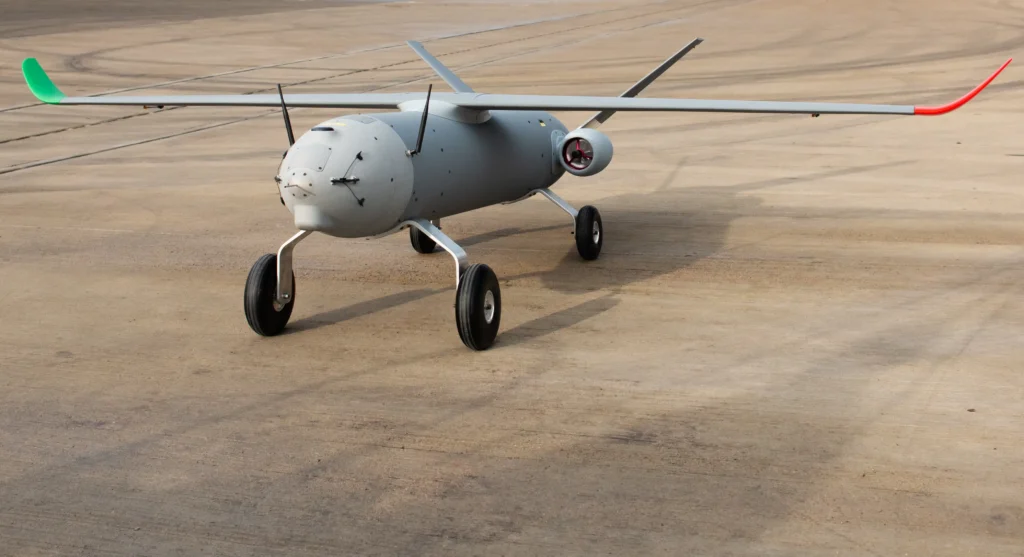
The Indian Air Force (IAF) has initiated the procurement process for 500 low-cost, made-in-India expendable surveillance drones designed to detect enemy air defence radars, as it seeks to strengthen its intelligence, surveillance and reconnaissance (ISR) capabilities close to hostile air defence networks.





The IAF has issued a Request for Information (RFI) to Indian companies, with responses due by January 12. The proposed drones are intended to be launched from canisters or catapults without requiring runways, allowing them to operate in contested environments and locate radar emitters in enemy airspace.
The RFI marks the initial stage of the procurement process. Following the assessment of responses, the IAF will finalise its requirements and seek Acceptance of Necessity (AoN), the formal approval required before a tender can be issued. The estimated cost of the 500-drone programme has not been disclosed.
The proposed systems are described in the document as low-cost, small-form-factor platforms with the capability to intercept radar emitters and identify their direction. They will also be equipped with electro-optical and infrared cameras to provide day-and-night imagery and must be capable of operating in Global Navigation Satellite System (GNSS)-denied environments, where satellite navigation signals may be jammed.
According to the requirements outlined in the RFI, the drones must be capable of flying at altitudes of up to 25,000 feet, remaining airborne for six hours and covering distances exceeding 200 km. A two-person crew should be able to launch multiple drones within 10 minutes.
Despite being categorised as expendable systems, the drones will be required to have a safe recovery mechanism to enable reuse in subsequent missions. The IAF has also asked vendors to provide a roadmap for collaborative swarm operations and human-on-the-loop autonomy, under which the drones can conduct missions autonomously while remaining under human supervision.
In a departure from conventional procurement and storage arrangements, the IAF is proposing that the original equipment manufacturers (OEMs) handle the storage and maintenance of the drones. The systems would be kept under 24/7 CCTV surveillance and delivered to IAF bases whenever required.
Operational lessons and the need for affordable mass
The requirement comes amid growing emphasis on identifying and neutralising enemy air defence systems before launching air campaigns. Recent conflicts, including Operation Sindoor and the ongoing wars in Ukraine and West Asia, have highlighted the operational importance of locating radar emitters and deploying large numbers of relatively inexpensive unmanned systems.
During Operation Sindoor, the IAF reportedly deployed dummy aircraft designed to resemble fighter jets. When Pakistani air defence units activated their radars to engage the simulated targets, their positions were exposed and subsequently targeted by Israeli-made Harop loitering munitions.
The proposed drones are expected to provide an additional forward layer to the IAF’s surveillance network. Unlike airborne early warning and control (AEW&C) aircraft, which monitor hostile aircraft and missiles from within friendly airspace, or ISTAR platforms that track ground targets from stand-off distances, these smaller systems are intended to operate closer to enemy air defence installations.
IAF seeks to strengthen its wider surveillance network
The proposed acquisition also comes against the backdrop of gaps in India’s airborne surveillance capabilities. The IAF currently relies significantly on Israeli-made Heron and Searcher unmanned aerial vehicles, alongside a limited fleet of six AEW&C aircraft.
The surveillance shortfall has also led to the deployment of the Indian Navy’s P-8I long-range maritime patrol aircraft for monitoring activities along the Himalayan frontier during military confrontations with China. The aircraft are primarily intended for maritime surveillance and anti-submarine warfare operations.
Several programmes are underway to expand India’s airborne surveillance network. The IAF is pursuing six upgraded Netra Mk-1A and six larger Netra Mk-II AEW&C aircraft, although these programmes are expected to take years to translate into operational capability.
India has also ordered 31 MQ-9B Predator drones from the United States under a deal worth approximately ₹32,000 crore signed in October 2024. The first eight aircraft allocated to the IAF are expected to begin arriving only in 2029.
Separately, the Defence Acquisition Council (DAC) has cleared projects for solar-powered pseudo-satellites, including airship-based and fixed-wing platforms, designed to remain in the stratosphere for extended periods. However, neither programme is close to induction.
The IAF’s Intelligence, Surveillance, Target Acquisition and Reconnaissance (ISTAR) aircraft programme has also faced prolonged delays. An earlier proposed $1-billion deal with US-based Raytheon for two aircraft collapsed in 2017 after disagreements between the IAF and the Defence Research and Development Organisation (DRDO) over technical evaluation responsibilities.
Following Operation Sindoor, the DAC granted initial Acceptance of Necessity for a ₹10,000-crore programme to acquire three ISTAR aircraft equipped with DRDO-developed sensors. The contract is yet to be signed.
Another major initiative, the tri-service programme for 87 medium-altitude long-endurance (MALE) drones worth around ₹30,000 crore, remains under evaluation after attracting approximately 10 bids in June.
The proposed 500-drone acquisition is expected to offer the IAF a relatively affordable option for conducting surveillance missions closer to enemy air defence systems. By relying on smaller platforms that can be deployed in larger numbers, the force aims to strengthen its ability to identify radar threats without exposing its high-value surveillance aircraft to the same level of risk.