

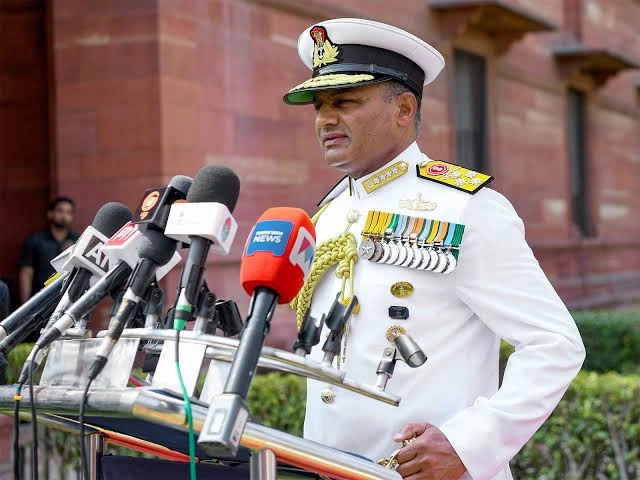
Indian Navy Chief Admiral Krishna Swaminathan has said that all 49 warships currently on order for the Navy are being constructed indigenously at Indian shipyards, highlighting the country’s growing capabilities in domestic warship design and construction and its push towards Aatmanirbharta in defence manufacturing.





Speaking at the National Security Summit 3.0 in New Delhi on Monday, Admiral Swaminathan said the Indian Navy had moved away from dependence on foreign countries for shipbuilding many years ago and had transformed from a “buyers’ navy” into a “builders’ navy”. He noted that India had commissioned its 100th indigenously designed and constructed ship a few months earlier and now operates more than 100 indigenous vessels.
Responding to a question on when India would become self-reliant in building its own aircraft carriers and warships, the Navy Chief emphasised that all the ships currently being procured for the Indian Navy were being built in the country. He said the Navy had around 49 ships on order, with every one of them under construction at Indian shipyards.
Tracing the development of India’s indigenous warship-building capabilities, Admiral Swaminathan recalled that the country built its first indigenous warship, a relatively modest vessel, in 1960. The establishment of the Central Design Office in 1964 marked another important step in developing domestic expertise in naval ship design.
He also highlighted the commissioning of India’s first indigenously designed and constructed aircraft carrier, INS Vikrant, in 2022. Describing the achievement as a major milestone, he said India was among a small group of nations capable of designing and building an aircraft carrier as well as a nuclear-propelled ballistic missile submarine within the country.
Admiral Swaminathan noted that INS Vikrant represented the Indian Navy’s progress in developing complex naval platforms through indigenous design and construction. The aircraft carrier’s commissioning demonstrated the capabilities developed by India’s domestic shipbuilding ecosystem over several decades.
However, the Navy Chief clarified that progress in indigenous shipbuilding did not mean India had achieved complete self-reliance across every naval system. He acknowledged that the Navy continued to depend on foreign supplies for certain critical components and technologies, including marine propulsion systems, some weapons, sensors and other capabilities that were not yet available domestically.
He expressed confidence that these gaps would reduce rapidly as India’s defence industrial ecosystem expands. The Navy, he said, has set a target of becoming a completely Aatmanirbhar force by 2047, requiring the development of domestic capabilities across the full range of systems and technologies needed for naval operations.
To achieve this objective, the Navy is working towards establishing an integrated ecosystem in partnership with the Ministry of Defence, public sector enterprises and private industry. The effort is aimed at enabling Indian industries to design and manufacture the systems required by the Navy, reducing dependence on external suppliers and strengthening the country’s indigenous defence manufacturing base.
The Navy Chief’s remarks underline the distinction between indigenous construction of warships and complete self-reliance in the systems fitted aboard them. While shipbuilding has made significant progress, achieving the 2047 target will also require domestic capabilities in propulsion, weapons, sensors and other advanced technologies.
With all 49 ships currently on order being built in India, the Navy’s ongoing procurement programme reflects its emphasis on domestic shipyards and indigenous construction. The longer-term objective is to extend this progress across the entire naval supply chain and establish a self-reliant industrial ecosystem capable of meeting the Indian Navy’s future requirements.