

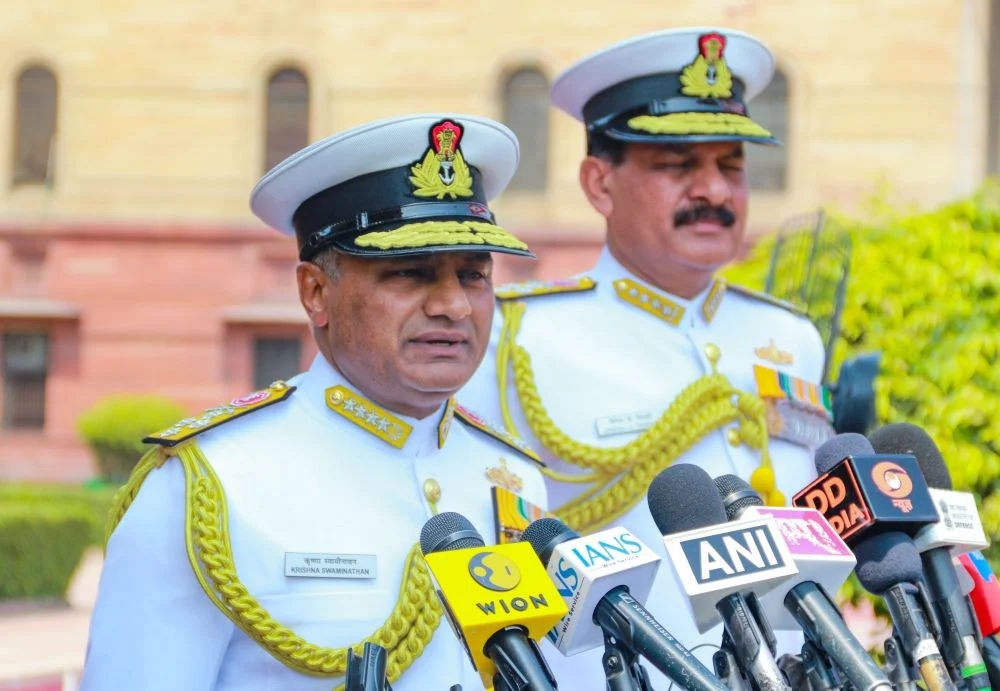
New Delhi: The Indian Navy is accelerating its expansion towards a 200-plus ship force by 2035, driven by the need to counter China’s rapidly growing naval presence in the Indian Ocean Region and Pakistan’s induction of advanced Chinese-built submarines. The plan forms a central pillar of India’s maritime strategy and the broader push for self-reliance under Atmanirbhar Bharat.





Chief of the Naval Staff Admiral has repeatedly underlined the target, stating that the Navy is on course to become a 200-plus ship maritime force by 2035, with the longer-term vision of a fully Atmanirbhar force by 2047.
Current Strength and Build-up
The Indian Navy currently operates around 140–150 vessels, of which approximately 135 are frontline combatants including destroyers, frigates, corvettes, and submarines. Roughly 50 warships and submarines are under construction across Indian shipyards. A larger pipeline of approved projects—covering about 65 surface vessels and several submarines—worth over ₹2.35 lakh crore is already in place.
Induction rates have increased significantly. The Navy is adding a new indigenous warship or submarine every 40 days on average. In 2025, it commissioned around 12 warships and one submarine. For 2026, plans include the induction of 15 to 19 additional vessels.
Recent milestones underline the momentum. In July 2026, the Navy commissioned two major platforms within a short span:
- INS Mahendragiri, the sixth Nilgiri-class (Project 17A) stealth frigate, built by Mazagon Dock Shipbuilders Limited with over 75% indigenous content. Designed by the Navy’s Warship Design Bureau, it was commissioned at Visakhapatnam.
- INS Malvan, the second Mahe-class Anti-Submarine Warfare Shallow Water Craft (ASW-SWC), built by Cochin Shipyard Limited with more than 80% indigenous content. The 78-metre, 1,100-tonne vessel was commissioned at Karwar and is optimised for coastal anti-submarine operations, mine-laying, and low-intensity maritime tasks.
The seventh and final Project 17A frigate, INS Vindhyagiri, is expected shortly, while a follow-on batch under Project 17B is already in the pipeline.
Strategic Imperatives: China and Pakistan
The expansion is being driven by clear regional challenges. China’s People’s Liberation Army Navy (PLAN) is the world’s largest by hull count, with more than 370 ships and submarines. Beijing has steadily expanded its footprint in the Indian Ocean through port access agreements, research and survey vessels, and submarine deployments.
Pakistan has simultaneously strengthened its underwater capabilities. In April 2026, it commissioned the first of eight Chinese-built Hangor-class attack submarines (PNS/M Hangor). Four of these boats are being built in China and four at Karachi Shipyard under a technology-transfer arrangement, significantly enhancing Pakistan’s ability to operate in the Arabian Sea and northern Indian Ocean.
Indian Navy planners view a larger, more modern fleet as essential to maintain sea control, protect critical sea lines of communication, and deter multi-front maritime threats.
Shift to Full Indigenous Construction
A defining feature of the current push is complete self-reliance in shipbuilding. INS Tamal, delivered by Russia in July 2025, was the last foreign-origin major warship the Navy intends to induct. Every subsequent hull counted towards the 200-ship target is expected to be built in Indian yards.
The Navy aims to take Atmanirbharta to the component level, reducing dependence on imported specialised steel, sensors, and high-end systems. Projects such as the Project 75(I) conventional submarines with air-independent propulsion, additional ASW shallow-water craft, next-generation frigates, and destroyers form the core of this effort.
Broader Capability Goals
Beyond numbers, the focus is on qualitative improvement—stealth features, advanced anti-submarine warfare sensors and weapons, long-range land-attack missiles, and better network-centric operations. The Navy is also expanding its aviation arm and undersea capabilities to create a balanced three-dimensional force capable of sustained blue-water operations.
Officials emphasise that the 200-ship target by 2035 is not merely about matching numbers with China, but about fielding a technologically advanced, combat-ready, and strategically autonomous force that can safeguard India’s interests across the Indian Ocean and beyond.
With a steady commissioning tempo, a robust domestic shipbuilding pipeline, and clear strategic direction, the Indian Navy is positioning itself for a significant capability leap over the next decade.